Olga's Gallery
Some time ago we added to our gallery a collection by Alexey Venetsianov, an original Russian artist of the first half of the 19th century. Venetsianov was a self-taught and self-made man; he began to study art and painting rather late. One can't call him a great master, who reached the peaks of profession. His paintings are intimate, serene, 'primitive' and very national. His models are not aristocratic beauties, but mostly peasants, common Russian types. Perhaps the most wonderful achievement of the artist was the creation of his own school, which differed greatly from the official Academy of Arts and was open to people of very low origin and means and of all ages.
Venetsianov’s School of Painting
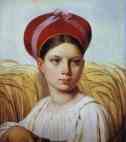 Venetsianov’s
ambition was to become a professor in the Academy of Arts, as he was a
naturally born teacher; but the academicians did not approve of him: he
was a stranger, he lacked, unlike them, academic training. At the end of
the 1810s, the artist began to attract young people, mostly commoners with
low means and even serfs (all of whom, in most cases, he was able to emancipate
from bondage) to teach them painting. In the mid-1820s, he had a group
of disciples. Tzar Nicholas I, who liked to stimulate ‘national trends’,
expressed his approval of the artist and appointed him a court painter.
This position gave Venetsianov financial support, necessary for running
his own school, where tuition was free. Teaching art in private studios
was not something unusual. But unlike his colleagues Venetsianov did not
limit his lessons to teaching professional techniques; his aim was to widely
educate gifted young people from the lower layers of society, and the propaganda
of art among the common people.
Venetsianov’s
ambition was to become a professor in the Academy of Arts, as he was a
naturally born teacher; but the academicians did not approve of him: he
was a stranger, he lacked, unlike them, academic training. At the end of
the 1810s, the artist began to attract young people, mostly commoners with
low means and even serfs (all of whom, in most cases, he was able to emancipate
from bondage) to teach them painting. In the mid-1820s, he had a group
of disciples. Tzar Nicholas I, who liked to stimulate ‘national trends’,
expressed his approval of the artist and appointed him a court painter.
This position gave Venetsianov financial support, necessary for running
his own school, where tuition was free. Teaching art in private studios
was not something unusual. But unlike his colleagues Venetsianov did not
limit his lessons to teaching professional techniques; his aim was to widely
educate gifted young people from the lower layers of society, and the propaganda
of art among the common people.
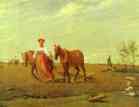 The
pedagogical system of Alexey Venetsianov was based on an attentive and
loving attitude to nature. His pupils lived and worked on his estate during
the summer, and in winter they studied at his St. Petersburg studio and
attended, on his recommendations, the drawing classes of the Academy of
Arts. Venetsianov rejected the academic method, which prescribed lasting
and sustained drawing from classical engravings, followed by the copying
of paintings. The master urged his pupils to work from nature from the
very beginning – to draw and paint geometrical bodies and occasional household
objects. Later on they started work on plaster models and eventually went
over to the representation of the human figure and uncomplicated genre
scenes. Venetsianov urged the need to carefully study “simple nature
because of its endless diversity”.
The
pedagogical system of Alexey Venetsianov was based on an attentive and
loving attitude to nature. His pupils lived and worked on his estate during
the summer, and in winter they studied at his St. Petersburg studio and
attended, on his recommendations, the drawing classes of the Academy of
Arts. Venetsianov rejected the academic method, which prescribed lasting
and sustained drawing from classical engravings, followed by the copying
of paintings. The master urged his pupils to work from nature from the
very beginning – to draw and paint geometrical bodies and occasional household
objects. Later on they started work on plaster models and eventually went
over to the representation of the human figure and uncomplicated genre
scenes. Venetsianov urged the need to carefully study “simple nature
because of its endless diversity”.
Venetsianov’s pupils painted still-lifes, interiors, and landscapes, scenes of everyday life and portraits. They tried to capture the surrounding world, which they found beautiful. They depicted the intimate world of everyday Russia, both of the gentry's country estates and of peasant huts. The simple canvasses of his pupils captivate the beholder by a compositional lucidity, at the same time they are full of meaning, brimming with the poetry of man's spontaneous naturalness and individuality. The works of Venetsianov pupils remind of Dutch genre painting of the early 17th century.
During the 25 years of the school's existence, Venetsianov had about 70 disciples; there were among them really gifted masters. Though the majority of the pupils were of average level, the school created the new 'national' trend in Russian art and influenced the next generation of the Russian artists. We represent here only several of Venetsianov's pupils of different level of talent, but nevertheless each one is interesting:
Kapiton Zelentsov (1790-1845), was one of the first of Venetsianov's students, he never became a professional artist, though reached some interesting results in painting. We found 4 of his works, mostly interiors of well-to-do homes of his time.
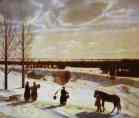 Nikifor
Krylov (1802-1831), also was among the first of Venetsianov's students.
He was a self-taught painter before he met Venetsianov, who insisted on
Krylov's education. Unfortunately, the painter died young during an epidemic
of cholera. His Winter landscape was highly appreciated by
critics.
Nikifor
Krylov (1802-1831), also was among the first of Venetsianov's students.
He was a self-taught painter before he met Venetsianov, who insisted on
Krylov's education. Unfortunately, the painter died young during an epidemic
of cholera. His Winter landscape was highly appreciated by
critics.
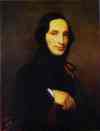 Alexey
Tyranov (1808 – 1859) is thought to be the best pupil of Venetsianov.
In the 1830s-40s, Tyranov was the most popular portraitist in St. Petersburg,
his popularity could be compared only to that of Karl
Brulloff. His story is also somewhat dramatically romantic. Being in
Italy, he fell in love with one of his models, whom he brought to Russia.
The young Italian appeared to be an adventuress, she robbed the painter
and left him. The stress was so strong, that Tyranov began to drink and
died an alcoholic several years later.
Alexey
Tyranov (1808 – 1859) is thought to be the best pupil of Venetsianov.
In the 1830s-40s, Tyranov was the most popular portraitist in St. Petersburg,
his popularity could be compared only to that of Karl
Brulloff. His story is also somewhat dramatically romantic. Being in
Italy, he fell in love with one of his models, whom he brought to Russia.
The young Italian appeared to be an adventuress, she robbed the painter
and left him. The stress was so strong, that Tyranov began to drink and
died an alcoholic several years later.
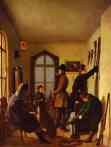 Evgraf
Krendovsky (1810-1870) became a professional painter. Unfortunately
most of his works disappeared during the Second World War.
Evgraf
Krendovsky (1810-1870) became a professional painter. Unfortunately
most of his works disappeared during the Second World War.
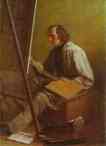 Fedor
Slavyansky (1817/9-1876), a peasant serf, who was given his freedom
by Venetsianov. Slavyansky was not a very talented painter; he was grateful
to his teacher for everything, but failed him in his works.
Fedor
Slavyansky (1817/9-1876), a peasant serf, who was given his freedom
by Venetsianov. Slavyansky was not a very talented painter; he was grateful
to his teacher for everything, but failed him in his works.
Sergey Zaryanko (1818-1870/71) is known in the history of Russian art as a good portraitist, though he is mainly known as a teacher of painting, professor of the Moscow School of Painting, Sculpture and Architecture.
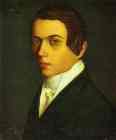 Grigoriy
Soroka (1823-1864) a peasant serf, was a particularly gifted artist
of great originality among Venetsianov’s pupils. Venetsianov was unable
to secure his emancipation despite stubborn efforts and petitions. Unable
to stand his slavery, Soroka committed suicide. We published the collection
of his works during the last fortnight.
Grigoriy
Soroka (1823-1864) a peasant serf, was a particularly gifted artist
of great originality among Venetsianov’s pupils. Venetsianov was unable
to secure his emancipation despite stubborn efforts and petitions. Unable
to stand his slavery, Soroka committed suicide. We published the collection
of his works during the last fortnight.
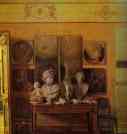
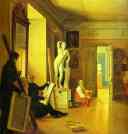
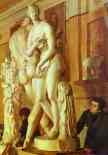
Below is a picture painted by one of Venetsianov's pupils Alexander
Alexeyev, which depicts the studio of the master in St. Petersburg.
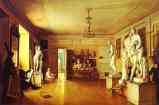 |
Alexander Alexeyev. The Workshop of A. Venetsianov in St. Petersburg. 1827. Oil on canvas. The Russian Museum, St. Petersburg, Russia. |
 |
Alexander Alexeyev. The Workshop of A. Venetsianov in St. Petersburg. Detail. 1827. Oil on canvas. The Russian Museum, St. Petersburg, Russia. |
 |
Alexander Alexeyev. The Workshop of A. Venetsianov in St. Petersburg. Detail. 1827. Oil on canvas. The Russian Museum, St. Petersburg, Russia. |
 |
Alexander Alexeyev. The Workshop of A. Venetsianov in St. Petersburg. Detail. 1827. Oil on canvas. The Russian Museum, St. Petersburg, Russia. |
We would be glad to receive your opinions and comments on our newsletters.
Please write to freeart@freeart.com

