Olga's Gallery
Dear Friends of Art,
Happy Easter! Today our guest Dr. Victoria Vekselman invites us to Jerusalem,
to follow the Way of the Cross, and the last hours of Jesus Christ on the
earth.
Way of the Cross
khodak@urbis.net.il
Initially the “Way of the Cross” had nothing in common with the present route along Via Dolorosa (or Via Crucis). In the Byzantine period pilgrims would repeat the whole route of the last 24 hours of Jesus' life.
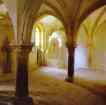
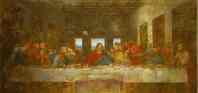 On
Holy Thursday before Good Friday they would start from Mt. Zion, from the
place of the Last Supper. The
present church, with the Room of the Cenacle, was built by the Crusaders
over King David's tomb, which was also identified (or misidentified) in
the early Byzantine period. But there is strong archeological evidence
that the living houses and the gate, the so-called Essen Gate, were there
at the Second Temple period. In the 15th century, Muslims took control
of Mount Zion and turned the church into a mosque. This place, sacred in
Christian tradition, is believed to be the site of the Last Supper, where
Christ established the rite of the Eucharist. In the same place, seven
weeks later, the Holy Ghost appeared to Mary and the Apostles at the Pentecost.
On
Holy Thursday before Good Friday they would start from Mt. Zion, from the
place of the Last Supper. The
present church, with the Room of the Cenacle, was built by the Crusaders
over King David's tomb, which was also identified (or misidentified) in
the early Byzantine period. But there is strong archeological evidence
that the living houses and the gate, the so-called Essen Gate, were there
at the Second Temple period. In the 15th century, Muslims took control
of Mount Zion and turned the church into a mosque. This place, sacred in
Christian tradition, is believed to be the site of the Last Supper, where
Christ established the rite of the Eucharist. In the same place, seven
weeks later, the Holy Ghost appeared to Mary and the Apostles at the Pentecost.
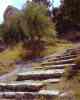
 Then
the pilgrims would descend the stone steps to the Kidron Valey. A very
ancient flight of stone steps leading to the Kidron Valley can be seen
in the garden of the Church of St. Peter. The steps were certainly in use
at the time when the events narrated in the Gospels were taking place.
Jesus probably descended them on the evening of Holy Thursday, when he
went to pray in Gethsemane.
Then
the pilgrims would descend the stone steps to the Kidron Valey. A very
ancient flight of stone steps leading to the Kidron Valley can be seen
in the garden of the Church of St. Peter. The steps were certainly in use
at the time when the events narrated in the Gospels were taking place.
Jesus probably descended them on the evening of Holy Thursday, when he
went to pray in Gethsemane.
Through the Kidron Valley the pilgrims would proceed to Mt. of Olives and the Garden of Gethsemane.
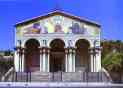
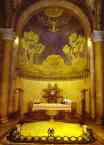 Several
beautiful churches commemorate the events that took place here –the Church
of Agony, known also as the Church of All Nations, where the Rock of Agony
is fenced off by a railing shaped like a crown of thorns.
Several
beautiful churches commemorate the events that took place here –the Church
of Agony, known also as the Church of All Nations, where the Rock of Agony
is fenced off by a railing shaped like a crown of thorns.
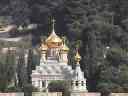 The
Russian Church of Mary Magdalene claims to have a rock upon which the belt
of the garment worn by the Virgin Mary fell
before she ascended to heaven, and the rock from which Mary
Magdalene saw St. Stephen being
stoned in the Kidron Valley. The interior of the church is decorated with
paintings by famous 19th century Russian artists, such as Alexander
Ivanov and Vasily Vereshchagin.
The
Russian Church of Mary Magdalene claims to have a rock upon which the belt
of the garment worn by the Virgin Mary fell
before she ascended to heaven, and the rock from which Mary
Magdalene saw St. Stephen being
stoned in the Kidron Valley. The interior of the church is decorated with
paintings by famous 19th century Russian artists, such as Alexander
Ivanov and Vasily Vereshchagin.
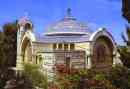
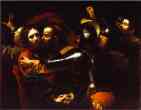 Then
the pilgrims would return to Mt. Zion, where on the slope of the hill the
palace of the High Priest Caiaphas stood, and where St. Peter, according
to Jesus’ prophecy denied Him thrice ‘… before the cock crow thou shalt
deny me thrice” (Luke 22:61). A beautiful neo-Byzantine church was built
over the ruins of Byzantine and Crusader churches and the ruins of the
Herodian residential quarter of the wealthy population.
Then
the pilgrims would return to Mt. Zion, where on the slope of the hill the
palace of the High Priest Caiaphas stood, and where St. Peter, according
to Jesus’ prophecy denied Him thrice ‘… before the cock crow thou shalt
deny me thrice” (Luke 22:61). A beautiful neo-Byzantine church was built
over the ruins of Byzantine and Crusader churches and the ruins of the
Herodian residential quarter of the wealthy population.
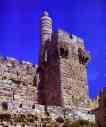
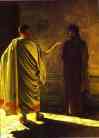 The
next stop is Pilate's palace. The Roman procurators generally dwelt in
the city of Ceasarea built specially for them by Herod the Great. During
their short stays in Jerusalem they used the Herod's palaces as their official
residence. There could be two, or even three options. The first one, and
the less probable, is the palace with the view of the Temple Mount in the
Upper City of Jerusalem. The second, royal palace was located where the
Tower of David (a Mameluke construction) now stands. The Russian author
Michael Bulgakov in his famous novel Master and Margaret adhered
to this version. The third location is the Antonia – a stronghold that
oversaw the whole Temple Mount from the North, and where the Roman garrison
was stationed, especially during the Temple festivities. The place was
canonized as Pilates' seat in the trial.
The
next stop is Pilate's palace. The Roman procurators generally dwelt in
the city of Ceasarea built specially for them by Herod the Great. During
their short stays in Jerusalem they used the Herod's palaces as their official
residence. There could be two, or even three options. The first one, and
the less probable, is the palace with the view of the Temple Mount in the
Upper City of Jerusalem. The second, royal palace was located where the
Tower of David (a Mameluke construction) now stands. The Russian author
Michael Bulgakov in his famous novel Master and Margaret adhered
to this version. The third location is the Antonia – a stronghold that
oversaw the whole Temple Mount from the North, and where the Roman garrison
was stationed, especially during the Temple festivities. The place was
canonized as Pilates' seat in the trial.
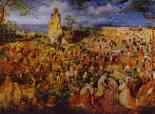 Finally
the sorrowful procession would go to Golgotha (Calvary), the site of the
Crucifixion.
Finally
the sorrowful procession would go to Golgotha (Calvary), the site of the
Crucifixion.
Thus, the fourteen Stations of the Cross are not in the picture yet. The “Way of the Cross” still follows the canonical Gospels. Another important aspect – the pilgrims could proceed safely through the entire route, up and down hills and valleys at night in perfect safety. Byzantine Emperor took special care to protect the pilgrims. The same was true of the Crusader period. It's worthwhile mentioning that one of the aims of the Crusade was to ensure safe and secure access of the pilgrims to the holy sites. With the Muslim occupation of the Holy Land (we should mark two dates – 637 C.E. when Caliph Omar conquered Jerusalem, and 1187 – recapture of Jerusalem by Saladin), this route became dangerous in the same way as nowadays, and even the most pious would not dare to repeat the entire itinerary.
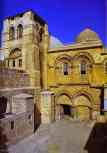 The
remains of the Christian community crowed around the Church of the Holy
Sepulcher, built on the site of Crucifixion, virtually closing it from
the view. Now the procession could go through the Sorrowful Way in a confined
variant, and within the city walls only. In the years of severe persecutions
the Christians even established the chapels commemorating the Passions
within the Sepulchre itself.
The
remains of the Christian community crowed around the Church of the Holy
Sepulcher, built on the site of Crucifixion, virtually closing it from
the view. Now the procession could go through the Sorrowful Way in a confined
variant, and within the city walls only. In the years of severe persecutions
the Christians even established the chapels commemorating the Passions
within the Sepulchre itself.
In 1342, the Pope gave the Franciscans the Custody of the Holy Land, a duty which the order has held to the present day. Franciscan churches in the land of Israel are decorated by the Jerusalem or the Holy Land Cross and the Franciscan Cross proper: two crossed hands with stigmas – the bare one is that of Jesus, and a covered – of St. Francis. The Franciscan brothers naturally became the first tour guides and developed several devotional tours for the European pilgrims. They rebuilt many churches and conducted tours even under great danger. They were the first to develop the present Via Dolorosa, taking into consideration both European tradition and security matters. Now the route is fixed within the city walls. Furthermore, the apocryphal Gospels, especially James’, enumerated the events in the last hours of Jesus’ life, and transferred them into fourteen Stations of the Cross. Why fourteen? The answer is simple – fourteen generations separate David, Messiah King, from Jesus, fourteen stations separate him from eternity. Europeans wanted to reenact the final journey of Jesus to the place of Crucifixion in the same way as they did it in their home towns. They wanted to see with their own eyes the sacred streets and stones, and this tradition influenced over the development of the route. The present Via Dolorosa, the route Jesus followed bearing the burden of the Cross from the Antonia Fortress to the Calvary, embraced several traditions and gradually the present route was fixed in 1880s as it exists today. It perfectly suits the needs and requirements of the pilgrim tour – it is short, not tiresome and secure – extremely important thing in our tumultuous days.
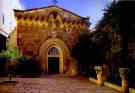
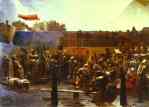 The
route starts at the place where the fortress Antonia used to be and where
Christ was judged before Pilate. “Then Pilate therefore took Jesus, and
scourged him. And the soldiers platted a crown of thorns, and put it on
his head, and they put on him a purple robe, and said, Hail, King of the
Jews! and they smote him with their hands” (John, 19: 1-3). The present
Church of the Flagellation was built on the site in the 1920s.
The
route starts at the place where the fortress Antonia used to be and where
Christ was judged before Pilate. “Then Pilate therefore took Jesus, and
scourged him. And the soldiers platted a crown of thorns, and put it on
his head, and they put on him a purple robe, and said, Hail, King of the
Jews! and they smote him with their hands” (John, 19: 1-3). The present
Church of the Flagellation was built on the site in the 1920s.
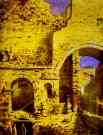
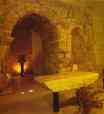 The
Second Station on the Way of the Cross is near the remains of an ancient
Roman triumphal arch, the place is known as the Arch of Ecce
Homo, in memory of the words (Behold the Man) pronounced by Pilate
when he showed Jesus to the crowd. On the old painting, you can see the
ruins of the arch. Today the left hand small arch is included in the Chapel
of the Ecce Homo in the Convent of the Sisters of Zion. The larger arch
spans part of the Via Dolorosa.
The
Second Station on the Way of the Cross is near the remains of an ancient
Roman triumphal arch, the place is known as the Arch of Ecce
Homo, in memory of the words (Behold the Man) pronounced by Pilate
when he showed Jesus to the crowd. On the old painting, you can see the
ruins of the arch. Today the left hand small arch is included in the Chapel
of the Ecce Homo in the Convent of the Sisters of Zion. The larger arch
spans part of the Via Dolorosa.
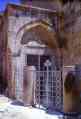
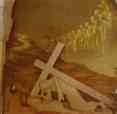 The
Third Station commemorates the site where Jesus fell for the first time
under the weight of the Cross. The place is marked by a small chapel, which
belongs to the Armenian Catholic Patriarchate. The chapel was built in
the 19th century; it was renovated and completed by Catholic soldiers of
the Free Polish Army during the World War II.
The
Third Station commemorates the site where Jesus fell for the first time
under the weight of the Cross. The place is marked by a small chapel, which
belongs to the Armenian Catholic Patriarchate. The chapel was built in
the 19th century; it was renovated and completed by Catholic soldiers of
the Free Polish Army during the World War II.
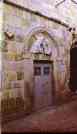
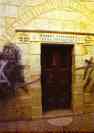 The
Forth Station is where Jesus met his mother. The place is marked by a small
Armenian oratory.
The
Forth Station is where Jesus met his mother. The place is marked by a small
Armenian oratory.
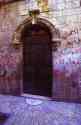
The Fifth Station marks the place where Simon the Cyrenian helped Jesus
to carry the Cross to Golgotha. The Franciscan chapel stands on the place.
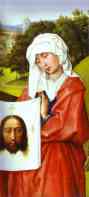 A
church belonging to the Greek Catholics preserves the memory of the meeting
between Jesus and Veronica, whose tomb is in the church. Veronica wipes
Christ's face with her veil, and his features remained of the cloth. (the
Sixth Station).
A
church belonging to the Greek Catholics preserves the memory of the meeting
between Jesus and Veronica, whose tomb is in the church. Veronica wipes
Christ's face with her veil, and his features remained of the cloth. (the
Sixth Station).
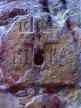
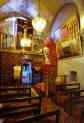 The
Franciscan chapel commemorates Jesus’ second fall, it's the Seventh Station
on Via Dolorosa. A small cross, carved into the wall of a Greek-Orthodox
monastery, marks the Eighth Station. It is here that Jesus said, “Daughters
of Jerusalem, weep not for me, but weep for yourselves and for your children…”
(Luke, 23:28). The third fall of Jesus (the Ninth Station) is commemorated
by a column of the Roman period at the entrance to the Coptic Monastery
of St. Anthony.
The
Franciscan chapel commemorates Jesus’ second fall, it's the Seventh Station
on Via Dolorosa. A small cross, carved into the wall of a Greek-Orthodox
monastery, marks the Eighth Station. It is here that Jesus said, “Daughters
of Jerusalem, weep not for me, but weep for yourselves and for your children…”
(Luke, 23:28). The third fall of Jesus (the Ninth Station) is commemorated
by a column of the Roman period at the entrance to the Coptic Monastery
of St. Anthony.
 The
last five stations are inside the Holy Sepulchre, the most sacred Christian
place in Jerusalem and the entire world. During Jesus’ time it was outside
the city gates. The place was called Golgotha from the Aramaic word for
skull; the name comes from the fact that the hill was skull-shaped, and
from the legend that Adam's skull was buried there. The first Church of
the Holy Sepulchre was begun in 326, completed in 335 and destroyed by
the Persians in 614. Fifteen years later it was restored. It was destroyed
again in 1009 by the Caliph Al-Hakim Bi-Amr Allah and restored by the Byzantine
emperor Constantine Monomachus in 1084. When Crusaders conquered Jerusalem
on 15 July 1099, they began modifying and embellishing the Church. The
new Church was constructed in 1149 and remained basically unchanged until
1808 when fire destroyed much of it. The Greek monks obtained permission
to rebuild it, but their work significantly changed the original plan.
The
last five stations are inside the Holy Sepulchre, the most sacred Christian
place in Jerusalem and the entire world. During Jesus’ time it was outside
the city gates. The place was called Golgotha from the Aramaic word for
skull; the name comes from the fact that the hill was skull-shaped, and
from the legend that Adam's skull was buried there. The first Church of
the Holy Sepulchre was begun in 326, completed in 335 and destroyed by
the Persians in 614. Fifteen years later it was restored. It was destroyed
again in 1009 by the Caliph Al-Hakim Bi-Amr Allah and restored by the Byzantine
emperor Constantine Monomachus in 1084. When Crusaders conquered Jerusalem
on 15 July 1099, they began modifying and embellishing the Church. The
new Church was constructed in 1149 and remained basically unchanged until
1808 when fire destroyed much of it. The Greek monks obtained permission
to rebuild it, but their work significantly changed the original plan.
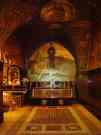
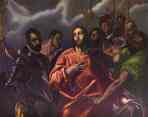
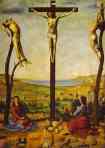
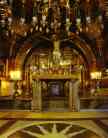 The
Chapel of the Crucifixion, which belongs to the Roman Catholic Church,
commemorates the Tenth Station (Jesus is stripped of his garments), and
the Eleventh Station (Jesus is nailed to the Cross). The Chapel of the
Calvary, which belongs to the Greek Orthodox Church, commemorates the Twelfth
Station (Jesus dies on the Cross).
The
Chapel of the Crucifixion, which belongs to the Roman Catholic Church,
commemorates the Tenth Station (Jesus is stripped of his garments), and
the Eleventh Station (Jesus is nailed to the Cross). The Chapel of the
Calvary, which belongs to the Greek Orthodox Church, commemorates the Twelfth
Station (Jesus dies on the Cross).
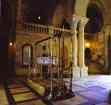
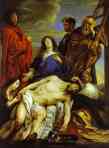 The
Thirteenth Station: the Stone of Unction (Jesus is taken down from the
cross). The stone sets on the site of the former Oratory of the Unction,
which was taken down during the many architectural changes made to the
building. According to tradition, Jesus’ body was placed here when it was
removed from the cross and anointed with myrrh and aloe.
The
Thirteenth Station: the Stone of Unction (Jesus is taken down from the
cross). The stone sets on the site of the former Oratory of the Unction,
which was taken down during the many architectural changes made to the
building. According to tradition, Jesus’ body was placed here when it was
removed from the cross and anointed with myrrh and aloe.
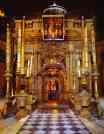 The
Shrine of the Holy Sepulchre (the Fourteenth and last Station of the Cross),
placed in the middle of the rotunda of Anastasis, is placed over an ancient
tomb, which is considered to be the Tomb of Christ. Here the body of Jesus
lay from Good Friday until Easter Sunday.
The
Shrine of the Holy Sepulchre (the Fourteenth and last Station of the Cross),
placed in the middle of the rotunda of Anastasis, is placed over an ancient
tomb, which is considered to be the Tomb of Christ. Here the body of Jesus
lay from Good Friday until Easter Sunday.
We must always bear in mind that the present Via Dolorosa cannot be the exact route that Jesus walked – the Herodian city lies ten or twenty meters deep under the Roman, Byzantine, Muslim, Crusader and Turkish constructions. I think that the modern tourists realize it, but 1500 year of tradition created special spiritual atmosphere that allows them to feel the anguish suffered by Jesus on his way to Crucifixion.
Victoria Vekselman, Ph.D.
Dear Friends, you can write to Victoria at khodak@urbis.net.il
During the last fortnight we have added Carlo Crivelli's and Antonello da Messina's sections.

