Francisco de Zurbarán Biography
A highly original Spanish artist, Francisco de Zurbarán, until recently was not known beyond Spain. His works are rarely met in European museums and are highly appreciated by collectors.
He was born in Fuente de Cantos (Estremadura) into the family of a petty merchant. His professional training he received in Seville in 1616/17 in the workshop of Pedro Diaz da Villanueva. Then he settled near his birthplace to paint a large number of religious pictures for the monasteries and churches.
In Seville, where he settled in 1629, he became the leading artist. There he produced many altarpieces and decorated a number of monasteries with extensive fresco style cycles. In 1630-1645, Zurbarán executed a lot of paintings of different saints; they are evidence of his talent as a portraitist. They are usually separate figures in full height, with a dark or neutral background. These paintings were used for decoration of the churches and were hung on both sides of a central painting or altar. Zurbarán executed a series of such paintings for churches and also for the Hospital de la Sangre in Seville.
His style, with massively simple figures and objects, clear, sober colors and deep solemnity of feeling expressed in thickly applied paint, made him the ideal painter of the austere religion of Spain.
His fortunes fell with Murillo's rise. In 1658 he moved to Madrid, where he entered the Santiago Order. In order to support himself he had to become an art dealer, though he was not successful in business either. He died in Madrid in 1664 in poverty.
Bibliography
Painting of Europe. XIII-XX centuries. Encyclopedic Dictionary. Moscow. Iskusstvo. 1999.
Zurbaran by Jeannine Baticle. Harry N Abrams, 1988.
Masters of Art: Zurbaran by Jonathan Brown. Harry N Abrams, 1991.
Zurbarán by Arsenio Moren. Gallimard, 1999.
- Our Lady Of Immaculate Conception.
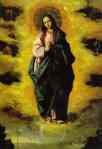
c.1628-1630. Oil on canvas. Museo del Prado, Madrid, Spain. Read Note.

