Alexey Zubov Biography
Alexey Zubov was born into the family of an icon painter of the Kremlin icon shop, Fyodor Zubov. After their father's death, both his sons, Ivan and Alexey, were accepted into the same icon shop as apprentices. In 1699, Alexey Zubov was ordered to become an apprentice of the Holland publisher and etcher Adrian Schoonebek (1661-1705), who had come to Russia on a personal invitation of Peter the Great. Etching at that time was looked upon as a means of mass propaganda, not as a kind of art, and practical Peter I encouraged etchers who depicted the most important events in the country and the revolutionary activities of its Tzar. In 1710-11 Zubov fulfilled his first major work - The Ceremonial Entry of Russian Troops into Moscow on December 21, 1709 after their Victory in the Battle of Poltava. The second version of the etching was finished already in St. Petersburg. In the young city of Peter I, the artist worked very fruitfully and variably. Here his best works were executed, which, among others are the Wedding Feast of Peter I and Catherine in the Winter Palace of Peter I in St. Petersburg February 19, 1712, and wonderful scenes of the sea battles Battle of Gangut, Grengam Battle, and others, full of life and dynamism. To his best belong, doubtlessly, the views of St. Petersburg that brought him fame.
Zubov's etchings have simple compositions and are usually panoramic views. From the academic point of view they have numerous mistakes in technique and perspective, but in those mistakes there is a charm of youth: everything is seen enthusiastically. The youthful energy, the impression of a new beginning that run through Peter's I epoch, live in the etchings of Zubov. Ships crowd the Neva River, cannons fire, smoke flows from chimneys, ladies and gentlemen walk along the embankments, carriages pass by – everything moves, everything lives. These are not just views of the city. It's a dream, which realizes itself before your eyes – many buildings, which are already in Zubov's works, existed only as projects.
After Peter's I death, Zubov continued to work in St. Petersburg for some time; he fulfilled portraits of Catherine I (1726), portraits of princesses D.M. and M.A. Menshikovs (1726). By 1730 the artist had left for Moscow. His last known etching dates 1745, and the last mention of the artist dates 1749. He died in poverty, forgotten, the exact date of his death and place of burial unknown.
Bibliography
Etcher of the Peter's I time, Alexey Zubov. By M. Lebedyansky. Moscow 1973.
Birth of Russian Genre. 18th century. By Y. Brook. Moscow. 1990.
Russian Painters. Encyclopedic Dictionary. St. Petersburg. 1998.
- The Ceremonial Entry Of The Russian Troops To Moscow On December 21,...
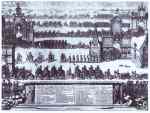
1711. Etching, chisel. 51.5 x 70.1 cm. The Hermitage, St. Petersburg, Russia.
- The Wedding Feast Of Peter I And Catherine In The Winter Palace Of...
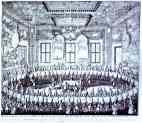
1712. Etching, chisel, 49.9 x 56.5 cm. The Hermitage, St. Petersburg, Russia.

