Rogier van der Weyden Biography
Rogier van der Weyden was the most important representative of Netherlandish painting in the years immediately following
Jan and Hubert van Eyck. Like no other painter of the 15th century outside Italy, he developed compositional and figural principles, which were adopted into every genre of painting north of the Alps. We should not underestimate the extent of his influence in Italy, where he was considered one of the most important artists of his day.
Rogier was born in Tournai around 1399/1400, son of the cutler Henry de le Pasture and Agnes de Wattrelos. In 1426, he married Elisabeth Goffaerts (c. 1405-1477). In 1427, Rogier’s first son, Corneille (d. 1473), who later studied in Louvain, and became a Carthusian monk in Hérinnes in 1449/49, was born.
Rogier was apprenticed to Campin in 1427 – a surprisingly late date. But having only become a master in 1432, in 1436 he was appointed official painter to the city of Brussels. Rogier came to Brussels in 1435, changing his name from the French ‘de le Pasture’ to its Flemish equivalent, which is ‘van der Weyden’.
Rogier took as his starting point the three-dimensional figures of Campin and Jan van Eyck and proceeded to clarify their anatomical structure. At the same time, he perfected the depiction of interiors and landscapes in proper perspective. Direct references to earlier masters – as, for example, in his several surviving versions of St. Luke painting the Virgin, which refer to Jan van Eyck’s The Virgin of the Chancellor Rolin – became far less frequent from about 1440 as he strove to find an artistic balance between depth and plane. Figures grew more slender, draperies and interior décor became more elegant. A visit to Rome in the year of 1449/50 led to an exchange between art north and south of the Alps, which would prove one of the most fruitful of the entire 15th century.
When Rogier died in Brussels on June 18, 1464, he was the best known and most sought after painter in the Netherlands, a standard for the majority of artists north of the Alps. He left behind him not only an obviously large workshop with extremely well trained assistants, but also a continuing demand for his work. The studio was very probably taken over by his son Pieter (1437-after 1514), also a painter.
Bibliography
Rogies van der Weyden. Lukas Painting Madonna. by N. Nikulin. Moscow-Leningrad. 1964.
Painting of Europe. XIII-XX centuries. Encyclopedic Dictionary. Moscow. Iskusstvo. 1999.
Van Der Weyden by Lorne Campbell. Chaucer Press, 2005.
Rogier van der Weyden. St. Luke Drawing the Virgin. Selected Essays in Context. by C. Purtle. Brepols Publishers, 1998.
Rogier van der Weyden: Rogier de le Pasture by Albert Châtelet. Gallimard, 1999.
Early Netherlandish Painting from Rogier van der Weyden to Gerard David. by Otto Pacht, Monika Rosenauer. Harvey Miller, 1997.
- Madonna.
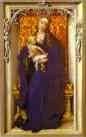
c.1440. Oil on panel. Kunsthistorisches Museum, Vienna, Austria.
- Portrait Of Charles The Bold.
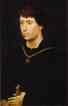
c.1460. Oil on panel. Gemaldegalerie, Berlin, Germany. Read Note.

