Jean-Antoine Watteau Biography
October 10, 1684, supposed day of Watteau’s birth, is actually the date he was baptized at the church of St. Jacques in Valenciennes. He was the son of Jean-Philippe Watteau, master roofer and carpenter, who knew how to read and write, and was officially registered as a bourgeois. All we know about Watteau’s mother is the name: Michele, née Lordenois; of Watteau’s three brothers that they continued his father’s enterprise. It is unknown whether his parents encouraged his artistic vocation. None the less they allowed the boy, on turning fifteen, to get some instruction from Jacques-Albert Gérin, the correct, mediocre official painter of Valenciennes.
After the death of Gérin (in 1702), Watteau studied with another painter, who specialized in decorating theatres. Watteau accompanied this man to Paris, where he was called to decorate the Opera House. Watteau helped his master for a few months, then moved back to his native town. From this short experience Watteau derived various staging devices, a certain science of costume and setting, and theatrical poses, which lend his pictures the character of pantomime. Later in Paris at the print-shop of Pierre II Mariette and his son Jean, Watteau had ample opportunities to study the great masters in the collection there (Rubens, Titian, Bruegel, Callot and others). He met there (in 1703) Claude Gillot, who asked him to come and lodge together. Gillot had won some recognition with pictures drawn from the performances of the commedia dell’arte. It seems that Watteau borrowed from him the idea of the fêtes galantes. In 1707 Watteau left Gillot for obscure reasons. His new partner was Claude Audran.
Before or after parting with Audran, at any rate between 1708 and 1711, he left for Valenciennes with some money paid to him by the art dealer Sirois, Gersaint’s father-in-law, for a picture. The town was then in a zone of military operations. The warlike bustle and atmosphere inspired him. Such subjects were, in fact, quite contemporary. Watteau did not work on commission but only as it pleased him, which did not prevent his pictures from being purchased. That accounts for the naturalness and vivacity of his military-scene sketches and for the free treatment of his paintings. Like veritable pieces of reportage, the painted scenes do not have the usual solemnity of such pictures. Instead of celebrating grandees, they capture the truth of life.
On his return to Paris Watteau competed for the Prize of Rome, which would have enabled him to go to Italy and study the great masters there. The attempt failed. Watteau was now living in Sirois’ house. He frequented the theatres and, abandoning the military scenes, began to paint fêtes galantes, quasi-pastoral idylls in court dress which became fashionable in high society. Still dreaming of Italy, he submitted a few works (Jealousy, or Pierrot Content, A Party for Four and A Jealous Harlequin) to the Royal Academy of painting, in the persisting hope of being sent to Rome. Once again he failed, but was asked to join the Academy.
After 1712, Watteau disappeared for a while and this period is almost totally unknown. In 1717, he joined the Academy of Painting. Of the two versions of the Embarkation for Cythera, one in Berlin and one in the Louvre, the earlier one in Louvre was the enrollment picture which Watteau deposited with the Académie in 1717 – a little tardily as he had become an Academician in 1712.
The tinge of melancholy in Watteau’s work is matched by his life. A lifelong sufferer from tuberculosis he went to London in 1719 partly in hopes that the famous Dr. Mead might cure his consumption, partly, perhaps from desire to extend his sphere of action. He was already, however, fatally ill. On his return to France (in 1720), he painted his last great work, depicting the interior of the shop of his art-dealer friend Gersaint, drawn from nature and intended as a signboard, but in fact the most classical and most perfectly composed of his paintings. L'Enseigne de Gersaint. As his death approached, he destroyed, persuaded by the abbot of Carreau Abby, a large number of his more erotic paintings.
Watteau never had his own house and moved from one friend, or patron, to another. Watteau died in Gersaint’s house on 18 July 1721, in the arms of Gersaint. He was 37.
During his 15-year artistic career, Watteau tacked a wide variety of genres, subjects and techniques: tapestry cartoons and ceiling decorations, wainscot, fans and harpsichord panels, also allegoric and satirical pictures, genre painting, military, theatrical and religious scenes, landscapes and rustic subjects, character heads and portraits. He gave his full measure, however, in his fêtes galantes. By the specificity he lent this theme, which is now strikingly associated with his name, Watteau succeeded in establishing it as a distinct genre. These fêtes galantes entirely crystallize the spirit of his painting. Essentially aristocratic in conception, Watteau’s paintings fell into disfavor during the Revolution, and it was not until the end of the 19th century that they regained popularity. Watteau is now regarded as a forerunner of the Impressionists in his handling of color and study of nature.
Bibliography
Watteau by Modest Marariu. Editions Meridiane. Bucharest. 1985.
Painting of Europe. XIII-XX centuries. Encyclopedic Dictionary. Moscow. Iskusstvo. 1999.
Antoine Watteau. Leningrad. 1973.
Watteau by M. German. Moscow. 1980.
Antoine Watteau 1684-1721 (Masters of French Art) by Helmut Borsch-Supan. Konemann, 2001.
Watteau and His World: French Drawing from 1700 to 1750 by Alan Wintermute, Colin B. Bailey, American Federation of Arts. Merrell Publishers, 1999.
Watteau's Painted Conversations: Art, Literature, and Talk in Seventeenth- And Eighteenth-Century France by Mary Vidal. Yale Univ Pr, 1992.
The Age of Watteau, Chardin, and Fragonard: Masterpieces of French Genre Painting by Colin B. Bailey, Philip Conisbee, Thomas W. Gaehtgens. Yale University Press, 2003.
Antoine Watteau 1684-1721 (Masters of French Art) by Helmut Borsch-Supan. Konemann, 2001.
Watteau and the Cultural Politics of Eighteenth-Century France by Julie Anne Plax. Cambridge University Press, 2000.
- Embarkation For Cythera.
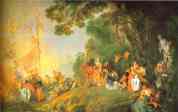
1718-19. Oil on canvas. Staatliche Museen, Schloss Charlottenburg, Berlin, Germany. Read Note.
- Embarkation For Cythera, Or The Pilgrimage To Cythera.
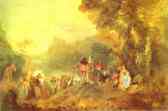
1717. Oil on canvas. Louvre, Paris, France. Read Note.
- L'Enseigne De Gersaint.
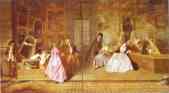
1721. Oil on canvas. Staatliche Museen, Schloss Charlottenburg, Berlin, Germany.
- Arlecchino Emperor In The Moon.
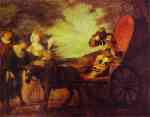
1708. Oil on canvas. Musée des Beaux-Arts, Nantes, France. (Apparently done from a drawing by Claude Gillot). Read Note.
- Satire On Physicians.
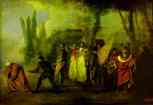
1708-1709. Oil on wood. The Pushkin Museum of Fine Art, Moscow, Russia.

