Maxim Vorobiev Biography
Maxim Nikiforovich Vorobiev was born into the family of a soldier, who after he had retired became a guard in the Academy of Arts in St. Petersburg. There Maxim was admitted in 1798; he studied in the architectural class of J. B. Toma de Tomon and graduated from the Academy in 1809 as a landscape painter.
His life was successful: in 1814 he became an academician; in 1815 he was invited to teach in the Academy; in 1823 he became a professor, in 1843 – an honored professor. He had many pupils, among them Ivan Aivazovsky, Alexey Bogolyubov, L. F. Lagorio, the Tchernetsov brothers and others. Despite his intensive teaching duties Vorobiev himself painted all his life. The artist painted city and sea, architectural monuments, landscapes and also war episodes. He traveled much throughout Russia and abroad. In 1813-14, he was with Russian troops in Western Europe and brought home many European cityscapes and landscapes. Later he executed the beautiful views of Moscow, especially Kremlin. View of Moscow, View from Yauza of Kremlin in Moscow. The paintings executed by Vorobiev during his trip to the Middle East brought him fame. View of Jerusalem. Oriental Landscape.
At the end of the 1820s the painter visited the military theatre on the Danube. From his impressions he painted the landscapes of Bosporus and Seashore near Varna. View of the Military Telegraph near Varna.
Vorobiev’s pictures were very popular with the Russian public and he repeated them for his clients. The most valuable part of his heritage is his Petersburg landscapes, fulfilled in the 1820s-30s. A romantic painter, he managed to see the city in his own tender and poetic way and render its changing atmosphere and light. Moonlit Night in St. Petersburg. Neva Embankment near the Academy of Arts.
Maxim Vorobiev’s works influenced many Russian painters, and among them was Socrat Vorobiev (1817-1888), Maxim’s adopted son. Two of his works are represented in our gallery. By an Old Mill. Landscape with a Cross, Lithuania.
Bibliography
Russian Water-Colour in the Collection of Hermitage, Leningrad. Moscow. Iskusstvo. 1975.
- View Of Moscow.
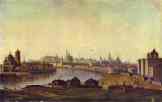
1810s. Oil on canvas. The Pavlovsk Palace. Pavlovsk, Russia.
- View From Yauza On Kremlin In Moscow.
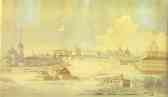
. Watercolor on paper. The Tretyakov Gallery, Moscow, Russia.

