Louise-Elisabeth Vigée-Lebrun Biography
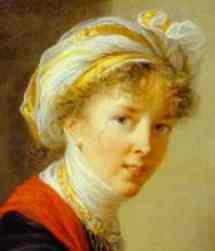
Louise-Élisabeth Vigée-Lebrun, French artist, the daughter and student of her father, the artist Louis Vigée, was born on 16th April, 1755 in Paris. In 1776, she married the known art-dealer Jeanne Baptiste Pierre Lebrun. She made an early and brilliant career: in 1779 she officially became a court painter of the Queen Marie-Antoinette, in 1783 she was admitted to the French Academy of Arts.
“Intelligent, diplomatic, resourceful, and independent, she remains a role model to women who paint, having won wide recognition for her skills and gained admission to academies long closed to her sex.” (Paintings in the Hermitage. by Colin Eisler. 1990. Stewart, Tabori & Chang. p 516)
Vigée-Lebrun was an extremely industrious and productive painter, she left more than 30 portraits of the queen and her ladies-in-waiting, many self portraits, and a lot of portraits of the European nobility. Her portraits are elegant and rich in color, very sentimental and idealized the model. But the evident difference of the models from their pictorial depiction did not embarrass the customers. Vigée-Lebrun was fashionable with the European aristocracy. Her fame grew even more with her immigration during the French Revolution first to Italy (1789-93), then to Vienna (1793-94), and then to St. Petersburg (1795-1802), where she also spent 6 very successful years painting portraits of Russian aristocrats. In her best works the magnificent art of French portraitists of the 18th century and fine sensitiveness of the European sentimentalism are happily united.
Bibliography
The Exceptional Woman: Elisabeth Vigee-Lebrun and the Cultural Politics of Art by Mary D. Sheriff. University of Chicago Press, 1996.
Memoirs of Madame Vigee Lebrun. George Braziller, 1989. Bibliography:
Famous Russians in the 18th and 19th centuries. Lenizdat. St. Peterburg. 1996. (in Russian)
- Portrait Of Mme D'Aguesseau.
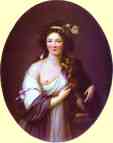
c.1770. Oil on canvas. 91.5 x 72.4, oval. Art Museum, Bucharest, Romania.

