Andrea del Verrocchio Biography
Andrea di Michele Cione was born in Florence c.1435. After his training under the goldsmith Giuliano del Verrocchio, whose name he adopted, he went on his own, trying himself and achieving success in different fields of fine arts: in jewelry, sculpture and painting, but it was in the field of sculpture that he excelled most. The works of Donatello had great impact on him. Verrocchio left works in marble, terracotta, silver and bronze, which show his brilliance as a modeler as well as a carver. Little is known about his early work. It was not until 1472 that he made his mark as a leading master of his generation with his sepulchral monument for Piero and Giovanni de’Medici (San Lorenzo, Old Sacristy). The culmination of his achievements was the bronze group Christ and Doubting Thomas (1467-83) at Or San Michele.
From about 1475, Verrocchio’s workshop in Florence became a kind of academy of arts: a number of important painters were trained there: Lorenzo di Credi, Pietro Perugino, Luca Signorelli, and Leonardo da Vinci are the most famous of them. It is difficult to separate Verrocchio’s works in the field of painting from that of his pupils. Thus Verrocchio’s painting The Baptism of Christ (1475), which is considered to be the finest representation of the subject in Early Renaissance Florentine art, was clearly assisted by Leonardo, at that time active in Verrocchio’s workshop.
The last work by Verrocchio was a bronze equestrian statue - the monument to a Venetian army commander Colleoni. In his will, Colleoni had requested such a statue and, by way of encouragement had left a sizable fortune to the Republic of Venice. The monument is not a portrait, but an idealization of the personality of a successful war leader.
Verrocchio died in Venice in 1488.
Bibliography
Verrocchio by S. Androsov. Leningrad. 1984.
The Art of the Italian Renaissance. Architecture. Sculpture. Painting. Drawing. Könemann. 1995.
The Sculptures of Andrea Del Verrocchio by Andrew Butterfield. Yale Univ Pr, 1997.
- Tomb Of Giovanni And Pietro De'medici.
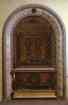
1472. Marble, pietra serena, porphyry, bronze. San Lorenzo, Florence, Italy.
- Christ And Doubting Thomas.
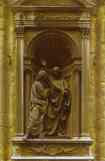
1467-83. Bronze. Orsanmichele, Florence, Italy. Read Note.

