Diego Velázquez Biography
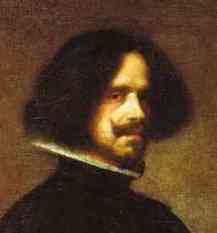
Diego Rodriguez de Silva y Velázquez was born in 1599 in Seville, the first child of Juan Rodriguez de Silva and Jeronima Velázquez, members of the lesser nobility. Almost nothing is known about Diego’s siblings – five brothers and a sister. Velázquez seems to have started his apprenticeship with Francisco de Herrera the Elder (c.1590-1654), but a short while later (in 1611) his father put him with Francisco Pacheco (1564-1644), who was an artist of modest talent, but a tolerant teacher and a man of society. Francisco Pacheco had good contacts in the royal court and besides, intellectuals of the city, poets, scholars, and artists, liked to meet at his workshop to discuss the subjects of classical antiquity, Raphael, Michelangelo and above all Titian, as well as the theory of art. At this time, Velazquez became familiar with the school of Caravaggio.
In 1617, Velázquez was accepted into the painters’ guild of St. Luke in Seville. Membership in this guild was necessary before he could start his own workshop, employ assistants, and receive commissions from churches and public institutions. The same year Velázquez married Juana, daughter of his teacher Pacheco. Within less than three years they had two daughters, of whom only one, Francisca, survived. The paintings executed by Velázquez in Seville before 1622 include bodegones (very popular genre of kitchen or tavern scenes, in which food and drink plays the main part) and his first portraits and religious compositions: Old Woman Frying Eggs, Three Men at Table, The Waterseller in Seville, Mother Jerónima de la Fuente, The Adoration of the Magi. In The Adoration of the Magi the main characters are thought to be portraits: the young king is a self-portrait of the artist, the kneeling king behind him – Pacheco, and Baby Jesus and the Virgin Mary – Pacheco’s daughter and Velázquez’ wife, Juana.
In 1622, Velázquez visited Madrid for the first time to see its art treasures, and to make useful contacts; then he went to Toledo to see works by El Greco and other painters of that city, including Pedro de Orrente (1580-1645) and Juan Sanchez Cotan (1561-1627). In the spring of 1623, Velázquez was summoned to court by the powerful Prime Minister, Count-Duke of Olivares, and received his first commission for a portrait of Philip IV. The success of this picture brought the artist an appointment as court painter and the privilege of becoming the only artist permitted to paint the king in the future. In 1628, Peter Paul Rubens came to the court in Madrid on diplomatic business. Velázquez often visited him at work. Actually he was the only Spanish painter to be honored with these personal conversations. It was Rubens who persuaded Velázquez to go to Italy.
During his first journey to Italy in 1629-30, Velázquez visited Genoa, Venice (where he saw the work of Titian, who effected him more strongly than any other artist), Florence, and Rome, where he stayed for almost a year. He copied old masters, but also painted large compositions of his own including The Forge of Vulcan and Joseph’s Bloody Coat Brought to Jacob.
In 1834-35, Velázquez was working on the decoration of the new palace of Buen Retino. One of his major works intended for this setting, together with several equestrian portraits, is The Surrender of Breda, part of a cycle of twelve battle pictures by different painters. The besieged fortress town of Breda in North Brabant surrendered to the Spanish general Spinola after a staunch resistance of 12 months. The victorious general had granted honorable terms to the captured garrison. The ceremony of the delivery of the keys is the subject of Velasquez’s painting. The work was soon popularly renamed The Lances, because of the verticals which seemed to express the peaceful halt of the army at the moment of surrender. It has been considered the best historical work in West European painting.
In 1636, the king appointed his court painter “Assistant to the Wardrobe” (without the corresponding salary); in 1643 the king promoted Velázquez to the post of Chamberlain of his private chambers (although still without a regular salary), later he was made assistant to the superintendent of special building projects. In the next few years Velázquez’ art approached its peak in such pictures as Venus at her Mirror and The Fable of Arachne.
During his second visit to Rome (1649-1651) Velázquez, among other pictures, painted the famous portrait of Pope Innocent X, which the pope himself declared to be ‘too truthful’. On his return to Madrid he was appointed Supreme court marshal, his obligations not connected with painting increased, but he was able now to enlarge his workshop, employing many assistants and pupils (none of whom, however, were of very great artistic merit).
Velasquez’s career ended with his most significant work Las Meninas. The painting is a multiple portrait of the royal family and court. The principal figure with all the power of her mischievous charm, is the little Infanta Margarita, who has burst into Velasquez’s studio, followed by her ladies, dwarfs and dogs, in a flurry of skirts, cloaks and ribbons, while he was intent on painting the king and queen, whose only images are visible, reflected in the mirror hanging on the wall in the background, where two large mythological paintings, one by Rubens, the other by Jordaens, are also hanging.
The great master died in the palace in Madrid on August 6, 1660.
Bibliography
Velázquez by T. Kaptereva. Moscow. 1961.
Paintings by Velázquez by V. Kemenev. Moscow. 1969.
Paintings by Velázquez in Soviet Museums. Leningrad. 1977.
Painting of Western Europe. XVII century. by E. Rotenberg. Moscow. Iskusstvo. 1989.
Painting of Europe. XIII-XX centuries. Encyclopedic Dictionary. Moscow. Iskusstvo. 1999.
Velazquez in Soviet Museums: Analysis and Interpretation of the Paintings in the Context of His Oeuvre by Vladimir Semenovich Kemenov Control Data Arts, 1979.
Velazquez: Painter and Courtier by Jonathan Brown. Yale Univ Pr, 1988.
Velazquez: Catalogue Raisonne: Painter of Painters: Werkverzeichnis (Jumbo) by Jose Lopez-Rey (Editor). TASCHEN America Llc, 1999.
The Cambridge Companion to Velazquez (Cambridge Companions to the History of Art) by Suzanne L. Stratton. Cambridge University Press, 2002.
Velazquez's Las Meninas (Masterpieces of Western Painting) by Diego Velazquez, Susanne L. Stratton-Pruitt. Cambridge University Press, 2003.
Velazquez in Seville by David Davies, Enriqueta Harris, Michael Clarke. Yale University Press, 1996.
Venus at Her Mirror: Velazquez and the Art of Nude Painting by Andreas Prater. Prestel, 2002.
Manet/Velazquez: The French Taste for Spanish Painting by Gary Tinterow, Genevieve Lacambre, Deborah L. Roldan. Yale University Press, 2003.
- Old Woman Frying Eggs.
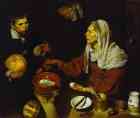
1618. Oil on canvas. National Gallery of Scotland, Edinburgh, UK.
- Three Men At Table.
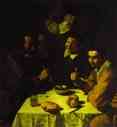
c.1618. Oil on canvas. The Hermitage, St. Petersburg, Russia.
- The Waterseller In Seville.
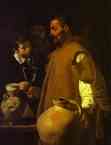
c.1620. Oil on canvas. Wellington Museum, London, UK.
- Mother Jerónima De La Fuente.
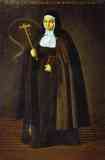
1620. Oil on canvas. Museo del Prado, Madrid, Spain. Read Note.
- The Adoration Of The Magi.
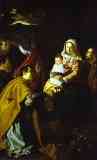
1619. Oil on canvas. Museo del Prado, Madrid, Spain. Read Note.
- The Forge Of Vulcan.
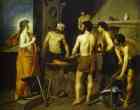
1630. Oil on canvas. Museo del Prado, Madrid, Spain. Read Note.

