Vincent van Gogh Biography
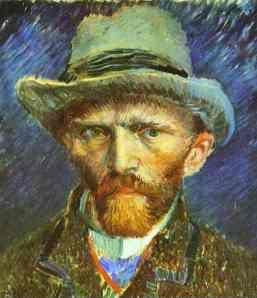
On March 30, 1853 a boy was born to the family of a Dutch village vicar, Theodorus van Gogh (1822-1885) and his wife Anne Cornelia, nèe Carbentus (1819-1907). A year before, exactly the same day, another boy was born to the family, he died, and now the new-born received his name: Vincent Willem van Gogh.
After getting school education, van Gogh started his career as a picture salesman: in The Hague (1869) he entered the branch office of the Paris art dealer Goupil & Cie, founded originally by his uncle Vincent. As an agent of the company he worked in its branches in Brussels (1873), London (1873), Paris (1875). But his personal disappointment increased and he left Goupil.
Van Gogh tried himself as a teacher in Ramsgate near London (April-December 1876), then he worked as an apprentice lay preacher and wanted to devote his life to evangelization of the poor. In 1878 Vincent convinced his father of his religious vocation and in August began a three-month course in preaching in Evangelist school in Laeken, near Brussels. At school he was considered unsuitable for the lay-preaching profession. But he persistently followed his inclination and went to Borinage, the Belgian coal mining area close to the French border. There, living in extreme poverty, he visited sick people and read the Bible to the miners.
In 1879 Vincent got permission to work for 6 months as a lay preacher in Borinage. But his involvement in the plight of the poor irritated his superiors, and his contract was not extended under the pretext that his rhetorical talents were insufficient. He continued to work without any payment until July 1880. In Borinage Vincent experienced a period of deep personal crisis, which was to mold his later life. While in Borinage he drew much, made sketches of the miners’ environment. Meanwhile his four-years younger brother, Theo ((1857-1891), began to work at Goupil’s in Paris and started to support Vincent financially, he also encouraged Vincent in his wish to become an artist.
Having chosen art as his new profession van Gogh went to Brussels (October 1880- April 1881), where he studied anatomical and perspective drawing at the Academy of Art. In January 1882 he moved to The Hague and settled there not far from his cousin, the artist Mauve, whom he admired and who became his teacher. With Mauve van Gogh for the first time tried oils. Accordingly, his early painting of August 1882 Beach with Figures and Sea with a Ship is strongly influenced by The Hague School to which Mauve belonged. During 1883-1885 van Gogh traveled and worked in The Hague, Nueven, where his parents' new home was, Amsterdam. His models were poor people, slums, hard working peasants; he painted landscapes and town views, all in dark, somber colors.
March 26, 1885 his father died. Vincent was heart-broken. In this mood he painted The Potato-Eaters, the main work of his Dutch period. In January 1886 he entered the Ecole des Beaux-Arts in Antwerp, but already in March he left it and arrived in Paris. He started studies in Cormon studio, the owner of which, the painter Fernand Cormon, was a fairly unknown artist, but a quite successful teacher. Van Gogh studied in the studio for 3 months. Here he made friends with Toulouse-Latrec and Emile Bernard. Theo introduced him to Monet, Renoir, Sisley, Pissarro, Degas, Signac, Seurat, and Gauguin who came to Paris from Pont-Aven. From now on the colors on Vincent’s palette became considerably brighter; under the influence of Impressionists his style also changed. View of Paris from Montmartre, Paris Seen from Vincent's Room in the Rue Lepic, Terrace of the Cafè "La Guinguuette" and others are based on a typical Impressionist interpretation.
Together with Gauguin and Bernard, Van Gogh spent many days in Asnières, a popular spa town on the Siene, not far from Paris. There he painted the views of Asnières and the well-known The Seine with the Pont de la Grande Jatte in summer 1887. In Paris he frequently visited the Café de Tambourin on the Boulevard de Clichy and had a love affair with its owner Agostina Segatori, a former model of Corot and Degas. She sat for van Gogh and he painted her many times, e.g. Agostina Segatori in the Café du Tambourin. In the café, together with Bernard, Gauguin and Toulouse-Lautrec, he exhibited his works; they also decorated the walls with Japanese colored woodcuts. They called themselves “Peintres du Petit Boulevard” (painters of small boulevard) in contrast to the “Peintres du Grand Boulevard” (Monet, Sisley, Pissarro, Degas, Seurat), who exhibited in Theo van Gogh’s gallery. That year Vincent painted several pictures using the techniques of Pointillism, e.g. The Vase with Daisies and Anemones. During his two years in Paris van Gogh painted more than 200 pictures.
In 1888 he left Paris and went to Arles. At first Vincent rented a room in a restaurant. The small attic was completely unsuitable for a studio and he mainly worked out of doors. He did not know anybody who could sit as his model, and so the landscapes of area around Arles with its trees, hills, bridges, huts became his main theme. “An endlessly flat landscape – seen from a bird’s eye view from the top of the hill – vineyards, harvested corn fields. All this is multiplies to infinity and spreads like the surface of the sea to the horizon, which is bordered by the hills of Grau,” wrote Vincent van Gogh about his surroundings. He painted many pictures with blooming flowers and trees, which reminded of Japanese landscapes. On receiving the news of Mauvre’s death he dedicated a picture to his memory Peach Tree in Bloom. Soon he moved to the “yellow house”. Gradually he made friends with people, who agreed to sit for him: Zouaves Milliet, a soldier, Joseph Roulin, the country postman, Madame Ginoux an owner of a station restaurant in Arles, and others.
In October, after Vincent’s repeated requests, Gauguin came to stay with him in Arles. Van Gogh was overjoyed. He gladly let Gauguin take the lead-role in art, placing himself in the role of a student. They worked out a lot of motifs together, compared the results and argued over artistic concepts. But their partnership could not last long, they were too different personalities, and besides, van Gogh was seriously ill. Guaguin decided to leave, but “ever since I wanted to leave Arles, he has been behaving so strangely that I hardly dare to breathe. ‘You want to leave’, he said to me and as soon as I answered in the affirmative he tore a piece, containing the following sentence, from the newspaper: ‘The murderer, has fled’,” Gauguin was later to recall in a letter. Van Gogh really appeared to be going mad. Gauguin waited with leave: “In spite of a few differences I can't be angry with a good chap who is ill and suffering and calling for me.” On the 23rd of December Gauguin went for a walk in the evening and heard steps behind, he turned and saw van Gogh, his face distorted, a razor blade in his hand. Gauguin spoke softly to Vincent, the latter turned and went away. When later Gauguin returned home, the whole of Arles was already there. Plagued with hallucination, Van Gogh cut off the lower part of his left his ear; after he managed to stop bleeding he wrapped the ear in a handkerchief, ran to the town brothel and gave the awful package to a prostitute. Then he returned home and slept. In this state police found him and took to town hospital. Gauguin immediately left. In order to quiet his bad conscience he later wrote in his autobiography that van Gogh had threatened him.
Theo immediately came to Arles. Epilepsy, dipsomania and schizophrenia were the presumed causes of Vincent’s illness. He stayed in hospital for two weeks. Back in his studio he painted the result of the catastrophe: his Self-Portrait with Bandaged Ear. Sleeplessness and hallucinations went on. The scared citizens of Arles initiated a petition asking to take Vincent back into hospital. Looked after by a priest and a doctor, he lived in the Arles hospital both as patient and prisoner until the beginning of May 1889. In May, although he felt better, he went on his own desire into the mental hospital Saint-Paul-de-Mausole near Saint-Rémy-de-Provence. “I am ready to play the role of a madman, although I have not at all the strength for such a role”. Theo paid for two rooms for Vincent, one as a studio with a view of the garden. He was allowed to paint outdoors under the supervision of the ward attendant Poulet. In the hospital he painted mainly landscapes. On January 31, 1890 Theo’s son was born and baptized Vincent Willem after his uncle and godfather. Van Gogh dedicated the Branches of an Almond Tree in Blossom to his nephew.
In May 1890 Vincent visited Theo and his family in Paris and then settled in Auvers-sur-Oise, near Paris. The town was chosen because Dr. Gachet, himself a hobby painter and friend of the Impressionists, was living there, he agreed to take care of Vincent. In Auvers van Gogh painted more than 80 pictures. During these last weeks of his life it was only due to his work that he could forget about his illness, and he painted as if possessed. Among the works of the period are religious works after Delacroix, Pietà and Good Samaritan, the masterpiece The Church in Auvers, multiple landscapes and portraits.
On the evening of the 27th July 1890 van Gogh went at dusk into the fields and shot himself in the chest with a revolver. With all his strength he managed to drag himself back to the inn; here he died two days later in the arms of his brother, who had hurried to his side. Besides Theo and Dr. Gachet some friends from Paris, amongst them Bernard and “Père” Tanguy, took part in the funeral.
Thus ended the singular life of an artist who defies comparison with any other. “I can’t change the fact that my paintings don't sell. But the time will come when people will recognize that they are worth more than the value of the paints used in the picture.” -- Vincent van Gogh
Bibliography
Henri Perruchot. La vie de Van Gogh. Hachette. Paris. 1957.
Vincent van Gogh. Correspondence. Moscow-Leningrad. 1966.
Van Gogh. by Ye. Murina. Moscow. 1978.
Vincent van Gogh. His Personality and Art. by N. Dmitrieva. Moscow. 1980.
Painters of Montmartre. by Illana Soldea. Bucharest. 1986.
Dear Theo: The Autobiography of Vincent Van Gogh by Vincent Van Gogh, Irving Stone (Editor), Jean Stone (Editor). Plume, 1995.
Stranger on the Earth: A Psychological Biography of Vincent Van Gogh by Albert J. Lubin. DaCapo Press, 1996.
Van Gogh's Van Goghs: Masterpieces from the Van Gogh Museum, Amsterdam by Richard Kendall, Vincent Van Gogh, John Leighton, Van Gogh Museum. Harry N. Abrams, Inc, 1998.
Vincent Van Gogh: 1853-1890, Vision and Reality (Basic Art) by Ingo F. Walther. TASCHEN America Llc, 2000.
Stranger on the Earth: A Psychological Biography of Vincent Van Gogh by Albert J. Lubin. DaCapo Press, 1996.
Van Gogh and Gauguin: The Studio of the South by Douglas Druick, Peter Kort Zegers. Thames & Hudson, 2001
Van Gogh and Friends Art Game: With Cezanne, Gauguin, Seurat, Rousseau and Toulouse-Lautrec by Wenda Brewster O'Reilly. Birdcage Books, 2002.
- Beach With Figures And Sea With A Ship.
August 1882. Oil on paper on cardboard. Vincent van Gogh Foundation, Rijksmuseum Vincent van Gogh, Amsterdam, the Netherlands.
- The Potato-Eaters.
April 1885. Oil on canvas. Vincent van Gogh Foundation, Rijksmuseum Vincent van Gogh, Amsterdam, the Netherlands.
- View Of Paris From Montmartre.
1886. Oil on canvas. Kunstmuseum, Öffentliche Kunstsammlung Basel, Basle.
- Paris Seen From Vincent's Room In The Rue Lepic.
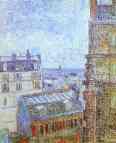
1887. Oil on canvas. Vincent van Gogh Foundation, Rijksmuseum Vincent van Gogh, Amsterdam, the Netherlands.
- Terrace Of The Cafè "La Guinguuette".
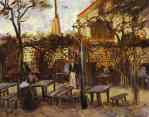
October 1886. Oil on canvas. Musée d'Orsay, Paris, France.
- The Seine With The Pont De La Grande Jatte.
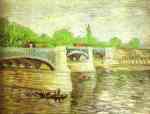
Summer 1887. Oil on canvas. Vincent van Gogh Foundation, Rijksmuseum Vincent van Gogh, Amsterdam, the Netherlands.
- Agostina Segatori In The Café Du Tambourin.
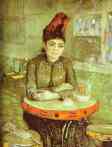
February-March 1887. Oil on canvas. Vincent van Gogh Foundation, Rijksmuseum Vincent van Gogh, Amsterdam, the Netherlands. Read Note.
- Vase With Daisies And Anemones.
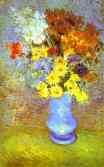
Summer 1887. Oil on canvas. Rijksmuseum Kröller-Müller, Otterlo, Netherlands.
- Peach Tree In Bloom. (In Memory Of Mauve).
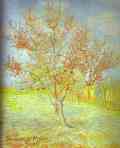
March 1888. Oil on canvas. Rijksmuseum Kröller-Müller, Otterlo.
- Self-Portrait With Bandaged Ear.
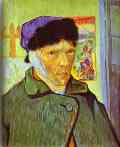
January 1889. Oil on canvas. Courtauld Institute Galleries, London, UK.
- Branches Of Almond Tree In Bloom. Saint-Rémy.
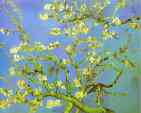
February 1890. Oil on canvas. Vincent van Gogh Foundation, Rijksmuseum Vincent van Gogh, Amsterdam, the Netherlands.

