Joseph Mallord William Turner Biography
Turner was only fourteen years old when he was admitted to the Royal Academy Schools. He started his career by painting watercolours and producing mezzotints under the strong influence of John Robert Cozen's work. Then, in 1796, he launched into oil painting, working in the neoclassical manner of Richard Wilson and Nicolas Poussin, with results that found wide acclaim. He exhibited his first picture Fishermen at Sea (1796) in the Royal Academy exhibition in 1796. He was elected an Associate in 1799 and in 1802 a full member of the Royal Academy. Turner was one of the most prolific painters of his time. He traveled extensively in England, Scotland and Ireland, and also on the Continent (France, Belgium, Holland, Germany, Italy).
In 1802, he visited Paris for the first time, where he studied the Old Masters in the Louvre, above all Dutch seascapes and Claude Lorrain's compositions, which lastingly influenced him. Turner's first private showing, at his own house, took place in 1804. During this period, thanks to the increasing concentration on the atmospheric effects of light, his original style began to evolve, a process that culminated during trips to Italy between 1819 and 1829.
Like the works of Constable, Turner's seemingly effortless watercolours and oil sketches were based on impressions of nature. But his perception of the world differed vastly from Constable's. Turner's pictures transcend ordinary appearances, conveying a visionary sense of the forces at work in the universe.
In his atmospheric depictions of shipwrecks and natural disasters such as The Shipwreck (1805), Snow Storm: Hannibal and His Army Crossing the Alps (1812), A Storm (Shipwreck) (1823), Shipwreck off Hastings (c.1825), Fire at Sea (1835), Snow Storm - Steam-Boat off a Harbour's Mouth (1842) reality and fantasy merge and colour is used to metaphorically evoke the power of natural phenomena. By abandoning form or merely outlining it, Turner lent colour autonomy and endowed it with a power of its own. This achievement was to be especially influential on XX century art. Turner's other best works are The Battle of Trafalgar, as Seen from the Mizen Starboard Shrouds of the Victory (1806-1808), The Decline of the Carthaginian Empire (1817), Childe Harold's Pilgrimage (1823), A Ship Aground (1828), The Fighting Temeraire Tugged to Her Last Berth to Be Broken up (1838), Peace - Burial at Sea (1842), The Dogana, San Giorgio, Citella, From the Steps of the Europa (1842), Light and Colour (Goethe's Theory) - The Morning after the Deluge - Moses Writing the Book of Genesis (1843), Rain, Steam and Speed - The Great Western Railway (1844).
Bibliography
Painting of Europe. XIII-XX centuries. Encyclopedic Dictionary. Moscow. Iskusstvo. 1999.
J.M.W. Turner'That Greatest of Landscape Painters': Watercolors from London Museums by Richard P. Townsend, J.M.W. Turner, Andrew Wilton, Philbrook muse, David B. Brown. University of Washington Press, 1998.
Turner: The Great Watercolours by Eric Shanes, J. M. W. Turner, Royal Academy of Arts, Andrew Wilton, Ian Warrell. Harry N Abrams, 2000.
Turner: The Late Seascapes by James Hamilton. Yale University Press, 2003.
The Oxford Companion to J. M. W. Turner by Evelyn Joll, Martin Butlin, Luke Herrmann. Oxford University Press, 2001.
The Paintings of J. M. W. Turner (Studies in British Art) by Martin Joll Butlin, J. M. W. Turner, Evelyn Joll. Yale University Press, 1984.
Turner by James Hamilton. Random House, 2003.
Turner's Britain by James Hamilton. Merrell Holberton, 2003.
- Fishermen At Sea.
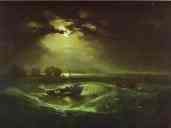
1796. Oil on canvas. Tate Gallery, London, UK.
- The Shipwreck.
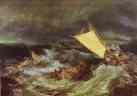
1805. Oil on canvas. Tate Gallery, London, UK.
- Snow Storm: Hannibal And His Army Crossing The Alps.
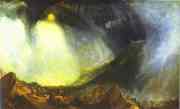
1812. Oil on canvas. Tate Gallery, London, UK.

