Vasily Tropinin Biography
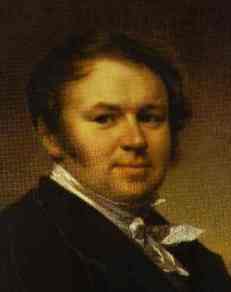
Vasily Tropinin was one of the major Russian artists active in the first half of the XIX century. He was born as a serf of Count A. Munich and then was given as a part of Munich's daughter's dowry to Count I. Morkov. Although his artistic talent and desire to paint were expressed early, he was sent by Count Morkov to St. Petersburg to learn to be a confectioner. During those years Tropinin managed to attend now and then free drawing lessons in the Academy of Arts, until in 1799, at the age of 23, he was sent by his owner to study art in the Academy. He took lessons from S. S. Schukin. In 1804 his work
Boy Grieving for a Dead Bird was exhibited in the Annual Academy of Arts exhibition and was noted by Russian Empress. The President of the Academy of Arts Count Stroganoff was going to intercede on behalf of Tropinin to get him freedom. Count Morkov, afraid of losing such a valuable possession, urgently recalled Tropinin from St. Petersburg to his Ukrainian estate Kupavka. There the artist was crudely reminded that he was only a slave. He was appointed a confectioner and a lackey, also he had to copy the works of European and Russian painters and produce portraits of the Morkovs. During the following years (1804-1821) in Ukraine, with occasional travels with the Morkovs to Moscow Tropinin continued to study art. He created a lot of portraits, landscapes and genre pictures. The most notable works of this period are Portrait of A. I. Tropinina, the Artist's Wife(1809), Head of a Boy. Portrait of A. V. Tropinin (About 1818), Portrait of the Writer and Historian N. M. Karamzin (1818). In 1821, Tropinin with the family of Count I. Morkov moved to Moscow. Although Tropinin was still a serf, he was well known as a talented artist and his friends continued to persuade Count Morkov to give him freedom. In 1823, at the age of 47, Tropinin was finally released from bondage. In the same year he submitted the pictures The Lace-Maker (1823), Old Beggar (1823), Portrait of E. O. Skotnikov (1821) and later Portrait of K. A. Leberecht (1824) to the Academy of Arts and was nominated an academician.
The following years were the most prolific for Tropinin. He settled in Moscow and opened up his own art studio. Already the well known artist he continued to paint portraits. His models ranged from peasants to the members of the most noble Russian families. The best of his works are Portrait of K. G. Ravich (1823), Gold-Embroideress (1826), Portrait of Alexander Pushkin (1827), Portrait of Countess N. A. Zubova (1834), Woman in the Window (Wife of a Treasurer)(1841), Self-Portrait with Brushes and a Palette Against a Window Facing the Kremlin (1844), Portrait of Yu. F. Samarin in a Hunting Dress (1846), Girl with a Pot of Roses (1850), Old Woman with a Hen (Portrait of the Artist's Wife) (1856). Tropinin died on 3rd of May, 1857 and was buried in Moscow.
Bibliography
Tropinin by E. Petinova. Russian Painters of the XIX century. Moscow. 1987.
- Portrait Of A. I. Tropinina, The Artist's Wife.
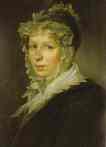
1809. Oil on canvas. The Tretyakov Gallery, Moscow, Russia.
- Head Of A Boy. Portrait Of A. V. Tropinin.
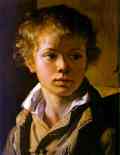
About 1818. Oil on canvas. The Tretyakov Gallery, Moscow, Russia.
- Portrait Of The Writer And Historian N. M. Karamzin.
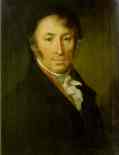
1818. Oil on canvas. The Tretyakov Gallery, Moscow, Russia. Read Note.

