Titian at Artprice. To look at auction records, find Titian's works in upcoming auctions, check price levels and indexes for his works, read his biography and view his signature, access the Artprice database.
Titian
or Tiziano Vecellio was born in a small alpine village of Pieve di Cadore,
now not far from the Austrian border, where his family lived for many years.
His parents, Lucia and Gregorio di Conte dei Vecelli, were respectable
people of modest means. In about 1498, at the age of nine or ten, Titian
and his elder brother Francesco were sent to Venice to start their training
as painters in the workshop of the mosaicist Sebastiano Zuccato. Though
soon Titian left his workshop and began studying painting in the
workshops of Gentile Bellini
and Giovanni Bellini. It is
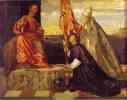
believed, that his earliest surviving work Pope
Alexander VI Presenting Jacopo Pesaro to Saint Peter (1502-1512)
was influenced by Giovanni Bellini. In 1507, Titian joined the workshop
of
Giorgione as his assistant
and three years (until Giorgione's death in 1510), which he spent with
this outstanding master, were a lasting influence on the young Titian to
such a degree, that some works which are now thought to have been painted
by Titian used to be attributed to Giorgione, and vice versa. One of them
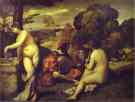
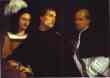
is Concert Champetre (c.1510-1511),
which is still in some sources considered to be painted by Giorgione. Other
works by Titian, which bear the Giorgione's influence are The
Birth of Adonis (1505-1510),
The
Legend of Polydorus (1505-1510),
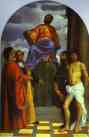
St.
Mark Enthroned with Saints (c.1510), The
Concert (c.1510),
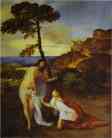
Noli me tangere
(1511-1512),
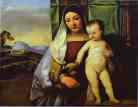
Gypsy Madonna (c.1512)
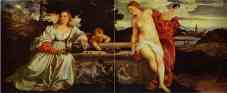
and even his masterpiece Sacred and Profane
Love (1514).
In 1510 Titian received his first important commission to produce some
frescoes in the Scuola del Santo in Padua dedicated the life
of St. Anthony of Padua. Since that time Titian began to win independent
commissions and to establish himself as a painter in Venice. In 1513 he
opened his own workshop, in which he employed two assistants, one of whom
had worked for Giovanni Bellini. In 1516 Titian was commissioned to paint
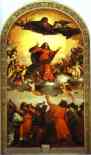
a new work for the high altar in the Franciscan church of Santa Maria Gloriosa
dei Frari in Venice, the Assumption of the
Virgin (Assunta) (1516-1518), which was destined to become
the milestone in the history of Venetian High Renaissance. This altarpiece
made Titian the most celebrated painter in Venice. At the same time, it
drew him to the attention of Bellini's old patrons in the northern Italian
ruling houses. He was commissioned by the Duke of Ferrara Alfonso d'Este
to produce three large mythological paintings The
Worship of Venus (1518), Bacchus
and Ariadne (1520-1522) and Bacchanal
of the Andrians (1523-1525).
In the following years Titian painted another monumental altarpieces Pesaro
Altarpiece (1519-1526) and Madonna
in Glory with the Christ Child and Saints Francis and Alvise with the Donor
Alvise Gozzi (1520), which set a standard for the future. His
another masterpiece of the time the Martyrdom of St. Peter Martyr
has been lost. In 1523 Titian first met Federico II Gonzaga, Duke of Mantua,
who became one of his clients. On Duke's commissions he painted Portrait
of Federico II Gonzaga (1523-1529) and also some religious
paintings, such as Madonna and Child with
St. Catherine and a Rabbit (1530). Federico II Gonzaga also
introduced Titian to the Holy Roman Emperor Charles V.
The 1520s - 1540s were the years when Titian created his best portraits.
The best, which survived, are A Knight of
Malta (c.1510-1515), Young Man
with Cap and Gloves (c.1512-1515), Man
with a Glove (c.1520-1522), Portrait
of Tomaso or Vincenzo Mosti (c.1526), Portrait
of Ippolito de' Medici (1533), La
Bella (1536), Portrait of Francesco
Maria della Rovere, Duke of Urbino (c.1536-1538), The
Young Englishman (c.1540-1545), Portrait
of Cardinal Pietro Bembo (c.1540), Portrait
of a Musician (c.1515 or c.1544-1546), Portrait
of a Girl (Lavinia) (c.1545).
In 1533 Titian was called to the court of Charles V, where he was appointed
a court painter and made a Count Palatine and Knight of the Golden Spur.
Titian painted several portraits of Charles V, such as Portrait
of Charles V (1533), Portrait
of Emperor Charles V at Muhlberg (1548), Portrait
of Emperor Charles V Seated (1548) and members of his family:
Portrait
of Isabella of Portugal (1548), Charles V's late wife, and
his son Philip, the future Emperor, Portrait
of Philip II in Armor (c.1550-1551), Portrait
of Philip II (c.1554).
In 1538 Titian created another masterpiece Venus
of Urbino (1538), one of the numerous paintings of a female
nude depicting Titian's ideal of female beauty. Other famous Titian's women
are
Flora (c.1515-1520), Salome
(c.1515),
Venus Anadyomene (c.1520),
Venus
and Cupid with an Organist (c.1548), Danae
with Nursemaid (1553-1554), Venus
and Adonis (1553-1554), Pardo
Venus (Jupiter and Antiope) (1535-1540) and even St.
Mary Magdalene (c.1530-1535).
Titian created several commissions for the Pope Paul III from the Farnese
family, among which Pope Paul III and His
Grandsons Ottavio and Cardinal Alessandro Farnese (1545-1546),
the picture was considered too revealing and was not finished.
By the end of the 1550s, Titian had come to value the exploration of the
color above all other aspects of art. His style and technique were evolving
from the more precise contours, modeling and finish of the early portraits
to a much bolder, freer style with more highly charged brushwork; he handled
the paint increasingly broadly, creating an effect almost like mosaic,
with patches of color. It was noted of his late work (as it was later of
the Impressionists) that while the painting did not cohere if seen close
up, when seen from the "proper" distance it became brilliantly clear. For
splendor of color, the climax was reached in some of Titian's late mythologies
painted for Philip II: Diana and Callisto
(1556-1559), Diana and Actaeon
(1556-1559), The Rape of Europe
(1562), Venus Blindfolding Cupid
(c.1565). Among of his other late works the most notable are Allegory
of Time Governed by Prudence (c.1565), Penitent
St. Mary Magdalene (1565), Religion
Succored by Spain (1572-1575), St.
Sebastian (1575). Titian died on 27 August 1576, in his house
in Biri Grande in Venice. He was buried in Santa Maria Gloriosa dei Frari
for which he created several of his best works.
In very different ways,
his art influenced painters such as Nicolas
Poussin, Peter Paul Rubens,
Anthony
van Dyck, Diego Velazquez,
Rembrandt,
Francisco
de Goya,
Eugene Delacroix,
Edouard
Maner, Auguste Renoir, to
name but a few.
Notes
Federico II Gonzaga (1523-1540) was the
son of the Margrave of Mantua, Francesco II and Isabella d'Este, who was
widely celebrated for her beauty and love of art. He spent his childhood
as a hostage at the courts of the German emperor Maximilian I, the French
king Francis I and the Pope. In 1529 he succeeded
his father as the ruler of Mantua. One year later he was made a duke by
Emperor Charles V. Like his mother he was knowledgeable
and cultivated patron of the arts.
See: Titian. Portrait of Federico II
Gonzaga.
Ippolito de' Medici (1511-1535) was the
illegitimate son of Giuliano, Duke of Nemours. While still a baby, he was
given into the care of his uncle, Pope
Leo X (Giovanni Medici). The pope's cousin, who succeeded him to become
Pope Clement VII, made Ippolito a cardinal in 1529. His unusual attire
is a reference to the part he played in the defense of Hungary against
the Turks, shortly before this portrait was created.
See: Titian. Portrait of Ippolito de'
Medici.
Charles V (1500-1558) Holy Roman Emperor
1519-1556 and king of Spain as Charles I (1516-1556), founder of the Habsburg
dynasty. He inherited the Spanish throne in 1516 after the death of his
maternal grandfather Ferdinand of Aragon and the crown of Germany in 1519
after his paternal grandfather Maximilian I's death. In 1520 he was crowned
Holy Roman Emperor at Aachen, having defeated Francis
I of France for the election, and became the most powerful monarch
in Europe at the age of 19. The ensuing years were dominated by virtually
continuous wars with France for possession of Italy, and by series of fruitless
attempts to achieve religious unity in Germany. In 1525 Francis I was defeated
at the battle of Pavia and taken prisoner, but repudiated the subsequent
treaty as soon as he was released. Charles invaded Italy and in 1527 captured
and sacked Rome. The Treaty of Cambrai (1529) brought a temporary peace,
and Charles made a triumphal procession through Italy and in 1530 was crowned
by the pope as emperor and king of Italy. The war broke out again in 1536,
when Francis I invaded Savoy, and again in 1542, until a final truce was
arranged through the Treaty of Crepy (1544). Charles also beat off an attack
by the Ottoman empire with the siege of Vienna by the sultan Suleyman the
Magnificent. On the religious front Charles worked hard to try to cope
with the tide of Protestantism which threatened to split his empire. Charles
extended Spanish dominions in the New World by the conquest of Mexico by
Cortes and of Peru by Pizarro. In 1527 he married Isabella
of Portugal (1503-1539), by whom he had a son Philip, future Philip
II of Spain.
See: Titian. Portrait of Charles V.
Portrait
of Isabella of Portugal. Portrait of
Emperor Charles V at Muhlberg. Portrait
of Emperor Charles V Seated.
Lucas Cranach the Elder. Portrait
of Charles V.
Anthony van Dyck. Portrait
of Charles V on Horseback.
Philip II (1527-1598) king of Spain from
1556, the only son of the Emperor Charles V,
born in Valladolid. In 1543 he married the Infanta Mary of Portugal, who
died in 1546 giving birth to their ill-fated son, Don Carlos. In 1554 he
married Mary I (Mary Tudor) of England, but spent only 14 months in her
country, where the marriage was not popular. In 1555-1556 his father Charles
V abdicated the sovereignty of Spain, the Netherlands and all Spanish dominions
in Italy and the New World to Philip, who nevertheless remained in Flanders
until after his father's death in 1558. He supported the Spanish Inquisition,
which he saw as a useful instrument both for combating heresy and for extending
his control over his own dominions. He was involved in the war against
France and the papacy (1557-1559) and, in 1560, against the Turks in the
Mediterranean. At home, Philip's government had to meet threats from the
Moriscoes (converted Muslims) of Granada, who rebelled in 1568-1570 and,
more seriously, from the Netherlands, in open revolt from 1573. In 1579
Spain was unable to prevent the seven United Provinces from gaining their
independence. In 1580 Philip succeeded to the Portuguese throne. The increase
in trade-revenue from the New World in the 1480s resulted in a new
prosperity and a more confident expansionist policy. Portugal was annexed
to Spain in 1580, and attempts to re-conquer the northern Netherlands came
close to success. In 1588, the year after Drake's sack of Cadiz, the great
Armada was launched against England, which had lent aid to the United Provinces,
but failed, when storms wrecked a substantial part of the fleet. Philip
died in 1498, leaving his empire divided, demoralized and economically
depressed.
See: Titian. Portrait of Philip II in
Armor. Portrait of Philip II.
Francesco Maria della Rovere, Duke of
Urbino (1490-1538) succeeded his uncle Guidobaldo da Montefeltre as
a ruler of Urbino. Though at first protected by his uncle Pope
Julius II (Giuliano della Rovere), he lost power under the Medici Pope
Leo X, but was able to regain his territories after his death. He was
one of the Italy's most important military leaders and frequently served
the Republic of Venice.
See: Titian. Portrait of Francesco Maria
della Rovere, Duke of Urbino.
Pope Paul III, named Allessandro Farnese
(1468-1549), pope from 1534, was a Tuscan. One of his first acts as a pope
was to give cardinals' hats to two of his young grandsons, and throughout
his reign he labored to advance his bastard son Pier Luigi Farnese and
his four grandsons. He created Duchy of Parma and Piacenza for his grandson
Ottavio,
who was married to the illegitimate daughter of Emperor
Charles
V Margaret. In 1538 Paul III issued the bull of excommunication and
deposition against Henry VIII of England, and also the bull instituting
the order of the Jesuits in 1540. He organized the Inquisition in
Rome.
See: Titian. Portrait of Pope Paul III
without a Cap. Pope Paul III and His
Grandsons Ottavio and Cardinal Alessandro Farnese. Portrait
of Pope Paul III.
Ranuccio Farnese (1530-1565) was the son
of Pier Luigi Farnese, the illegitimate son of Pope
Paul III. He came to Venice in 1542 to be the prior of San Giovanni
dei Forlani, which belonged to the Knights of Malta. The white cross on
his cloak shows that he is a member of the order.
See: Titian. Portrait of Ranuccio Farnese.
Cardinal Alessandro Farnese (1520-1589)
was the son of Pier Luigi Farnese, the illegitimate son of Pope
Paul III. Though he was showered with ecclesiastical honors by his
grandfather, he did not succeed in becoming pope when Paul died in 1549.
Nonetheless, he continued to exert considerable influence on Roman politics
until his death, and was in addition, a particularly important patron of
the arts.
See: Titian. Portrait of Cardinal Alessandro
Farnese.
Pietro Aretino (1492-1557) Italian poet,
born in Arezzo, Tuscany, the illegitimate son of a nobleman named Luigi
Bacci. Banished from his native town, he went to Perugia, where he worked
as a bookbinder, and afterwards wandered through Italy in the service of
various noblemen. In Rome (1517-1527) he distinguished himself by his wit,
impudence and talents, and secured the favour of Pope
Leo X, which he subsequently lost by writing his 16 salacious Sonetti
Lassuriosi. He then won the friendship of Giovanni de'Medici and gained
an opportunity of ingratiating himself with Francis
I at Milan in 1524. A few years later he settled in Venice, there also
acquiring powerful friends. Apart from both sacred and profane texts and
plays, he mainly wrote letters, which quickly spread his fame throughout
Europe, but also won him many enemies. They earned him the nickname "flagello
dei principe" ("scourge of princes"). He was one of Titian's most important
friends.
See: Titian. Portrait of Pietro Aretino.
Jacopo de Strada was a true Renaissance
man. Naturally gifted, he was a scientist, architect, engineer, writer,
artist, jeweler and collector of arts. He wrote several books about numismatics
and was an author of the 11 language dictionary. Being a courtier of the
Habsburg monarchs, he was employed as an agent for acquiring objects of
art. He was connected with Titian, who obtained commissions through him.
See: Titian. Portrait of Jacopo de Strada.
Pope Alexander VI Presenting
Jacopo Pesaro to Saint Peter was painted to commemorate the
naval defeat of the Turks by the allied fleets of Spain, Venice and the
Pope in 1502. The commander of the papal fleet was the Venetian Cardinal
Jacopo Pesaro, who commissioned this work. He is depicted kneeling in front
of St. Peter, he is wearing the black cloak of the Maltese knights and
holding a standard bearing the coat of arms of Pope Alexander VI.
See: Titian. Pope Alexander VI Presenting
Jacopo Pesaro to Saint Peter.
Religion Succored by Spain. The
kneeling woman holding the chalice and cross is a personification of Religion
being attacked by the serpents of Unbelief. From the left, though, the
personification of Spain is approaching to assist Religion. The painting
is alluding to the leading role that Spain played in the wars of religion.
At the same time, the background commemorates the victory of the Christian
fleet over the Turks in the Battle of Lepanto in 1571.
See: Titian. Religion Succored by Spain.
Doge Francesco Venier was
elected the doge in 1554; he passed away in 1556.
See: Titian. Portrait of Doge Francesco
Venier.
La Gloria was commissioned by Charles
V. From the beginning the painting had a different title. Charles V called
it The Last Judgment, later it was called The Triumph of the Trinity. The
Trinity is represented in the upper part of the painting, while in the
lower band is assassination of St. Peter Martyr, who died confessing his
Trinitaruan belief. The assembled saints worship the Trinity and from this
derives the present name of the painting.
See: Titian. La Gloria.
Allegory of the Battle of Lepanto was
commissioned by Philip II as a dual commemoration of the victory in the
Battle of Lepato on October 7, 1571, and the birth of crown Prince Ferdinand
on December 5, 1571 (died in 1578). The naval battle appears in the background.
The king in the foreground takes his son in his arms and offers him to
the to a winged victory.
See: Titian. Allegory of the Battle
of Lepanto.
Alonso de Avalos, Marquis of Vasto
(1502-1546) was sent to Venice by Charles V in December 1539 to greet the
new doge, Pietro Lando. It was at this time that this work was commissioned.
It represents an historic fact, when the eloquence of the marquis who had
exhorted his troops, spared the soldiers the disaster of a confrontation
with the Turks. Beside the marquis his son Ferrante is depicted as
his page.
See: Titian. Alfonso di'Avalos Addressing
his Troops.
Bibliography:
Painting of Europe. XIII-XX centuries. Encyclopedic Dictionary.
Moscow. Iskusstvo. 1999.
The Art of the Italian Renaissance. Architecture. Sculpture. Painting.
Drawing. Könemann. 1995.
The
Renaissance Artist at Work: From Pisano to Titian (Icon Editions
Ser.) by Bruce Cole. Westview Press, 1984.
Titian
to 1518: The Emergence of Genius by Paul Joannides. Yale Univ
Pr, 2002.
Titian:
Prince of Painters by Titian, Susanna Biadene (Editor), Mary
Yakush, Palazzo Ducale. Prestel USA, 1990.
Titian's
Women by Rona Goffen. Yale Univ Pr, 1997.
Titian
(Masters of Italian Art Series) by Marion Kaminski. Konemann,
1998.
Titian
by Filippo Pedrocco. Rizzoli International Publications, 2001.
Titian's
Portraits Through Aretino's Lens by Luba Freedman, Pietro Aretino.
Pennsylvania State University Press, 1995.
Titian:
Essays by Charles Hope, Jennifer Fletcher, Jill Dunkerton.
Yale University Press, 2003.
Bellini,
Giorgione, Titian, and the Renaissance of Venetian Painting
by David Alan Brown, Sylvia Ferino-Pagden. Yale University Press, 2006.