Gerard Terborch Biography
This Dutch painter was born in 1617 in Zwolle into the family of an artist, Gerard Terborch the Elder, who became his first mentor. Then, in 1634, Gerard was apprenticed to Pieter de Molyn in Haarlem, where he also experienced the influence of
Frans Hals. He became a member of the Haarlem St. Lukas Guild in 1635 and soon started off on his 5-years travels, visiting England, Italy and France. In 1635, in London, he probably got acquainted with portraits by Van Dyck; in 1640-41 he visited Italy and Spain, where he was admitted by court and painted King Philip IV. In Spain Velazquez's work made a deep impression on him. In 1646-48, Terborch visited Münster (Westphalia), where he painted “The Treaty of Westphalia” (Peace Treaty of Münster), now in the National Gallery, London, which marked the end of the Thirty Years’ War. The composition of 80 figures combines the features of portrait and historical painting.
Gerard Terborch belongs to the few Dutch painters of the European school. He painted genre pictures and portraits, which he dated very seldom. In his early period (1630s-50s) he often depicted the scenes of everyday life of soldiers and entertainers: examples. The picture The Knifegrinder's Family belongs to the same period, it shows the miserable life of an artisan and is the only painting of such character in all his work.
In 1654 the painter settled at Deventer. The characters of Terborch works changed, the life of the rich families became his main subject. His pictures are elegant and marked with restraint lyricism, which sign off his work among other Dutch genre painters. The masterpieces of Terborch of The Fatherly Admonition, The Concert, Glass of Lemonade, and others. The artist died in 1681 at Deventer.
Bibliography
Holland Genre Painting. XVII century. by E. Fehner. Moscow. Izobrazitelnoe Iskusstvo. 1979.
Painting of Western Europe. XVII century. by E. Rotenberg. Moscow. Iskusstvo. 1989.
Painting of Europe. XIII-XX centuries. Encyclopedic Dictionary. Moscow. Iskusstvo. 1999.
- The Knifegrinder's Family.
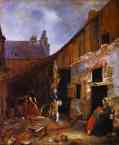
1650s. Oil on canvas. Gemäldegalerie, Berlin, Germany.
- "The Fatherly Admonition.".
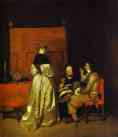
c.1654-55. Oil on canvas, 33 x 27 cm. Gemäldegalerie, Berlin, Germany.

