Pavel Tchistyakov Biography
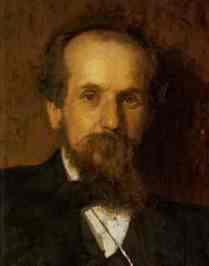
Pavel Petrovich Tchistyakov was born into the family of a serf, who served as a manager of an estate. When the baby was baptized the family's owner gave Pavel freedom for his father’s good work. At the age of 17 Pavel entered the Academy of Arts; in 1861 he got Major Gold Medal for his picture
Great Duchess Sophia Vitovna (1861) and in 1862 went abroad as a pensioner of the Academy.
On his return in 1870, Tchistyakov was awarded the title of Academician for 4 of his works (among them Roman Pauper 1867). The consequences of a serious disease he had had in Italy made it difficult for him to paint. Lots of his canvases remained unfinished. Only in 1876, he showed a new picture Boyar (1876). This portrait, fulfilled in Rembrandt’s style, was highly appraised by critics. As a pair to this picture was his last finished work- Portrait of Mother (1880).
In 1890-1912, he was head of the mosaic department in the Academy of Arts, he was responsible for the main mosaic projects in Russia: in the Cathedral of Christ the Savior in Moscow, St. Isaac's Cathedral and the Cathedral of the Resurrection in St. Petersburg.
Tchistyakov was immensely popular as a teacher. He began teaching very early, while still a student (fom 1850). “I think I was born with talent and love for teaching”, he wrote to P.A. Tretyakov. In 1872, he was invited to teach in the Academy. At the same time he organized classes in his studio, gave private lessons. During many years of teaching he created his own system of teaching drawing. Among his pupils are very different but bright and talented artists: Victor Vasnetsov, Mikhail Vrubel, Vasiliy Polenov, Ilya Repin, Andrey Ryabushkin, Valentin Serov, Vasiliy Surikov and others.
- Great Duchess Sophia Vitovna.
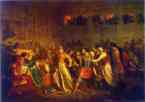
1861. Oil on canvas. The Russian Museum, St. Petersburg, Russia. Read Note.
- Boyar.
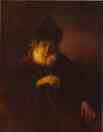
1876. Oil on canvas. The Tretyakov Gallery, Moscow, Russia.

