Alfred Sisley Biography
Alfred Sisley was born in Paris on 30th October 1839 into the family of a well-to-do English businessman
William Sisley (1799-1879), see his portrait by Renoir. Between 1857 and 1861 he lived in London, preparing for a career in commerce. In 1862, having decided to become a painter, he entered the Atelier Gleyre in Paris and there met Monet, Renoir and Bazille. The friends often worked together in the open air in the Forest of Fontainebleau, in the suburbs of Paris.
Sisley first sent his paintings to the Paris Salon in 1866 and subsequently exhibited there in 1868 and 1870. During Franco-Prussian War Sisley lost all his possessions when the Prussian army overran the family’s estate in Bougival, west of Paris. After the war his father was ruined, so the artist was left in desperate poverty for many years. Until 1880, he lived and worked in the countryside west of Paris, around Marly and Louveciennes, especially at Villeneuve-la-Garenne, Bougival and Port-Marly. The flood of 1876 at Port-Marly became the subject of a large series of his landscapes: Flood at Port-Marly (1876), Boat in the Flood at Port-Marly (1876), Flood at Port-Marly (1876). From 1880, onwards he painted almost exclusively landscapes depicting the banks of the Seine and the Loing at Saint-Mammès and Sablon and Moret-sur-Loing, the town where he lived from 1889 until his death. The Canal du Loing at St. Mammes (1885). Matrat's Boatyard, Moret-sur-Loing (1883), Moret-sur-Loing (1891), Courtyard of Farm at St. Mammes (1884).
Sisley did not live to see his talent recognized. He had contributed to the Impressionist exhibitions of 1874, 1876, 1877 and 1882, and also exhibited at the Durand-Ruel galleries in Paris and New York. Every year, starting from 1892, his paintings were on show at the Salon de la Société Nationale des Beaux-Arts; several of his works were displayed by Georges Petit at international exhibitions. All this, however, brought him neither fame nor financial security. The failure of his retrospective exhibition at Georges Petit’s in 1897, to which he had been looking forward and for which he had selected his best pictures, was an especially hard blow to the artist. Backed by one of his patrons, Francois Depeau, a Rouen manufacturer, Sisley left for the south of England. From May to October 1897 he stayed at Penarth, a seaside resort near Cardiff, and painted views of rocky seashores: Bristol Channel from Penarth, Evening. (1897). The same year he married Marie Louise Adélaïde Eugéne Lescouezec (1834-1898), who gave birth to his two children: son Pierre (1867) and daughter Jeanne (1869). On January 29, 1899 the artist died in his home in Moret.
Bibliography
Painters of Montmartre by Illana Soldea. Bucharest. 1986.
Painting of Europe. XIII-XX centuries. Encyclopedic Dictionary. Moscow. Iskusstvo. 1999.
Sisley by Richard Shone, Alfred Sisley. Phaidon Press Inc., 1999.
Alfred Sisley by Mary Anne Stevens (Editor). Yale Univ Pr, 1992.
- Flood At Port Marly.
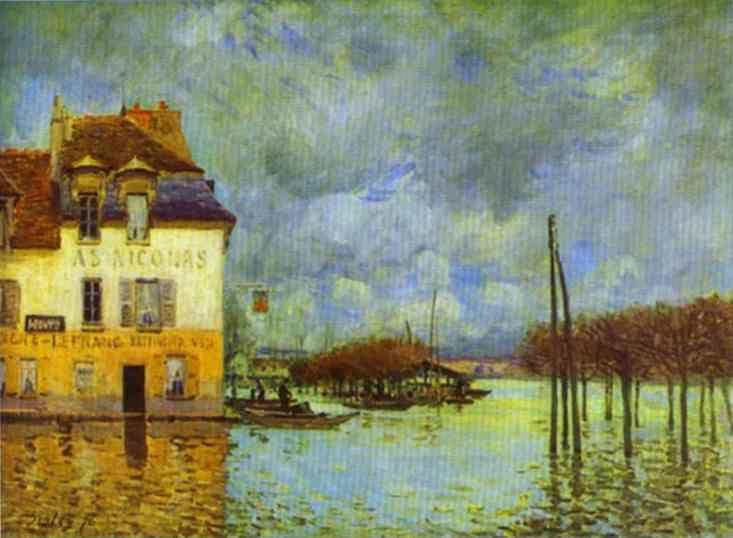
1876. Oil on canvas. Musée d'Orsay, Paris, France.
- Boat In The Flood At Port-Marly.
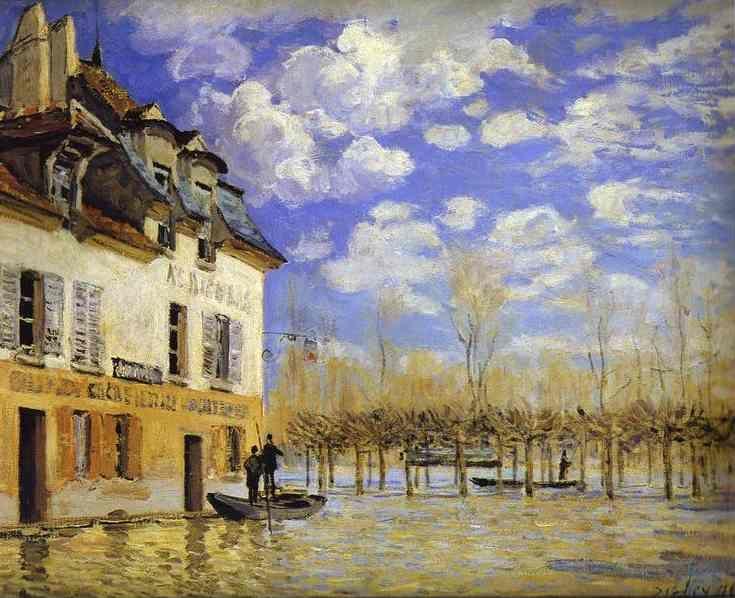
1876. Oil on canvas. Musée d'Orsay, Paris, France.
- Flood At Port-Marly.
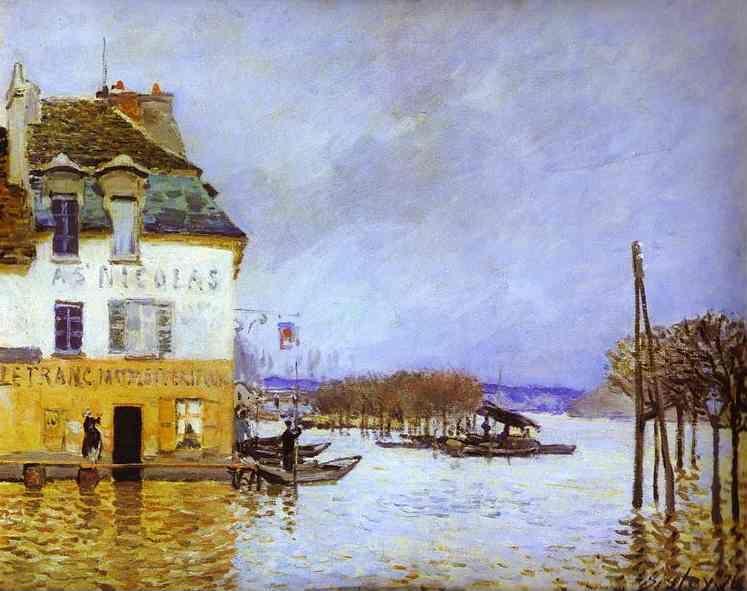
1876. Oil on canvas. Musée des Beaux-Arts, Rouen, France.

