Ivan Shishkin Biography
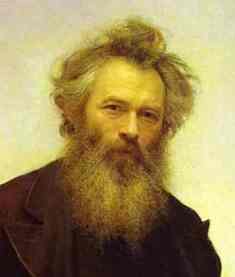
The works of this outstanding artist enjoy vast popularity in Russia; the best of them have become the classics of Russian landscape painting. During 40 years of his artistic activity Ivan Shishkin produced hundreds of paintings, thousands of studies and drawings and a large number of engravings. For contemporaries, Shishkin’s personality embodied Russian nature itself; they called him “forest tzar”, “old pine tree”, and “lonely oak”.
Ivan Ivanovich Shishkin was born into the family of a merchant. His father, a self-made and broad-minded man, after long hesitations, supported his son's desire to become an artist. In 1852-1856, Shishkin studied in the Moscow School of Painting and Sculpture, in 1856-1860, he continued his studies in St. Petersburg, in the Academy of Arts. He made rapid progress and got all the awards the Academy offered. Having received a Major Gold Medal for two pictures with the same name View of Valaam Island. Kukko. (1860) and an Academy grant for studies abroad, Shishkin spent 3 years (1862-1865) in Germany, Switzerland, Czech, France, Belgium and Holland. Gradually he got disappointed in his foreign teachers and European authorities in landscape painting. Now he felt free and independent and longed to return home, to Russia.
During his stay abroad Shishkin engaged in lithography and etching. His numerous pen drawings caught the eye of the Dusseldorf public and critics by their virtuoso hatching and filigree treatment of detail. In 1865, Shishkin painted his View near Dusseldorf for which he was awarded the title of Academician and which was shown at the 1867 World Fair in Paris.
In 1865, he returned to Russia and settled in St. Petersburg, where he joined the Itinerants’ Society of Traveling Exhibitions (Peredvizhniki). One of his first masterpieces Noon in the Neighbourhood of Moscow (1869) critics called “song of joy”. He always preferred to draw daytime scenes, full of sunlight and life. Pine Forest in Viatka Province (1872), Rye (1878), Path in a Forest (1880), Oaks (1887), Coniferous Forest. Sunny Day. (1895). His scrupulous reproduction of nature stood in sharp contrast to the academic canons of landscape painting. For his loving approach to detail some critics called his works colored pictures, which lack of life. But despite such attention to details Shishkin’s paintings do not fall apart, but give full and finished impression.
Shichkin had a troubled private life, twice he fell in love and married and twice his wives died. His sons also died. But never Shishkin allowed his sorrows appear on his canvases. His last work is Mast-Tree Grove (1898). He died in his studio at the easel with newly begun canvas.
Among the Russian landscape painters Shishkin was the staunchest and most consistent exponent of the materialistic aesthetics – to depict nature in all its pure, unadorned beauty. His role in Russian art did not lose its significance even in the years, which saw the appearance of splendid landscapes by Isaac Levitan, Valentin Serov and Constantin Korovin. Despite the fact that he espoused different aesthetic principles and advocated a different artistic system, Shishkin enjoyed an indisputable authority among young Russian painters of the late 19th century. The new generation did not fail to acknowledge him as a thoughtful and masterful portrayer of Russian nature.
Bibliography
Shishkin by I. Shuvalova. Russian Painters of the XIX century. Moscow. 1990.
- View Of Valaam Island. Kukko.
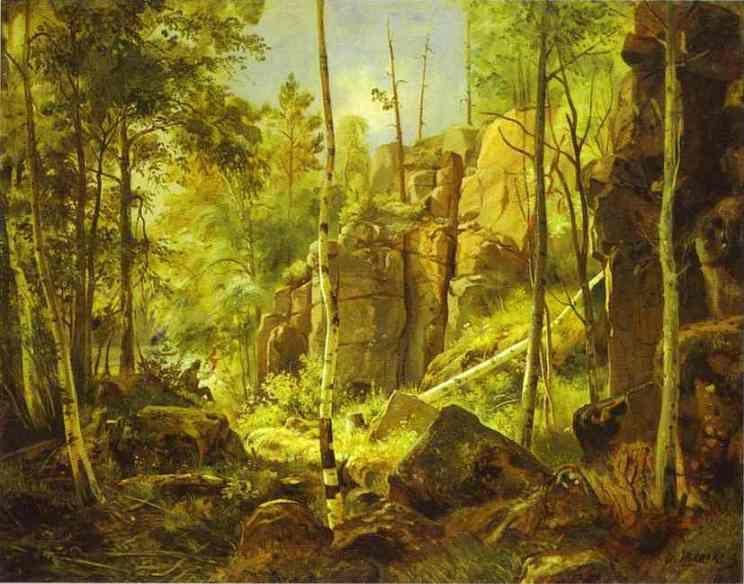
1859. Oil on canvas. The Russian Museum, St. Petersburg, Russia.
- View Near Dusseldorf.
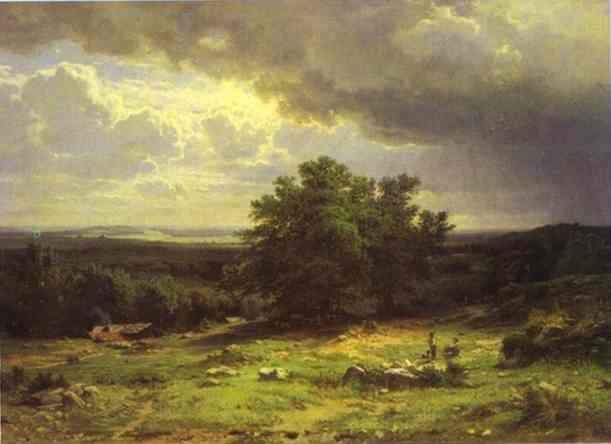
1865. Oil on canvas. The Russian Museum, St. Petersburg, Russia.
- Noon In The Neighbourhood Of Moscow.
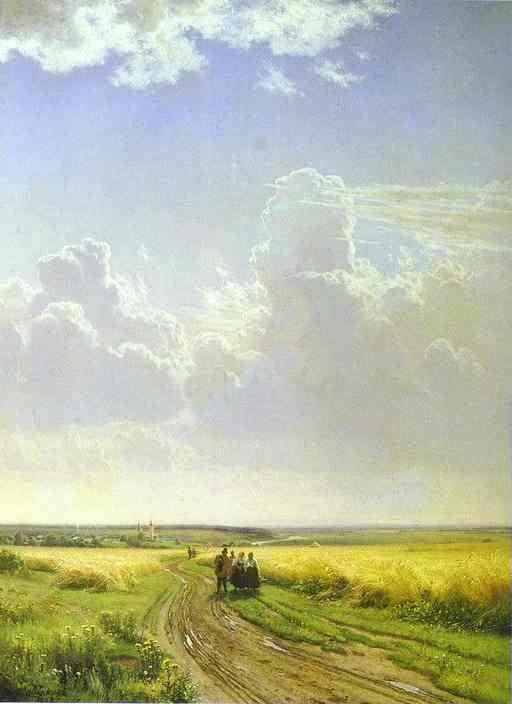
1869. Oil on canvas. The Tretyakov Gallery, Moscow, Russia.
- Pine Forest In Viatka Province.
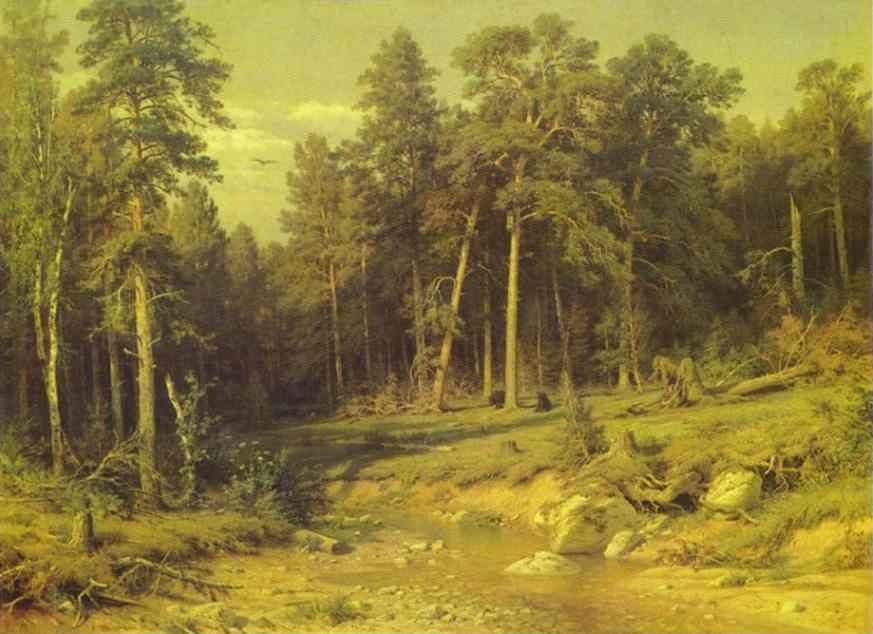
1872. Oil on canvas. The Tretyakov Gallery, Moscow, Russia.

