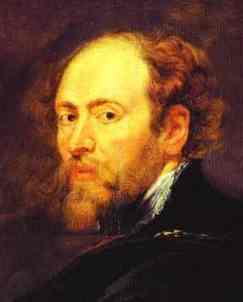
Peter Paul Rubens at Artprice. To look at auction records, find Rubens's works in upcoming auctions, check price levels and indexes for his works, read his biography and view his signature, access the Artprice database.
Peter
Paul Rubens was born into the family of a Calvinist who had to live in
exile from Antwerp. On his father's death, Ruben’s mother returned to Antwerp
in 1587, where he was brought up and educated in the Catholic faith. At
the age of fourteen (1591) he entered the household of a Flemish princess
as a page, and began to study painting first under Tobias Verhaecht, then
under Adam van Noort, and then under Otho Venius. In 1598, he was accepted
as master in the Lukas Guild, though continued to work in Venius’s
workshop until 1600.
In 1600, Rubens went to Italy. In Venice he was introduced to Duke Vincenzo
Gonzaga and accepted his offer to join his court in Mantua. Rubens accompanied
the duke on his travels to Florence and Rome; in Florence he happened to
be present at the marriage of Marie de' Medici to Henry IV, King of France.
Later his impressions would find reflection in the painting, devoted to
the episode. In 1603, the duke sent him on a diplomatic mission to Spain.
While in Italy, Rubens studied and copied Titian,
Tintoretto, and Raphael, he also
admired the works of his contemporaries, including Caravaggio
and Carracci. During his Italian period he also produced some of his finest
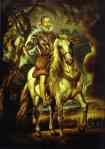
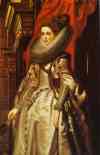
portraits at various princely Italian courts: The
Equestrian Portrait of the Duke of Lerma (1603), Portrait
of Marchesa Brigida Spinola Doria (c.1606). In 1608, he returned
to Antwerp as a known and successful painter.
In 1609, Rubens was appointed court painter to the Regent Albert and Isabella.
He married Isabella Brant. In 1610, he built himself a large house and
studio. During his Antwerp period, until 1622, he received a flood of commissions
from the church, state and nobility. The Gobelin factory produced tapestries
after his sketches, and engravers used his paintings, distributing the
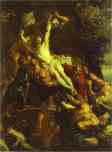
‘Rubens style’ all over Europe. Among his best works are The
Elevation of the Cross (the triptych). (1610-1611), The
Descent from the Cross (the triptych). (1611-1614), The
Union of Earth and Water (c.1618), Castor
and Pollux Abduct the Daughters of Leukyppos (c.1618), The
Battle of the Amazons (c.1618-1620), Perseus
and Andromeda (c.1620-1621).
His largest commission was in 1621 for a series of 21 paintings for Marie
de’Medici, the Queen Dowager of France, widow of Henry IV. The paintings,
describing Marie's life, were for her palace in Paris. It was not an easy
work. The queen was far from being a beauty, her life was not full of interesting
events, besides she was of bad temper: she had constantly quarreled with
her deceased husband, Henry IV, wasted enormous sums of money, and bothered
her son, Louis XIII, with constant advice so that at last he ordered her
out of Paris. Rubens’s diplomatic skills were much at hand in fulfilling
the order. He successfully managed it within three years to the great satisfaction
of the customer.
Between 1623 and 1631, Rubens traveled frequently on diplomatic missions,
visiting London and Madrid, where he received peerages from both Charles
I of England and Philip IV of Spain. Isabella Brant died in 1626; in 1630
Rubens married the 16-year-old Helene Fourment, who sat for many portraits
and other works: Bathsheba at the Fountain.
c.1635, The Fur Cloak (Helene Fourment).
(1636-1639), The Three Graces.
(c.1636-1638), Rubens, His Wife Helena Fourment,
and Their Son Peter Paul. (c.1639). After the death of Archduchess
Isabella he gradually withdrew from the court and bought castle Steen near
Mecheln.
His last big commission was the decoration of the Spanish King’s hunting
lodge, Torre de la Parada near Madrid, which he designed but was no longer
able to carry out himself.
Rubens is often called Prince of Baroque painters. In his style he successfully
united the features of Northern and Flemish art with those of Italy.
His influence on the painters of his century was enormous, as it was on
sculpture and architecture. He was a versatile genius and rivaled in inventive
power the great minds of the Italian Renaissance. He was a humanist and
classical archaeologist, a sumptuous designer of religious, historical
and allegorical canvases and a supreme master in ‘pure’ landscape. Rubens
was endlessly active. There are thousands of works by his hand, scattered
through collections and museums across the world. The paintings amount
to more than three thousand. He also gave the world the great number of
pupils, the celebrated artists van
Dyck, Jordaens, Snyders
and Cornelis de Vos are among them.
Notes
Decius Mus, member of a noble Roman
family and Council of Early Republic, sacrificed his life for the victory
of Rome. About 340 BC, Rome fought against southern Italian cities. Two
armies met near Naples. The Roman leaders were prophesied that the army
which lost its commander would be victorious. Rubens depicted the
moment when Decius Mus was explaining to his soldiers that he must allow
himself to be killed.
See: Peter Paul Rubens. Decius Mus Addressing
the Legions.
Rubens collected ancient coins and cameos. And this portrait, traditionally
called Tiberius and Agrippina, might
be the result of his studies.
Tiberius Claudius Nero (42 BC -37
AD) the second emperor of Rome, son of Tiberius Claudius Nero and Livia,
who three years after his birth became the wife of Octavian Augustus, the
first emperor of Rome. He was married to Vispania Agrippina, daughter
of the commander Marcus Vipsanius Agrippa. Many historians, however, consider
that the people on the portrait are Germanicus (15 BC - 9 AD), Tiberius's
nephew and adopted son, and Agrippina the Elder ( 14 BC - 33 AD), another
daughter of Marcus Vipsanius Agrippa, and the wife of Germanicus. They
were the parents of the future Roman emperor Caligula and grandparents
of emperor Nero.
See: Peter Paul Rubens. Tiberius and Agrippina.
Deborah Kip, Wife of Sir Balthasar Gerbier,
and Her Children. In 1629, Rubens spent several months in London as
the houseguest of Balthasar Gerbier, a Flemish-born art dealer and diplomatic
courier. Gerbier's Dutch-born wife, Deborah Kip, is depicted
here with four of their nine children.
See: Peter Paul Rubens. Deborah Kip, Wife
of Sir Balthasar Gerbier, and Her Children.
Maria de' Medici (1573-1642), Queen of
France, was born into the family of Francesco de'Medici, Grand Duke of
Tuscany. In 1600 she became the second wife of Henry IV (Henry of Navarre)
of France, after his assassination in 1610 she became regent for her son
Louis XIII. Because of constant intrigues she was exiled by her son in
1617, they reconciled in 1622, however when she again started plots against
king's minister, Cardinal Richelieu, Louis exiled her again. Her daughter
Henrietta
Maria married Charles I
of England.
See: Peter Paul Rubens. Portrait of Marie
de' Medici.
Life of Marie de'Medici
The Destiny of Marie de' Medici. The Three Fates spin
the thread of fate for the unborn child and are watched by the supreme
god Zeus (Jupiter) and his wife Hera (Juno).
Peter Paul Rubens. The Destiny of Marie
de' Medici.
The Birth of Marie de' Medici. Hera presents the glimmering
infant to the personification of Florence, where she was born.
Peter Paul Rubens. The Birth of Marie
de' Medici.
Marie's Education. Apollo, the patron god of arts,
and Hermes, the messenger of the Olympian Gods, lead her in music and eloquence,
Athena (Minevra), goddess of wisdom, teaches her to read, and the Tree
Graces offer her beauty.
Peter Paul Rubens. Marie's Education.
Henry IV Receives the Portrait. Hera, who patronizes
marriage, sends a portrait showing Marie's irresistible beauty to Henry
IV, King of France.
Peter Paul Rubens. Henry IV Receives
the Portrait.
The Marriage. The King, too busy to travel, marries Marie
by proxy in Florence.
Peter Paul Rubens. The Marriage.
The Landing at Marseilles. Escorted by spectacular sea
gods and goddesses, Marie is welcomed by the figure in a helmet, personification
of France, Fame, which blows pipes, announces her coming to the people.
Peter Paul Rubens. The Landing at Marseilles.
The Meeting at Lyons. Marie and Henry IV meet at Lyons.
The city is personified by the figure of a woman in a chariot drawn by
the lions. The city greets the newlyweds.
Peter Paul Rubens. The Meeting at Lyons.
The Birth of Louis XIII. The newborn Dauphin is held
by Health, the figure with an arm entwined by a serpent, while Fertility
presents the Queen with a basket of infants and flowers.
Peter Paul Rubens. The Birth of Louis
XIII.
Institution of the Regency. Leaving for the war against
Austria, Henry entrusts the Queen with the government (symbolized by an
orb marked with a fleur-de-lys) and with his son, the Dauphin.
Peter Paul Rubens. Institution of the
Regency.
Coronation of Marie de' Medici. To increase the authority
of the regency the King has the Queen crowned in her own right at St. Denis.
Peter Paul Rubens. Coronation of Marie
de' Medici.
Apotheosis of Henry IV. The King, assassinated by a madman,
is lifted to the heavens by the Olympian gods, while the bereaved Queen
accepts from France the orb, symbol of government.
Peter Paul Rubens. Apotheosis of Henry
IV.
The Council of the Gods. To illustrate the Queen's role
as the divinely appointed ruler of France, she is portrayed talking with
Zeus, while Apollo, armed with his bow, is chasing away her enemies.
Peter Paul Rubens. The Council of the
Gods.
The Capture of Juliers. After taking an Austrian held
town the Queen, at the head of her army, is crowned by Victory and
accompanied by Generosity.
Peter Paul Rubens. The Capture of Juliers.
The Exchange of Princesses. Surrounded by gods and goddesses,
Princess Anne of Austria (on the left) and princess Elizabeth of France
(on the right) are meeting before their marriages to the brothers of each
other, Princes of Spain (future Philip IV of Spain) and France (future
Louis XIII of France).
Peter Paul Rubens. The Exchange of Princesses.
The Happiness of the Regency. An allegory of the happy
benefits of the Regency.
Peter Paul Rubens. The Happiness of the
Regency.
The Majority of Louis XIII. Coming of age in 1614, the
Dauphin takes over the rudder of the Ship of State, which is rowed by Strength
and Faith, Justice and Prudence.
Peter Paul Rubens. The Majority of Louis
XIII.
The Flight from Blois. Marie's opposition to her son
has led to her confinement to Blois, from which she escaped by night. The
account of her triumphs does not omit her reverses, but her dignity remains
intact.
Peter Paul Rubens. The Flight from Blois.
The Treaty of Angoulême. Accepting an olive branch
from Hermes, the Queen agrees to discuss peace with her son.
Peter Paul Rubens. The Treaty of Angoulême.
The Piece of Angers. Hermes leads the Queen Mother to
the Temple of Concord, while Innocence bars the entry of Fury, Fraud, and
Envy under a still stormy sky.
Peter Paul Rubens. The Peace of Angers.
The Queen's Reconciliation with Her Son. While Justice
aims thunderbolts at the hydra-headed calumnies, the godlike Louis raises
his mother toward a break in the storm clouds and the prospect of peace
Peter Paul Rubens. The Queen's Reconciliation
with Her Son.
The Triumph of Truth. Time raises truth to take her place
at the meeting between mother and son.
Peter Paul Rubens. The Triumph of Truth.
Duke of Lerma, Francisco Gomez de Sandoval y Rojas (1553-1625), Spanish statesman of a noble family, he, while in the service of Philip II, won the confidence of the heir to the throne, who on becoming the king, Philip III, in 1598 entrusted him with the conduct of public affairs and in 1599 made him Duke of Lerma. He enjoyed considerable influence on Spanish and European policy. In 1618 Pope Paul V appointed him a cardinal.
Seneca, Lucius Annaeus, called ‘the Younger’
(c. 4 BC – 65 AD), Roman stoic philosopher and statesman, was born in Spain
to a noble Roman family. His father, Seneca ‘the Older’ was a philosopher.
He began his political career in Rome in 31. In 41, however, he was exiled
to Corsica by the Emperor Claudius for adultery with the emperor’s niece
Julia. In 49 Claudius, under the influence of his 3rd wife Agrippina the
Younger, sister of Julia, returned Seneca to Rome and appointed him the
tutor to his step-son, future Emperor Nero. For some period Seneca exercised
considerable influence on Nero, but later came out of favor, was accused
of treason and condemned to commit suicide, which he did. Seneca is the
author of a number of philosophical essays.
See: Peter Paul Rubens. The Death of
Seneca.
The Four Evangelists: 4 authors
of Gospels, Matthew, Mark,
Luke,
and John.
See: Peter Paul Rubens. The Four Evangelists.
The Four Philosophers. From
right to left: Jan Voverius, Justus Lipsius (1547-1606), Flemish
humanist, professor of classics at Jena, Leiden and Louvain; Rubens's brother
Philip and self-portrait of Rubens.
See: Peter Paul Rubens. The Four Philosophers.
Henry IV, known as Henry of Navarre (1553-1610)
king of France from 1589, the first of the Bourbon dynasty, headed the
French Protestants. He was spared during the St. Bartholomew Day Massacre
of Huguenots only because he was married to Margaret of Valois, sister
of Charles IX and Henri III. For three years he was a captive of the French
court, but then managed to escape and again headed the Protestants. As
a result of intrigues and wars, which he successfully won, he managed
to become the King of France. Though he adopted Catholicism, he issued
edits to protect the rights of Protestant minority. In 1600 he married
his second wife Marie de'Medici, by whom he had several children, Louis
XIII and Henrietta Maria among them.
See: Peter Paul Rubens. Henry IV at the
Battle of Ivry. The Triumph Entrance
of Henry IV into Paris.
Susanna Fourment was related by
marriage to Rubens' first wife,
Isabella Brant (see Isabella's portraits
by Rubens and van Dyck).
Later the widowed Rubens married Susanna's sister Helena Fourment.
See: Peter Paul Rubens. Portrait
of Susanne Fourment ("Le Chapeau de paille").
also her portrait by van
Dyck, who depicted widowed Susanna with her young daughter Clara.
Marchesa Brigida Spinola Doria (1584 -
?) Genoese aristocrat, a Spinola by birth, in 1605 married Giacomo Massimiliano
Doria. The portrait is painted in the year following her marriage.
See: Peter Paul Rubens. Portrait of Marchesa
Brigida Spinola Doria.
Democritus (460-370 BC), Greek philosopher,
born in Abdera in Thrace. He has works on ethics, physics, mathematics,
cosmology and music. He is best known for his atomic theory, which he developed
from Leucippus. According to the theory the world consists of infinite
number of minute particles; their different combinations explain the variety
of properties and qualities of the matter.
See: Peter Paul Rubens. Democritus.
Democritus
by Diego Velázquez
Mucius Scaevola Before Porsenna.
The subject of the picture is taken from the early history of ancient Rome.
In 509 BC the Etruscan King
Porsenna besieged Rome, which had driven
away their king Tarquinius and declared the Republic. Romans bravely defended
their city, but the forces were not equal. Then a young Roman, Mucius
Scaevola, decided to kill Porcenna. He entered the Etruscan camp and,
having mistaken another man for Porcenna, killed him. He was immediately
captured and put in front of Porcenna, who began to mock the young man.
Then Scaevola stepped toward a fire-camp and put his right hand into
it. Despite pain, without changing the face, he said to Porcenna in calm
voice
that 300 young Romans had given the oath to kill the king; he, Scaevola
was only the first, the others would be luckier. Porcenna was so much astonished
with the young man that the next day offered Rome the peaceful agreement.
See: Peter Paul Rubens and Anthony van Dyck. Mucius
Scaevola Before Porsenna.
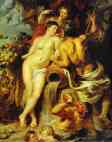
The Union of Earth and Water. The four
elements, Earth, Air, Fire, and Water, were considered to be fundamental
elements of the world contents, and were usually depicted as classical
gods and goddesses. Earth is personified by Demeter (Ceres); Water is personified
by a river god; Air is usually represented by Hera (Juno); Fire is represented
by Hephestus (Vulcan) or may be depicted as a woman with her head in flames.
See: Peter Paul Rubens. The Union of
Earth and Water.
Isabella Clara Eugenia (1566-1633), daughter
of King Philip II and his third
wife, Elizabeth Valois, married Archduke of Austria Albert VII (1598-1621).
Jointly they ruled the Spanish Netherlands. Their attempts, both diplomatic
and military, to reunite the country met with failure. After Albert's death
(1621), sovereignty of the Spanish Netherlands reverted to Spain, and Isabella
ruled as governor of the country for her nephew, King Philip IV of Spain,
until her death.
See: Peter Paul Rubens. The St. Ildefonso
Altar (right wing). Archduchess Isabella.
The Fall of the Rebel Angels. In Christian
belief, before the creation of man, one of archangels, Lucifer, backed
by some angels, rebelled against God and was driven by Him into Hell, where
they remain under the names of Satan and the devils (or demons, evil spirits)
enemies of God and active promoters of evil. In Medieval art Satan
and devils are often depicted as monsters, dragons, and beasts. Since th
early Renaissance the artists depict the devil as the classical Satyr with
horns and hoofs, which signifies that paganism was enemy of the Church.
Satan likes to disguise as a monk, or a lord, but betrays himself by a
hoof or claw. Satan constantly fights against God over souls of men. The
main business of devils is to seduce mankind.
See: Peter Paul Rubens. Fall of the
Rebel Angels.
Queen Tomyris before the Head of Cyrus.
The most detailed and earliest account of the story is given by Herodotus.
Cyrus, the greatest Persian king (c. 550 BC), sought to conquer the Messagetae
which was ruled by the widowed Queen Tomyris. First he tried to woo her,
but after she refused he captured and killed Tomyris's son. Then she vowed
to avenge. Another battle Tomyris's troops won, she found his body, cut
off the head and put it in a bowl of blood with the famous words 'Satia
te sanguine quem semper sitisti' (Sate thyself on the blood for which thou
hast always thirsted).
See: Andrea del Castagno. Queen
Tomyris.
Peter Paul Rubens. Queen Tomyris before
the Head of Cyrus.
Bibliography:
Painting of Western Europe. XVII century. by E. Rotenberg. Moscow.
Iskusstvo. 1989.
Painting of Europe. XIII-XX centuries. Encyclopedic Dictionary.
Moscow. Iskusstvo. 1999.
Rubens
(Art and Ideas) by Kristin Lohse Belkin. Phaidon Press Inc.,
1998.
The
Making of Rubens by Svetlana Alpers (Editor). Yale Univ Pr,
1996.
Rubens
and His Age/Rubens En Zijn Tijd by Nora De Poorter, Guido Jansen,
Jeroen Gitaij. University of Washington Press, 1991.
Rubens:
Garden of Love by Peter Paul Rubens, Federico Zeri (Editor),
Marco Dolcetta. NDE Canada Corp., 1999.
Rubens:
A Double Life by Marie-Anne Lescourret, Elfreda Powell (Translator).
Ivan R Dee, Inc., 1993.
Masters
of Art: Rubens by Charles Scribner. Harry N Abrams, 1989.
Peter
Paul Rubens: A Touch of Brilliance by Mikhail Piotrovksy, Natalya
Gritsay, Alexey Larionov, Vegelin Van Claer, Stephanie-Suzanne Durante,
James Cuno. Prestel, 2004.
Rubens:
A Portrait by Paul Oppenheimer. Cooper Square Publishers, 2002.