Notes
Bariatinsky, Ivan Ivanovich (1767-1830), prince, son of Ivan Sergeevich Bariatinsky, Russian diplomat, and princess Ekaterina Petrovna, nee Golstein-Bek, from the present royal dynasty of Denmark; diplomat, Privy Councillor.
Count Alexey Grigoryevich
Bobrinsky (1762-1813) was an illegitimate son of the Empress
Catherine II and her lover Count Grigory Orlov.
Immediately after his birth, the child was taken to the household of Catherine’s
valet, Vasily Shkurin. To conceal the process of the birth and to distract
everybody’s attention from the empress, Shkurin set his own house on fire.
When Peter III returned from
the fire, Catherine had enough will power to meet him face to face. Twenty
years later Catherine wrote to Bobrinsky, that being afraid for the lives
of her elder son (future Emperor
Pavel I) and her own, she had to conceal the birth of her second son
from everyone.
The first years of his life Bobrinsky spent in the house of Shkurin
under the name of prince Sitsky. In 1765, Catherine granted the child the
big estate of Bobriki, which gave him his name.
Bobrinsky was educated in Leipzig, then in a military school in St..
Petersburg; he lived much abroad and irritated Catherine with his dissolute
behavior, extravagance, unwillingness to study and constant scandals. At
last she ordered him back to Russia. In 1796, Bobrinsky married baroness
Anna Ungern-Sternberg. The marriage did him only good. He settled down
and got interested in agriculture.
Pavel I sympathized with Bobrinsky and called him ‘brother’. In 1796,
Pavel gave him the title of a count and made him general-major, but Bobrinsky
preferred the quiet life of a private citizen and resigned in 1798. Till
his death he was busy with his own estates and died in 1813 in Bobriki.
See also his portrait
by Christineck.
Dolgorukaya, Anna Alexandrovna (1733-1808), Princess, daughter of colonel, the vice-governor of Novgorod A. Bredikhin; second wife of Prince Nikolay Alekseevich Dolgoruky (1713-1790), had 5 children by him, son Alexander (1757-1842) and 4 daughters.
Maykov, Vasily Ivanovich (1728-1778), Russian poet, was the son of a nobleman. At the age of 19 he entered military service in 1747 and in 1761 resigned. Afterwards he settled in Moscow, where he joined literary circles and published his first verses. In 1766-1768, he was a Deputy Governor of Moscow, then moved to St. Petersburg, where he held high positions in the government. He continued publishing his works: poems, fables, odes, plays, which were very popular in society. His poem Elysey, or Annoyed Bacchus earned him fame.
Obreskov, Aleksey Mikhailovich (1720-1787), ambassador of Russia in Constantinople, married to Varbara Andreyevna (1744-1815).
The Orlov Brothers:
Ivan Grigoryevich Orlov (1733-1791) the elder
son of the Novgorod vice-governor Grigoriy Ivanovich Orlov and Lukeria
Ivanovna, nee Zinovyeva. After his father's death in 1746 he became the
head of the family; all Orlov brothers looked upon him and respected him
as father. He led a modest life and managed the Orlovs' estates. Even after
the palace revolution of 1762, when the Orlovs became counts, then princes,
and got enormous fortune, he refused any state career and continued to
live in Moscow and the Orlovs' estates.
Grigoriy Grigoryevich Orlov (1734-1783),
count after 1762, prince after 1763, favourite of Catherine II, the Great.
One of the organizers of the palace revolution of 1762; played an important
role in state affairs; had a son by Catherine II, Bobrinsky, was
married to Orlova, Ekaterina Nikolayevna (1758-1781), nee Zinovyeva,
daughter of N. I. Zinovyev and E. N. Senyavina; cousin and wife of count
G. G. Orlov; maid of honor to Catherine II, since 1777 lady-in-waiting,
she was given the order of Catherine, she died in 1781 in Switzerland.
Rimsky-Korsakov, Alexander Mikhailovich (1753-1840), son of the State Chancellor Mikhail Andreevich; he participated in the wars of Russia with Poland in the rank of lieutenant-colonel; with Turkey 1788-89, and with Sweden 1789-90. In 1793, he became general major; in 1798, general-lieutenant. From 1812 till 1830, he was the governor-general of Lithuania; 1830-40 - member of State Council. He had three sons Nikolay (?-1814), Vladimir (?- 1829), and Mikhail (? - 1882).
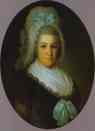
Struisky, Nikolay Eremeevich (1749-1796), poet, published his works in his own print-shop; admired Rokotov and collected many of his works; Rokotov trained Struisky's serf A. Zyablov; despite his 'poetic character' advocated serfdom, lived in his estate Ruzayevka. See also the portrait of his wife Struiskaya, Alexandra Petrovna (1754-1840).
Vyrubov, Peotr Ivanovich (1729-1801) member of the Board of Trustees of the Moscow Foundling Hospital.
Unknown Man in a Cocked Hat. Many historians consider this man to be Bobrinsky, Alexey Grigoryevich (1762-1813), count after 1796, bastard son of Catherine II and Grigory Orlov.
Bibliography:
Fedor Rokotov. by L. Markina. Moscow. Izobrazitelnoe Iskusstvo.
1986.
If you would like to read interesting facts about world-famous artists,
historical events or important historical individuals or
just simply want to know the latest additions to our online collection,
subscribe to our monthly newsletter.
|