Carel Fabritius Biography
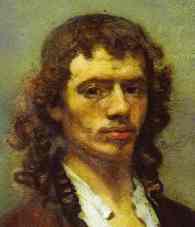
Carel Fabritius was Rembrandt’s most outstanding pupil: he was a brilliant experimental artist whose exceptional reputation rests on a handful of surviving paintings. Carel was born to the family of a village schoolmaster and amateur artist, who himself gave his son the first lessons in drawing and painting. Between 1641 and 1643 Carel worked in Rembrandt’s workshop in Amsterdam. His earliest known painting The Raising of Lazarus reveals his careful study of his master’s The Night Watch. Approximately to this period belongs the proto-romantic Self-portrait.
In 1650, Fabritius moved to Delft, where he entered the Lucas Guild two years later. His short life ended tragically: he died in the explosion of a municipal powder store, which devastated almost a quarter of Delft, and with him perished the greater part of his work. Those that survived, about a dozen, however, show his original gift and early artistic independence. In particular, he opened up new ways of handling space and perspective. He also differed from Rembrandt in the treatment of light background. Fabricius did not specialize, as so many others did, in any field, but covered the wide range of portraiture, genre pictures and still life. During the few years he worked in Delft he had a great influence on the local school of painters, especially on de Hooch and Vermeer. The latter was his pupil and continued to develop his particular conception of how light should be used.
Bibliography
Painting of Western Europe. XVII century. by E. Rotenberg. Moscow. Iskusstvo. 1989.
Painting of Europe. XIII-XX centuries. Encyclopedic Dictionary. Moscow. Iskusstvo. 1999.
- Self-Portrait.
c. 1645. Oil on wood. Museum Boymans-van Beuningen, Rotterdam, Netherlands.

