Nicolas Poussin Biography
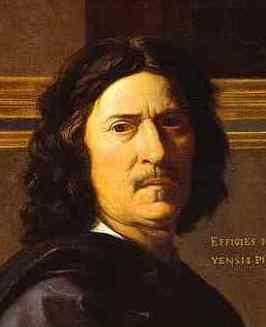
Nicolas Poussin, the greatest French artist of the 17th century, is considered one of the founders of European classicism, a movement in art, based on antique and Renaissance heritage.
Poussin was born in Normandy, in Les-Andelys, in 1594. The son of an impoverished family, Poussin received some early professional training at home. In 1612, Poussin left for Paris, where he entered the workshop of the mannerist painter J. Lallemald. The training was reinforced by independent study of, mainly, Italian art in the Royal Collections. By the end of the 1610s Poussin became an authoritative master, the evidence of this are his commissions for the decoration of the Luxembourg Palace in Paris, and the big altarpiece Assumption of the Virgin. Unfortunately from the works of the first Paris period (1612-23) only drawings based on Ovid’s Metamorphosis survived.
In 1623, the artist came to Italy, first to Venice, where he enriched his French training with the sensuous splendor of Venetian painting. And in 1624, he came to Rome, where he stayed all his life, except for his trip to Paris in 1640-42. Poussin’s new friends in Rome were mainly classical scholars, who played the main role in turning Poussin into a philosopher, erudite and intellectual. The 1620s in Italy were years of intensive learning for Poussin, and active creative work. Within four years he achieved a young painter’s highest aim, he was commissioned to paint an altarpiece for a chapel in St. Peter’s Cathedral Martyrdom of St. Erasmus (1628-29). At that period he acquired the dynamic style already dominant in Europe, the style that we now know as Baroque. It was at this time that he produced the most baroque of all his pictures, the altarpiece The Virgin of the Pillar Appearing to St. James the Greater, which was ordered for a church in the Spanish Netherlands. Eventually this work reached not the town of Valenciennes but the collection of Cardinal Richelieu and finally came to Louis XIII and to the Louvre. Poussin was evidently frustrated and disappointed by his lack of success in the intensely competitive field of baroque altarpiece painting. He never attempted this style again.
After a short crisis he chose the more restrained and intellectual direction of development, which appealed to the learned tastes of his Roman friends. In 1629, Poussin married his landlord’s daughter. The first Roman period (1624-30) on the whole is characterized by mythological themes, with sweet love, poetical inspiration, carefree happiness in harmony with nature.
In the next decade history became the main subject of Poussin’s work. The artist is attracted by situations, in which the moral qualities of people reveal themselves. In pictures of the 1630s the compositions are complex and compound with many characters, they remind of the classical tragedy on stage. Poussin used a special box and wax figures: first he built his compositions, then started to draw preliminary sketches, and only then painted. The best-known works of the period are – The Rescue of Pyrrhus (1634), The Noble Deed of Scipio (1640). Very popular in his time were the so-called bacchanal series, commissioned by Cardinal Richelieu. One of them, which survived, is Triumph of Neptune and Amphitrite (1634). Those paintings were supposed to decorate the cardinal’s palace, and this fact indicates that the interest to Poussin in France grew. In the second half of the 1630s the young artists in Paris chose to follow Poussin’s style in historical genre. The King’s officials wanted to return the artist to France. Poussin did not hurry back. He came to France only in 1840, after they had passed him the King’s threat. In Paris Poussin was immediately appointed the person in charge of all art works in the King’s palaces. This caused violent jealousy on the part of other court artists; Vouet headed the opposition.
For about two years Poussin painted altarpieces, canvases for Richelieu and supervised the decorative works in the Big Gallery in Louvre. Surrounded by hatred and jealousy, Poussin did not finish the work and fled to Rome. His artistic and moral ideals stood in conflict with those of the monarch.
In the late Roman period (1642-65) Poussin continued to work mainly in historical genre. The most important work of that period is the series Seasons (1660-64).
Poussin’s work influenced the further development of European painting. His authoritative interpretations of ancient history and Greek and Roman mythology left their mark on European art down to the 19th century.
Bibliography
Poussin by Yu. Zolotov. Moscow. 1988.
Painting of Western Europe. XVII century. by E. Rotenberg. Moscow. Iskusstvo. 1989.
Painting of Europe. XIII-XX centuries. Encyclopedic Dictionary. Moscow. Iskusstvo. 1999.
Poussin and France: Painting, Humanism, and the Politics of Style by Todd P. Olson. Yale Univ Pr, 2002.
Poussin by Fedrico Zeri. NDE Publishing, 2001.
A Dance to the Music of Time by Richard Beresford, Nicolas Poussin. Wallace Collection, 1995.
Nicolas Poussin by Elizabeth Cropper, Charles Dempsey. Princeton University Press, 2000.
Nicholas Poussin Paints the Seven Sacraments Twice by Tony Green. Paravail, 2000.
The Seven Sacraments of Nicolas Poussin by Neil Bartlett. Artangel, 1998.
Poussin and France: Painting, Humanism, and the Politics of Style by Todd Olson. Yale University Press, 2002.
Ideal Landscapes: Carracci, Poussin and Lorain by Margaretha Lagerlof. Yale University Press, 1990.
Commemorating Poussin: Reception and Interpretation of the Artist by Katie Scott, Genevieve Warwick. Cambridge University Press, 1999.
- The Martyrdom Of St. Erasmus.
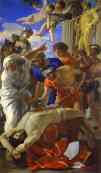
1628. Oil on canvas. Musei Vaticani, Vatican. Read Note.
- The Virgin Of The Pillar Appearing To St. James The Greater.
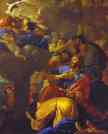
1628-1630. Oil on canvas. Louvre, Paris, France. Read Note.
- The Rescue Of Pyrrhus.
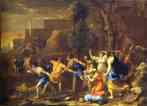
1634. Oil on canvas. Louvre, Paris, France.
- The Noble Deed Of Scipio.
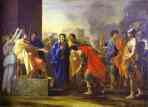
1640. Oil on canvas. The Pushkin Museum of Fine Art, Moscow, Russia. Read Note.
- Triumph Of Neptune And Amphitrite.
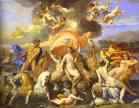
1634. Oil on canvas. Philadelphia Museum of Art. Philadelphia, PA, USA. Read Note.

