Vasiliy Polenov Biography
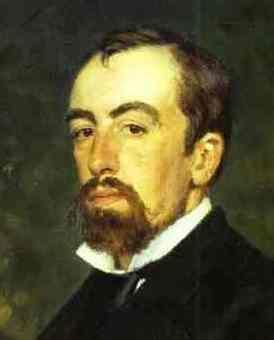
Vasiliy Dmitrievich Polenov was born into a noble and intelligent family; his father was a high-ranking military officer and archeologist. His mother was fond of fine arts and was an amateur painter. Their son inherited the talents of both parents – love for science and for art.
He studied simultaneously in the St. Petersburg University and in the Academy of Arts. In 1871, he got a diploma of a lawyer and a Major Gold Medal in the Academy for his picture Raising of Jairus' Daughter (1871). It took him several years to decide to go in favor of painting. As a pensioner of the Academy he traveled to Germany, Italy, France, painted historical and genre pictures and portraits. But most attractive for him was landscape painting on plein air. He studied the works of French landscape painters, especially those by the Barbizon school.
In 1876 he returned to Russia. In 1878, at the exhibition of the Itinerants’ Society of Traveling Exhibitions he displayed his Moscow Backyard (1878). In this serene picture he managed to unite spontaneity and frankness of plein air perception with Russian landscape tradition and intimate lyricism. His next works Granny's Orchard (1878), Pond (1879), and studies of 1881-82, which he made during his trip to Greece and the Middle East, established his fame as one of the best Russian landscape painters. He was the first to introduce the principles of ‘European influence’ in Russia, these were the basics of plein air painting: clean and bright colors, colored shadows, free strokes. In 1882-84, Polenov taught in the Moscow School of Painting. Among his students were Isaac Levitan, Constantin Korovin, A. Arkhipov and others.
The artist also created a series of canvases devoted to Jesus Christ. He visited Palestine twice, studied the landscape, architecture, people of the land. During 1888-1909 he created dozens of works devoted to Christ: Christ and Woman Taken in Adultery (1886-1887), On the Genisaret (Tiberias) Lake (1886). His manner of depicting Christ was new, and his compositions, though academic, were rather realistic.
Polenov worked much for theater, he was one of the reformers of theater decorative art. In Moscow he built a House of Theatral Education in 1915. In his estate of Borok, where he created many of his landscapes, he collected objects of art to open a museum. Now it is a Museum of Polenov.
Bibliography
Polenov by T. Yurova. Moscow. Iskusstvo. 1972.
- Raising Of Jairus' Daughter.
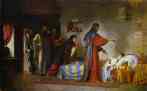
1871. Oil on canvas. The Museum of the Academy of Arts, St. Petersburg, Russia. Read Note.
- Moscow Backyard.
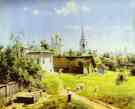
1878. Oil on canvas. The Tretyakov Gallery, Moscow, Russia.

