Maximilien Luce Biography
A painter, lithographer and draftsman, Maximilien Luce was born into a poor family in Paris on March 13, 1858. After an initial training as a wood carver at the Ecole des Arts décoratifs, he began to study engraving in 1872 and took evening courses to deepen his knowledge. In 1876 he entered the shop of the engraver Eugène Froment (1844-1900), with whom he traveled to London in 1877. After his return to Paris in 1879 Luce began his 4-year military service. During his service and later, up to 1885, he studied at the Académie Suisse and the studio of Carolus-Duran (1837-1917) at the Ecole des Beaux-Arts. In his painting, he became influenced by Impressionism. In the 1880s he met and established friendly contacts with many Parisian painters, including Camille Pissarro (1830-1903), Georges Seurat (1859-1891) and Paul Signac (1863-1935). Together with them he was one of the founders of Neo-Impressionism (Pointillism). Through Camille Pissarro Luce came under the influence of Anarchist ideas and formed friendships with the Anarchist writers and journalists Jules Christophe, Jean Grave, Georges Darien and Emile Pouget. In 1894 he became involved in the Trial of the Thirty and served a short term of imprisonment.
Until 1904 Luce lived in Montmartre, the streets of which he liked to paint. During 1904-1924, he lived in Auteuil, then moved back to Paris. Besides street scenes, factories and wharfs, he painted numerous landscapes on his travels through the Etampes, Normandy and Brittany. During the First World War he also painted war scenes, wounded and homecoming soldiers. In 1934, Maximilien Luce was elected President of the Société des Artistes Indépendants after Signac’s retirement, but soon resigned in a protest against society's policy to restrict the admission of Jewish artists.
Maximilien Luce died in Paris in 1941. He remains an important artist in Pointillism and social realism.
Bibliography
Henri Perruchot. La vie de Seurat. Hachette. 1966
Impressionist Art. 1860-1920. Edited by Ingo F. Walther. Benedikt Taschen Verlag GmbH. 1997
Painting of Europe. XIII-XX centuries. Encyclopedic Dictionary. Iskusstvo. 1999.
Neo-Impressionist Painters: A Sourcebook on Georges Seurat, Camille Pissarro, Paul Signac, Theo Van Rysselberghe, Henri Edmond Cross, Charles Angrand by Russell T. Clement, Annick Houze. Greenwood Publishing Group, 1999.
- Paris Seen From Montmartre.
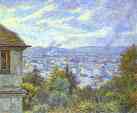
1887. Oil on canvas. 54 x 63 cm. Musée du Petit Palais, Paris, France.
- The Seine At Herblay.
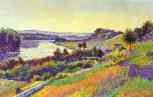
1890. 50.5 x 79.5 cm. Musée d'Orsay, Paris, France.

