Bartolomé Esteban Murillo Biography
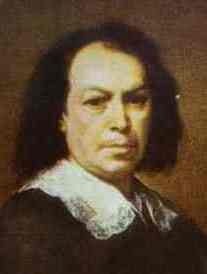
Bartolomé Esteban Murillo was the youngest of fourteen children of a Sevillian barber, Gaspar Esteban, and his wife Maria Peres. In 1627, his father died, a year later he lost his mother. Murillo’s elder sisters and brothers were already grown up and could take care of themselves, while the 10 year old Bartolomé was adopted into the family of his aunt, married to a wealthy Sevillian doctor.
Murillo was apprenticed early to a painter Juan del Castillo (1584-1640). When, in 1639, Castillo left Seville for Cadiz, Murillo did not enter any workshop of a known artist, as it was the traditional way of all the beginners, but preferred to stay independent. It is said that to gain a living Murillo started to make sargas - cheap paintings on rough canvas sold at country fairs, and shipped to America by traders. Obviously his paintings appealed to the taste of the public, besides they revealed a certain talent of the young man. That was why the Franciscan monastery in Seville commissioned this unknown artist with a cycle of 11 paintings with scenes from the lives of Franciscan saints, which, after their execution, brought Murillo fame. The artist dated his works very seldom. The first dated canvas belongs to the cycle for the Franciscan Monastery: one of the paintings is dated 1646, thus the whole series is usually dated 1645-46. But some art historians consider that the work took a longer period, of approximately 1642-1646. The canvases of the cycle are executed in different styles; thus some art historians consider that Cuisine of Angels (Miracle of St. Diego de Alcada) was inspired by Rivera; Death of St. Clara was influenced by van Dyck; and Velazquez had an effect on St. Diego Giving Charity. Even if it is really so, no wonder, the young artist was studying, during this long work his own style of soft forms and warm colors was being formed.
At some point in his life, probably in the late 1640s, Murillo is believed to have visited Madrid. In any case, after 1650 his style changed, which might be the result of his meeting with Velazquez and studying of the works of Titian, Rubens, and Van Dyck in the royal collections in Madrid.
On February 26, 1645 Murillo married Beatrice Sotomajor-i-Cabrera; soon their first daughter, named Maria, was born (died 1650). In 1647-1654 the artist painted a lot of ‘Madonnas’, small in size, the canvases were aimed for home altars: Madonna of the Rosary, Madonna and Child.
Already in his early religious paintings for the Franciscans Murillo widely used the genre scenes, which soon became a separate subject in his works: The Beggar Boy(1650), Grape and Melon Eaters. (c.1650), The Little Fruit Seller. (c.1670-1675) etc. Today considered somewhat sentimental, his genre scenes nevertheless represent a new way of perception. Murillo’s ‘children’, as well as his ‘Madonnas’, very soon became popular not only in Spain. Thanks to them he was the first Spanish painter to achieve widespread European fame. To the 1650s, also belong many of his portraits. Unfortunately, we do not know anything about the depicted people, even when they are identified, and we know their names.
With fame and multiple commissions the financial position of the artist became secured. It is known that in 1657 Murillo invested big money in a trade company in the New World, he bought slaves for his household. In 1662, he was admitted to several religious organizations of Seville. These organizations reminded in their structure and activities the later mason loges. Murillo also took an active part in the social life of his city. Thus he was one of the founders of the Academy of Fine Arts in Seville, which was opened in 1660, with Murillo as its first president.
In January 1664, Murillo buried his wife. Though 20 years of his life were still ahead, and during these 20 years he would painted 2/3 of all his known works, Murillo would never fully recover from this blow. During 1664, he could not work, at the end of the year he moved with all his surviving children (Jose Esteban, aged 14, Francisca Maria, aged 9, Gabriel, aged 8, Gaspar Esteban, aged 2, and infant Maria) into the Convent of Capuchins.
From 1665 to 1682, he painted many of his major religious works, such as those for the Santa Maria la Blanca (1665), of the Caridad Hospital (1670-74), of the Capuchins (1676), of the Venerables Sacerdotes (1678), of the Augustinians (1680), and, lastly, of the Cadiz Capuchins, together with a large number of pictures made at different times for the Cathedral of Seville or other churches and many devotional works for private individuals.
A legend says that the artist died in poverty. It does contradict with the fact of many commissions he had, more close to the truth is the version that he gave off his money as charitable contributions to the religious organizations of which he was the member. The story about Murillo’s death sounds like a legend. Murrilo accepted commission from the Capuchin church in Cadiz. For the first time in his life he went to decorate another city. While working on the Marriage of St. Catherine (1682) Murillo fell from the scaffold, in critical condition he was brought to his native Seville, where he soon died, on April 13, 1682.
After his death he left very modest private property, but many pupils and innumerable followers. His works influenced later Spanish painting and anticipated 18th-century European Rococo painting.
Bibliography
Paintings of Murillo in the Hermitage. Leningrad. 1969.
Spanish Painting in the Hermitahe. XVI-XVII centuries. Leningrad. 1970.
Murillo and His Time. by Ye. Vaganova. Moscow. 1988.
Painting of Europe. XIII-XX centuries. Encyclopedic Dictionary. Moscow. Iskusstvo. 1999.
Bartolome Esteban Murillo 1617 to 1682: Paintings from American Collections by Suzanne L. Stratton-Pruitt. Harry N Abrams, 2002.
Murillo: Scenes of Childhood by Peter Cherry. Merrell Holberton, 2001.
- La Cuisine Des Anges.
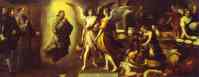
1646. Oil on canvas. Louvre, Paris, France. Read Note.
- Madonna Of The Rosary.
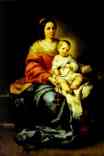
Oil on canvas. Palazzo Pitti, Galleria Palatina, Florence, Italy.
- Madonna And Child.
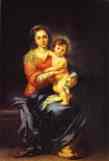
Oil on canvas. Palazzo Pitti, Galleria Palatina, Florence, Italy.
- The Beggar Boy.
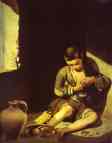
c.1650. Oil on canvas. Louvre, Paris, France.
- Grape And Melon Eaters.
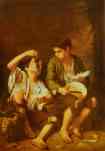
c.1650. Oil on canvas. Alte Pinakothek, Munich, Germany..
- The Little Fruit Seller.
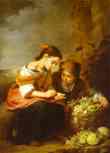
c.1670-1675. Oil on canvas. Alte Pinakothek, Munich, Germany.

