Sir John Everett Millais Biography
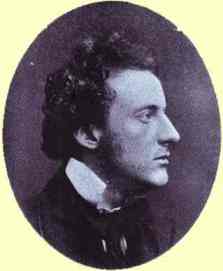
Sir John Everett Millais is an English painter, born in Southampton. He started to draw at the age of 4 years; and his parents supported his artistic inclinations, providing him with private art lessons with a Mr. Bessel. Encouraged by Mr. Bessel, the family came to London with an introduction to the President of the Royal Academy and in 1840 John Millais became the youngest student ever at the Academy. In 1846, he exhibited his
Pizarro Seizing the Inca of Peru at the RA.
Along with Dante Gabriel Rossetti and William Holman Hunt he was a founder of the Pre-Raphaelite Brotherhood, and was markedly influenced by them and by John Ruskin. His first Pre-Raphaelite picture Lorenzo and Isabella (1849), the banquet scene from the poem Isabella, or The Pot of Basil about ill-fated love by English poet Keats, figures in the Academy in 1849, where it was followed in 1850 by Christ in the House of His Parents (1849), Ferdinand Lured by Ariel (1849) which met the full force of the anti-Pre-Raphaelite reaction.
In 1851, The Woodman's Daughter (1851), Mariana (1851) and The Return of the Dove to the Ark (1851) are exhibited at the RA, but were poorly received. Four years later in Paris the same The Return of the Dove to the Ark and The Order of Release made a strong impression. Millais executed a few etchings, and his illustrations in Good Words, Once a Week, The Cornhill, etc. (1857-64) place him in the very first rank of woodcut designers.
In 1855, he married Euphemia (Effie) Charmers Ruskin, the divorcée of John Ruskin, who bore him 8 children; they appeared later on many of his pictures. Ruskin continued to praise the artist.
Preoccupied with his social standing, Millais later abandoned the Pre-Raphaelite style, broke with John Ruskin, and began to cater to popular tastes. The exquisite Gambler’s Wife (1869) and The Boyhood of Raleigh (1870) mark the transition of his art into its final phase, displaying brilliant and effective coloring and his effortless power of brushwork. The interest and value of his later works, largely portraits, lies mainly in their splendid technical qualities. A late painting Bubbles (1886), showing his grandson, William James, achieved huge popularity.
Eventually he was made a baronet (1885) and became president of the Royal Academy (1896), was decorated with many foreign orders and awards. He died in 1896. Millais was buried in St. Paul’s Cathedral. Ruskin, John (1819-1900) English author and art critic. His works Modern Painters (1843), which hotly supported Turner’s art, The Seven Lamps of Architecture (1848), The Stones of Venice (1851-53) made him critic of the day, later he became the most influential art critic of the Victorian era. Supported artists of the Pre-Raphaelite Brotherhood. From 1867, held the post of Rede Lecturer in Cambridge, and from 1869-1884 a professorship of fine arts in Oxford. Founded a museum and a drawing school in Oxford, and in Meersbrook a night school for craftsmen. Towards the end of his life Ruskin increasingly suffered from a severe nervous illness. His watercolors and drawings were exhibited from 1873 to 1884 at the Old Water-Color Society. See his Cascade de la Folie, Chamonix (1849), grandly atmospheric view of an Alpine chain, its expansiveness recalls early Turner.
See: Sir John Everett Millais. John Ruskin.
Bibliography
Victorian Painting. by Christopher Wood. Bulfinch Press. 1999.
The Life and Letters of Sir John Everett Millais, President of the Royal Academy by John Guille Millais. AMS Press.
John Everett Millais: A Biography by Gordon H. Fleming. Constable & Co Ltd, 1999.
Sir John Everett Millais by Russell Ash, John Everett Millais. Pavilion, 1998.
Millais by Peter Funnell, Malcolm Warner, Kate Flint. Princeton University Press, 1999.
Time Present And Time Past: The Art Of John Everett Millais by Paul Barlow. Ashgate Publishing, 2005.
John Everett Millais: Beyond the Pre-Raphaelite Brotherhood by Debra N. Mancoff. Paul Mellon Center, 2001.
John Everett Millais: Illustrator And Narrator by Paul Goldman, Tessa Sidey. Lund Humphries Publishers, 2004.
- Lorenzo And Isabella.
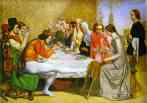
1849. Oil on canvas. The Walker Art Gallery, Liverpool, UK. Read Note.
- Christ In The House Of His Parents.
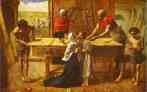
1849. Oil on canvas. Tate Gallery, London, UK.
- Ferdinand Lured By Ariel.
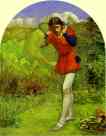
1849. Oil on canvas. The Makins collection, UK. Read Note.
- The Woodman's Daughter.
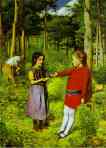
1851. Oil on canvas. The Guildhall Art Gallery, UK. Read Note.

