Anton Raphael Mengs Biography
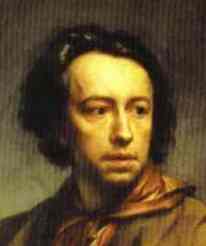
Anton Raphael Mengs was born in 1728 in Aussig, Bohemia, into an artistic family of German origin. Soon after his birth his parents returned to Saxony. Anton received his earliest training from his father in Dresden and in Rome, where he studied Italian Renaissance painters and worked in the studio of Marco Benefial. When he came back to Dresden in 1745, he became a painter to the Saxon court of Elector Augustus III, who was at the same time the King of Poland. Mengs executed for the court a large number of portraits.
In the early 1750s, Mengs again left for Rome. About 1755, he became a close friend of the German archaeologist and art critic J. J. Winckelmann, the author of the famous A History of Ancient Art (1764). Mengs came to share Winckelmann's enthusiasm for classical antiquity, and worked to establish the dominance of Neoclassical painting. At the same time the influence of the Roman Baroque remained strong, particularly in his religious paintings.
In Italy Mengs was commissioned to paint a series of portraits for Augustus III’s son-in-law, Charles VII, King of Naples. In October 1759, Charles VII inherited the Spanish Crown as Charles III and, as his court painter, Mengs spent several years (1761-1769) in Madrid, painting decorations in the Royal Palace and portraying the important persons belonging to the court.
From 1769 to 1772, Mengs worked in Rome, decorating the Camera dei Papiri in the Vatican, and he returned to Spain from 1773 to 1777.
Mengs was widely regarded in his day as Europe's greatest living painter. Although he died at the early age of fifty (1779) he had a profound influence not only on his native contemporaries but also on Roman, French and Spanish artists. Mengs's treatise Reflections on Beauty and Taste in Painting (1762) was also influential in his day.
Artist died in Rome in 1779.
Bibliography
German and Austrian Paintings. XV-XVIII centuries. by N. Nikulin. Leningrad. 1989.
Painting of Europe. XIII-XX centuries. Encyclopedic Dictionary. Moscow. Iskusstvo. 1999.
- Portrait Of Johann Joahim Winkelmann.
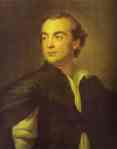
Oil on wood. 67 x 53 cm. The Hermitage, St. Petersburg, Russia. Read Note.
- Charles Iii.
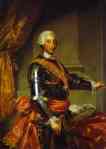
1761. Oil on canvas. 154 x 110 cm. Museo del Prado, Madrid, Spain. Read Note.

