The Brancacci Chapel - Paintings Galleryin Santa Maria del Carmine in Florence, Italy.
|
|
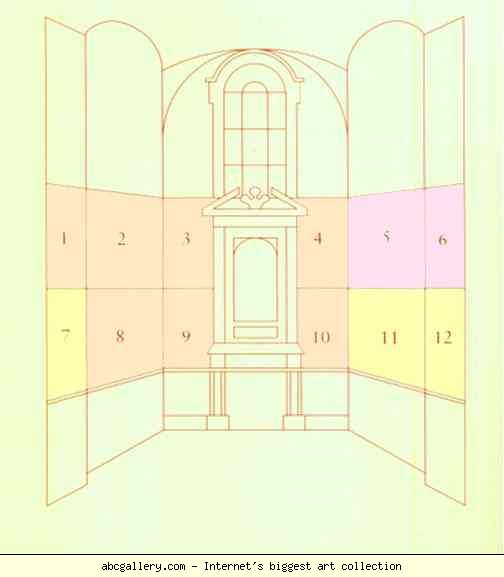
Scenes from the Life of St. Peter, c.1424-28, completed c. 1481-85
- Masaccio Expulsion from Paradise.
- Masaccio Rendering of the Tribute Money.
- Masaccio St. Peter Preaching in Jerusalem.
- Masaccio St. Peter Baptizing the Neophytes.
- Masolino Healing of the Cripple and the Raising of Tabitha.
- Masolino The Temptation of Adam.
- Filippino Lippi St. Paul Visiting St. Peter in Prison.
- Masaccio and Filippino Lippi Raising of the Son of Theophilus.
- Masaccio St. Peter Healing with His Shadow.
- Masaccio Distribution of the Goods of the Community and the Death of Ananias.
- Filippino Lippi St. Peter in Dispute with the Magician Simon and the Crucifixion of St. Peter.
- Filippino Lippi The Liberation of St. Peter from Prison.
The frescoes of the Brancacci Chapel in Santa Maria del Carmine
in Florence are considered to be the incunabula of Renaissance painting
and, thanks to their innovative power, served as a source of inspiration
to artists for over a century.
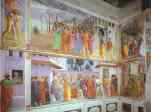 General view of the left wall.
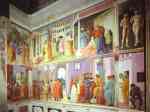 General view of the right wall.
Masolino and Masaccio were commissioned the frescoes in the Brancacci Chapel by the rich silk merchant Felice Brancacci, who was evidently interested not only in commerce, but in politics as well. Brancacci soon fell out of favor with the powerful Medici family, and was exiled by them in 1436. This explains the late completion of the chapel, which was probably undertaken after the rehabilitation of Felices heirs.

