Edouard
Manet at Artprice. To look at auction records, find Manet's
works in upcoming auctions, check price levels and indexes for his
works,
read his biography and view his signature, access the Artprice database.
|
|
Notes
Meurent, Victorine Louise (1844-1885)
was
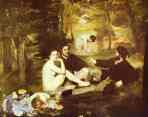
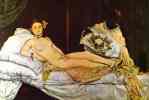
Manet’s favorite model in the 1860s, posing for such important works as
The
Picnic and Olympia.
She went to America in mysterious circumstances in the 1860s and then
returned
to France, serving again as Manet’s model in the early 1870s, e.g. in The
Railway. She became a painter herself, exhibiting a
self-portrait
at the 1876 Salon when Manet’s submission was rejected, and in the 1879
Salon her entry was in the same room as Manet’s. (The Street
Singer).
She probably died an alcoholic, in poverty.
See: Edouard Manet. Mlle Victorine
Meurent in the Costume of an Espada. Portrait of Victorine Meurent. The Picnic ("Le Déjeuner sur l'Herbe"). Olympia.
The Railway.
Lola de Valence, the scene name of Lola
Melea,
the première danseuse of the dance company of Camprubi. They
performed
at the Porte Dauphine during summer of 1862. Manet persuaded Camprubi
to
bring his dancers to the studio of his friend the Belgian painter
Alfred
Stevens during their leisure hours, and they posed for him there.
See: Edouard Manet. Lola de Valence.
The Battle of the Kearsarge and the
Alabama.
In 1864, the American Confederate cruiser Alabama took refuge in
Cherbourg
harbor to avoid the Union corvette, the Kearsarge. The captain of the
Alabama,
Captain Sammes, eventually determined to run the blockade and on 19
June
1864 the battle took place. Crowds had gathered in Cherbourg to watch
the
confrontation, and a number of boats stationed themselves near the
combatants
to see the fight at close quarters.
See: Edouard Manet. The Battle of the
Kearsarge and the Alabama.
The Execution of the Emperor
Maximilian
of Mexico. In April 1864, Napoleon III persuaded the Hapsburg
Archduke
Maximilian to accept the Mexican throne. Less then three years later,
in
February 1867, Napoleon III withdrew all French troops from Mexico,
leaving
Maximilian totally defenseless. Benito Juárez’ guerillas
captured
Maximilian and his generals Miguel Miramon and Tomás
Mejía
and executed them on 19 June 1867. It is this date that Manet signed on
his canvas.
Probably in late September 1867 Manet began to work on a second variant
of the theme of the execution, of which four fragments now survive in
the
National Gallery, London. Manet was not able to exhibit the painting in
France, where it was regarded as politically incorrect, and it was
first
shown in New York in 1879.
See: Edouard Manet. The Execution
of the Emperor Maximilian of Mexico. The
Execution of Emperor Maximilian (four fragments).
Zola, Emile (1840-1902) French writer and
art critic; schoolfriend of Cézanne.
Manet was introduced to Zola in February 1866. Three months later Zola
wrote an enthusiastic essay in defense of Manet’s work (L’Evénement,
May 1866), which he later expanded into a long article (Revue du
XIXe
Siècle, January 1867). Manet painted this portrait as an
expression
of his thanks, and it was shown at the 1868 Salon. In 1870-1903, Zola
wrote
and published his novel series about the Rougon-Macquart family,
including
1880 Nana (see Manet’s picture on
the
subject) and 1886
The Masterpiece, a critical characterization of
Impressionism.
See: Edouard Manet. Portrait of Emile
Zola.
Duret, Théodore ( 1838-1927) a
businessman,
later a journalist and art critic, met Manet in Madrid in the late
summer
of 1865. In 1867, Duret published Les Peintres français en
1867,
in which he discussed Manet’s work. Manet presented him with this
portrait
as an expression of gratitude. In 1868, he founded a republican
newspaper
with Zola and others. In 1870 he published his first Salon report in
which
he spoke about the Impressionists. In 1871, he was a deputy mayor of
his
region under Paris Commune and narrowly escaped being shot. Since 1872,
he actively helped the Impressionists, collected their paintings. Manet
introduced Whistler to
Duret
in 1880. Portrait of Théodore Duret by Whistler is one of the
best
works of the artist. Duret posed in an evening dress, at Whistler’s
request,
over a period of several months. Duret owned several of Whistler’s
paintings,
and published a number of influential articles on him, as well as a
monograph
(1904).
See: Edouard Manet. Portrait of
Théodore
Duret.
Edouard Vuillard. Theodore
Duret.
James Abbott McNeill Whistler. Arrangement
in Flesh Color and Black: Portrait of Théodore Duret.
The Balcony. The painting shows
Berthe
Morisot, next to her is the violinist Fanny Claus, and behind the women
is the painter Antonin Guillemet, who exhibited Village on the
Banks
of the Seine at the same Salon. This canvas was exhibited at the
1869
Salon.
See: Edouard Manet. The Balcony.
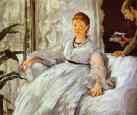
Morisot, Berthe (1841-1895) French painter, daughter of a top civil servant and a great-niece of the rococo painter Fragonard. In 1864, exhibited her first landscapes in the Salon. In 1868, became friends with Manet, who gave her advice and painted in several works (Repose, The Balcony). In December 1874, she married Manet’s brother, Eugène. She participated in all Impressionists exhibitions and made an important contribution to Impressionism.
Henri de Rochefort, Marquis
de Rochefort Lucay (1830-1913) civil servant and critic, Sub-inspector
of the Paris Beaux-Arts. He was condemned under military law to
life-imprisonment
for his support of the Commune and exiled to New Caledonia in 1873.
Four
months later he and some other convicts escaped in a whale boat. He
lived
in Geneva and London until the amnesty made his return to Paris
possible,
and shortly thereafter he founded a new paper, L’Intransigiant.
Ironically, the radical Rochefort later became a follower of General
Boulanger
and leader of the anti-Dreyfusands.
See: Edouard Manet. The Escape of
Rocherfort. Portrait of Henri Rochefort.
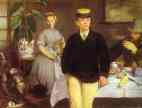
The Conservatory is a portrait
of Monsieur and Mme Jeles Guillement, who owned a fashionable
dress-shop.
Mme Guillemet was American, and one of the few femmes du monde of
Manet’s
acquaintance who was also a friend of Suzanne Manet’s.
See: Edouard Manet. The Conservatory.
At Père Lathuille’s.
The restaurant Chez le Père Lathuille was almost next door to
the
Café Guerbois, Manet’s ‘headquarters’. The models for the
picture
were the son of the proprietor, Louis Gauthier-Lathuille and Judith
French,
a relative of the composer Offenbach.
See: Edouard Manet. At Père
Lathuille's.
Mallarmé, Stéphane
(1842-
1898) French Symbolist poet and writer, influential critic. Close
friend
of Manet, Renoir, Whistler
and
Degas. Mallarmé wrote in 1874 a highly appraisal of Manet for La
Renaissance artistique et littéraire, and in 1876 for Art
Monthly Review. Manet in his turn illustrated Mallarmé’s
translation
of Edgar Allan Poe’s The Raven and made a number of woodcut
illustrations
for L’Après-midi s’un Faume, which he published in April
1876.
See: Edouard Manet. Portrait of
Stéphane Mallarmé.
Claude Monet… Boat, Claude Monet
acquired his studio boat in about 1873, and used it to make painting
trips
up and down the Siene in search of new motifs. In 1874, Manet painted
him,
accompanied by his wife Camille.
See: Edouard Manet. Claude Monet
Painting on His Studio Boat.
Beach at
Boulogne-sur-Mer
… marked the beginning of the phase in Manet’s career which brought him
closest to the Impressionist, and which culminated in his paintings
executed
at Argenteuil or Gennevilliers in summer of 1874, often in the company
of Monet.
See: Edouard Manet. Beach at
Boulogne-sur-Mer.
Astruc, Zacharie (1835-1907) French poet, critic, amateur sculptor and musician. As a critic he was quick to recognize the importance of Courbet and praised Manet, who painted his portrait and portrayed him in Music in the Tuileries. Astruc wrote a song called Lola de Valence and Manet executed a lithograph after his portrait of Lola for the cover.
Music in the
Tuileries
Gardens. Manet portrayed himself surrounded by his friends and
associates.
Manet is to be found at the extreme left of this canvas. Other
identifiable
figures include Zacharie Astruc, the composer Offenbach,
Théophile
Gautier, Henri Fautin-Latour, Manet’s friend the painter Albert de
Balleroy,
and his brother Eugène Manet, who was later to become Berthe
Morisot’s
husband.
See: Edouard Manet. Music in the
Tuileries Gardens.
Georges Clemenceau
(1841-1929)
French statesman. He was educated as a physician, in 1865-69 lived in
the
USA. Since 1871 went into politics. He was the Premier in 1906-09,
1917-20.
He presided at the Peace Conference in 1919. A brilliant journalist, he
founded L'Aurore, and from 1918 was an Academician.
See: Edouard Manet. Georges
Clémenceau.
The Monet Family in the Garden. Manet
was working on the picture in the Monets' garden in Argenteuil, when
Renoir
arrived. The latter loved the scene so much that immediately began to
paint
the same thing. Manet did not like the situation and in his irritation
told Monet to advise his friend to quit painting, as it was clearly not
his vocation.
See: Madame Monet
with Her Son by Renoir.
Edouard Manet. The Monet Family in the
Garden.
Alphonse Maureau French
Impressionist
painter, exact details of his life are unknown. He was a friend of
Degas
and Manet, and Desboutin. In 1877, participated in the 3rd
Impressionist
Exhibition with four works. See one of his works here.
See: Edouard Manet. Man in a Round Hat
(Alphonse Maureau).
Gilbert-Marcellin
Desboutin
(1823-1902), French painter, engraver, and poet. He came from a rich
family,
first studied law in Paris, but then switched to sculpture. In
1854-1870,
lived in Florence as a painter. In 1873, settled in Paris: became
acquainted
with Manet and Degas. Took part in the second Impressionist exhibition,
though he pained in almost Neo-Baroque style. In 1895 became member of
the Legion of Honor. In 1900, won the grand prize at the Paris World
Fair.
See: Edouard Manet. Portrait of
Gilbert-Marcellin Desboutin.
George Moore (1853-1933) Irish
painter,
critic, and writer. Took drawing lessons in London. At the age of 21 he
moved to Paris and studied at the Ecole des Beaux-Arts and at the
Academie
Julian; got acquainted and made friends with numerous artists,
especially
Manet. In 1879, Manet painted three portraits of him. In 1880, he moved
back to England and became active in the New English Art Club, a group
of artitsts working on Impressionism principles.
See: Edouard Manet. Portrait of George
Moore.
Antonin Proust (1832-1900) French
political
figure, journalist, and art critic, uncle of the French writer Marcel
Proust.
He for some time was the Minister for Fine Arts. He was a friend of
Manet
and wrote a book about the artist.
See: Edouard Manet. Portrait of
Antonin Proust.
Bibliography:
Henri Perruchot. La vie de Manet. Hachette, Paris. 1959.
French Paintings from the Hermitage, Leningrad. Aurora.
Leningrad.
1975.
Painting of Europe. XIII-XX centuries. Encyclopedic
Dictionary.
Moscow. Iskusstvo. 1999.
Edouard
Manet: Rebel in a Frock Coat by Beth Archer Brombert.
University
of Chicago Press, 1997.
Manet:
The Still-Life Paintings by Henri Loyrette, Musee D'Orsay,
Walters Art gall, George L. Mauner. Harry N Abrams, 2001.
The Last Flowers of
Manet by Andrew Forge, Robert Gordon. Harry N Abrams, 1999.
Manet : The Still Life
Paintings by George Mauner. Harry N Abrams, 2001.
Alias Olympia: A
Woman's Search for Manet's Notorious Model & Her Own Desire
by Eunice Lipton. >Cornell University Press, 1999.
Manet's Modernism: or,
The Face of Painting in the 1860s by Michael Fried.
University of Chicago Press, 1998.
Masters of Art: Manet
by Pierre Courthion. Harry N Abrams, 1984.
Manet/Velazquez: The
French Taste for Spanish Painting by Gary Tinterow,
Genevieve Lacambre, Deborah L. Roldan. Yale University Press, 2003.
Manet and the Sea
by Juliet Wilson-Bareau, David Degener. Yale University Press, 2003.
Manet's 'Le
Déjeuner sur l'herbe' (Masterpieces of Western
Painting) by Paul Hayes Tucker. Cambridge University Press, 1998.
Manet Manette
by Carol Armstrong, Edouard Manet. Yale University Press, 2002.
Twelve Views of Manet's
Bar by Bradford Collins. Princeton University Press , 1996.
<>
>