Lorenzo Lotto Biography
Lorenzo Lotto, one of the most important 16th century Venetian painters, lived an unsettled life. He grew up in Venice under the influence of
Giovanni Bellini (reputedly Lotto got his professional training in his studio) and the works of Antonello da Messina. Then he traveled to Marches, where he saw the works of Melozzo da Forli and Luca Signorelli. These sharpened his understanding of perspective and precise presentation of human movement.
Then came his work in the Vatican (1509-1511), of which no traces remain. The artist was recognized while working in Bergamo (1513-1525), where he painted altarpieces, portraits and fresco cycles. The perfect example of his work is Susanna and the Elders. (1517), one of Lotto’s masterpieces. In his religious works Lotto abandoned traditional patterns of composition, e.g. The Annunciation. (c. 1527). Lotto was also an outstanding portraitist, though we do not know anything about the people he depicted. The artist preserved for history their appearances and sometimes their names, but not their stories.
After Bergamo he tried to settle in Venice, but his lack of success in his native city caused him to retire to the Marches in 1549. In his last years, his painting became hesitant and uncertain. Lotto supposedly went blind. Already an old man, he took vows as a lay-brother and entered the Sanctuary of the Santa Casa in Loreto.
Bibliography
Lorenzo Lotto: Rediscovered Master of the Renaissance by David Alan Brown, Peter Humfrey (Contributor), Mauro Lucco. Yale Univ Pr, 1997.
Lorenzo Lotto by Peter Humfrey, Lorenzo Lotto. Yale Univ Pr, 1997.
Lorenzo Lotto: The Frescoes in the Oratorio Suardi at Trescore by Francesca Cortesi Bosco. Skira, 1998.
Lorenzo Lotto by Jacques Bonnet, Michael Taylor. Art Books Intl Ltd, 1997.
- Susanna And The Elders.
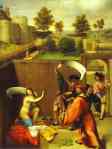
1517. Oil on wood. Galleria degli Uffizi, Florence, Italy. Read Note.

