Ambrogio Lorenzetti Biography
Ambrogio was probably the younger brother of Pietro Lorenzetti and certainly came from the same artistic background. Ambrogio, who is documented as living in Siena from 1319 to 1347, paid at least two lengthy visits to Florence. This may explain his detailed knowledge not just of the painting of Giotto, but also that of his Florentine successors. It may explain, too, the influence of Sienese art upon Florence, and particularly upon the genre of the small-scale devotional picture. In the thoroughness with which he established space and depth, he was the most modern master of the 14th century. Noteworthy, as in the case of his brother, is his faithful observation of nature, and even more so the assurance and lightness with which he portrays movement and life, rhythm and emotion. While the mood in Pietro’s painting tend towards somberness, Ambrogio creates a more cheerful, more relaxed, richer atmosphere. His best known work is allegorical frescoes in the Palazzo Publico at Siena (1337-39), symbolizing the effects of good and bad government. They depict scenes from everyday life, crammed with incidents and yet newly naturalistic in his treatment of architecture. Alongside these, there are also lesser but nonetheless charming works such as the Madonna of the Milk.
The Lorenzetti brothers both died in the great plague of 1348, which carried off half the population of Siena.
Bibliography
Ambrogio Lorenzetti. by G. Rompey. Princeton. 1958.
Painting of Europe. XIII-XX centuries. Encyclopedic Dictionary. Moscow. Iskusstvo. 1999.
Ambrogio Lorenzetti: The Palazzo Pubblico, Siena by Randolph Starn. George Braziller, 1994.
- Madonna Of The Milk.
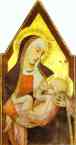
Tempera on wood. Archbishop's Palace, Museo del Seminario, Siena, Italy.

