Filippino Lippi Biography
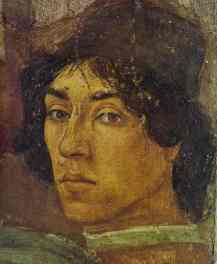
If his birth proved embarrassing for his parents, Fra Filippo Lippi
and Sister Lucrezia Buti, who were both in holy orders, Filippino certainly compensated for this by being a true infant prodigy. He assisted his father from an early age and had only turned 12 when Filippo died. Nevertheless, Filippino was able to complete the frescoes in the Spoleto Cathedral.
In 1472, he is mentioned in connection with Botticelli, who influenced him greatly. His earliest panels are hardly distinguishable from those of his great master. Around 1481, Filippino must already have had a reputation in Florence as he was commissioned to complete the fresco cycle in the Brancacci Chapel which Masaccio and Masolino had left unfinished. By incorporating Flemish elements, which determined the brilliance of his colors, the young painter reached the pinnacle of his career over the next few years The Apparition of the Virgin to St. Bernard (c.1486). In 1496, Lippi finished his The Adoration of the Magi, which were commissioned by the monks of San Donato a Scoreto as a substitution for a painting on an identical subject, left unfinished by Leonardo. Thanks to Lorenzo the Magnificent's intervention, Filippino was called to Rome in 1488, to paint the frescoes in the Carafa Chapel in Santa Maria sopra Minerva. Back in Florence, the artist was one of the first to respond to the crisis in art caused by the death of Lorenzo the Magnificent and Savonarola's sermons. His painting became bizarre, fantastical and tend increasingly to seem hallucinatory. Among his last works are The Deposition from the Crosswhich was completed by Perugino.
Bibliography
Painting of Europe. XIII-XX centuries. Encyclopedic Dictionary. Moscow. Iskusstvo. 1999.
The Drawings of Filippino Lippi and His Circle by George Goldner, Alessandro Cecchi (Contributor). Harry N Abrams, 1997.
- The Apparition Of The Virgin To St. Bernard.
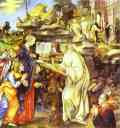
c.1486. Tempera on panel. Badia, Florence, Italy. Read Note.
- The Adoration Of The Magi.
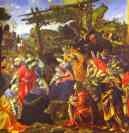
c.1496. Tempera on panel. Galleria degli Uffizi, Florence, Italy. Read Note.

