Mikhail Lebedev Biography
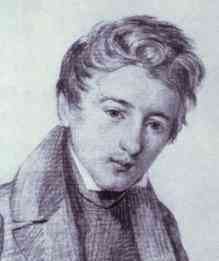
Mikhail Ivanovich Lebedev was born in Derpt (now Tartu), into the family of a serf. In the 1820s, serfdom was abolished in that part of the Russian Empire (now the independent state of Estonia) and young Mikhail even got the opportunity to study in the Derpt gymnasium; his success in drawing attracted the attention of the Count P.A. Palen, who promoted the young man to the St. Petersburg Academy with an Imperial scholarship (1829-1833). In the Academy, Lebedev studied in the class of
Maxim Vorobiov. In 1833, he got the major gold medal for the painting View of Ladoga.
In 1834, he came to Italy as a pensioner of the Academy and was heartily welcomed by the Russian artistic colony, headed by the great Karl Brulloff, who appreciated the works of his young colleague. In Italy, Lebedev was interested in everything: its bright nature, beautiful architecture, and its folk. For a northern man, used to the subdued hues of St. Petersburg and Derpt, Italy was quite a new world. The artist loved to paint Italy’s nature; his landscapes are built on the contrast of dark foliage and bright sunny spots. These light spots give his landscapes optimistic characteristics: Ariccia near Rome. View of Castel-Gandolfo near Rome. Lebedev’s landscapes had an immediate success with the public and he had to make copies of his own works.
Tragically enough in May of 1837 he came to work in Naples, where an epidemic of cholera started. The artist became ill and died.
- Ariccia Near Rome.
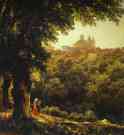
1836. Oil on canvas. The Russian Museum, St. Petersburg, Russia.

