Sir Edwin Landseer Biography
Sir Edwin Henry Landseer (1802-73) is an English painter, born in London, the son of the engraver John Landseer (1769-1852). Trained by his father to sketch animals from life, he began exhibiting at the Royal Academy (RA) when only 13; the same year (1815) he received a silver medal from the Society of Arts for his drawing of a hunter. Success came easily and early. By the age of 16 he was a constant and active exhibitor at the RA, already patronized by leading collectors and talked about as a rising star. His election as an Associate of the RA in 1826, when he was only 24, surprised no one but himself.
In 1824, Landseer went to Scotland for the first time to visit Sir Walter Scott. He fell in love with the Highlands, and since then every year he used to return there for inspiration, drawing, hunting, and rest. Landseer’s romantic vision of border history is reflected in his work, inspired by Scott, The Hunting of Chevy Chase (1825-26). Landseer was elected a full Academician in 1931; the decade that followed was the most successful and the most creative of his entire career.
Major works, such as Hawking (1832), Scene in the Olden Time at Bolton Abbey(1834) won him critical acclaim, but it was often his smaller pictures of dogs such as The Old Shepherd's Chief Mourner (1837) and Dignity and Impudence (1839) that captured the popular imagination. Most of Landseer’s pictures were well known from excellent engravings of them by his elder brother Thomas (1796-1800). The publication of numerous prints won him a vast and devoted popular audience.
The strain of keeping up his career, of satisfying his patrons, and of maintaining his social position cost Landseer more effort than he cared to admit. In May 1840, at the height of his powers and reputation, he suffered a severe nervous breakdown. In the face of all his personal and professional problems, Landseer continued to paint pictures of high quality, which enhanced his popularity. His The Monarch of the Glen (1851) was exhibited in 1851; the bronze lions at the foot of Nelson’s Monument in Trafalgar Square were modeled by him (1859-66). He was a favorite with the aristocracy, but it was his position at court, which gave him an unrivaled prestige in the eyes of the public. As well as painting a succession of royal pets Eos, A Favorite Greyhound, the Property of H.R.H. Prince Albert (1841), Macaw, Love Birds, Terrier, and Spaniel Puppies, Belonging to Her Majesty (1839), Landseer undertook major portrait commissions, including the great unfinished picture of Queen Victoria, the conversation piece Windsor Castle in Modern Times (1841-1845), and the Portrait of Queen Victoria and Prince Albert (1842-1846).
Landseer was the most famous English artist of his generation, and he was mourned throughout the nation. He was accorded the honor of public funeral, and he was buried in St. Paul’s Cathedral alongside Sir Joshua Reynolds, Sir Thomas Lawrence, and J.M.W. Turner.
Bibliography
The Monarch of the Glen: Landseer in the Highlands by Richard Ormond, T. C. Smout. National Galleries of Scotland, 2005.
Landseer's Animal Illustrations by Joseph Batty. Beech Publishing House, 2002.
- The Hunting Of Chevy Chase.
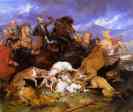
1825-1826. Oil on canvas. Birmingham City Museum and Art Gallery, Birmingham, UK.
- Hawking.
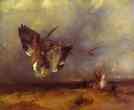
1832. Oil on canvas. Iveagh Bequest, Kenwood, UK.
- Scene In The Olden Time At Bolton Abbey.
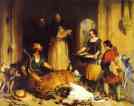
1834. Oil on canvas. Duke of Devonshire, Chatsworth House, Derbyshire, UK.

