Ivan Kramskoy Biography
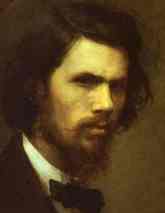
Ivan Nikolayevich Kramskoy is an outstanding representative of the democratic culture in Russia of the second half of the 19th century. He is known as a wonderful painter and draughtsman, a remarkable art critic and theoretician of art, a talented teacher. Besides, he was an originator and ardent inspirer of the first independent artistic organizations, namely the Itinerants’ Society of Traveling Exhibitions and St. Petersburg Team of Artists, which had played an important part in the development of art in Russia.
Born into the family of a provincial state clerk, Kramskoy had no opportunity to study art during childhood. At the age of 15 he became an apprentice to an icon-painter, a year later a photographer took him as a retoucher. Only in 1857, he managed to come to St. Petersburg and enter the Academy of Arts. There he soon became a popular leader among the students. In 1863, he was among the 14 best graduates who refused to fulfill the diploma work on a given mythological theme. All 14 were dismissed from the Academy, and Kramskoy headed the St. Petersburg Team of Artists, a commune where artists shared studios and household. The young wife of Kramskoy, Sophia Nikolayevna, née Prokhorova, took care of their mutual household.
Ivan Kramskoy is famous mainly as a portraitist; his portraits of the 60s are not large, and very often monochrome, reminding of photographs. At the same period (1863-68) Kramskoy taught in The Drawing School of the Society for Promoting of the Artists; his pupils, among others, were Iliya Repin and Nicolay Yaroshenko.
Since 1869, Kramskoy started to receive regular commissions from the collector of Russian art Pavel Tretyakov. Tretyakov commissioned portraits of personalities of Russian culture and science. These portraits have become an innate part of the Russian art and social history. For Kramskoy it was a feat to preserve, for the generations to come, the likeliness of his outstanding contemporaries. Portrait of the Author Ivan Goncharov. Portrait of the Sculptor Mark Antokolsky. Portrait of Dmitry Mendeleyev.
In 1869, St. Petersburg Academy chose him an academician. The same year he made his first trip abroad: he visited Berlin, Dresden, Munich, Düsseldorf, Antwerp, Paris, and Vienna, where he studied famous art collections. After his return to Russia he started organizing the Itinerants’ Society of Traveling Exhibitions. The aim of the Society was:
1) to give the opportunity to everybody in Russia to get acquainted with its contemporary art;
2) to develop love for art in Russian society;
3) to make selling their works easier for the artists.
In 1872 Kramskoy painted his masterpiece Christ in the Desert, a traditional topic, yet, in Kramskoy’s work it acquired new social interpretation and deep philosophical meaning. Christ in the Desert carried the idea of man’s moral duty to society and therefore it greatly impressed the painter’s contemporaries, who found a definite affinity to their attitudes and feelings in it in the crucial period of Russian history, which demanded personal heroism and sacrifice for the sake of people. “The best Christ I ever saw”– Leo Tolstoy.
In 1873 Tretyakov commissioned the Portrait of Leo Tolstoy for his gallery. Tolstoy had refused several times. “Please use all your charm to persuade him “, wrote Tretyakov to Kramskoy. And Kramskoy managed to do this, the writer and the artist were both impressed by each other’s personalities. Kramskoy painted one of the best of all Tolstoy’s portraits. Tolstoy was working on Anna Karenina at the time and he used Kramskoy’s character as one of the secondary personages in the novel – the artist Mikhailov.
Kramskoy always understood the capturing charm of color, admired Alexander Ivanov, his younger contemporaries – Repin, Vasiliyev, Polenov, French Impressionists - “…Just a small group of laughed at painters, but the future belongs to them…”, he wrote in the 70s about his French colleagues. But he himself was a poor colorist. Once during the work on the portrait of Adrian Prakhov, the mother of the sitter saw the portrait after the first day of painting and impressed by it, took it away and did not allow Kramskoy to finish it, she said that if the artist went on working he would dry it as usual. Kramskoy himself understood his drawbacks and limits, but was afraid to change his manner.
The artist died on 24 March 1887 during his work on the portrait of Doctor Rauhphus with brush in his hand.
Kramskoy’s works embody the high moral and social ideals of his time. For him, artistic truth and beauty, moral and aesthetic values were inseparable. His works greatly influenced his contemporaries’ ideology. Today they still affect people because the artist’s attitude to life was based on love and respect of man, on his belief in truth and justice.
Bibliography
Kramskoy. by T. Kurochkina. Russian Painters of the XIX century. Moscow. 1989.
The Art and Architecture of Russia (Pelican History Art) by George Heard Hamilton. Yale Univ Pr, 1992.
A Dictionary of Russian and Soviet Artists 1420-1970 by John Milner. Antique Collectors' Club, 1993.
- Portrait Of Pavel Tretyakov, The Art Collector, Founder Of The Gallery.
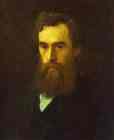
1876. Oil on canvas. The Tretyakov Gallery, Moscow, Russia. Read Note.
- Portrait Of The Author Ivan Goncharov.
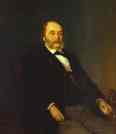
1874. Oil on canvas. The Tretyakov Gallery, Moscow, Russia. Read Note.
- Portrait Of The Sculptor Mark Antokolsky.
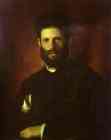
1876. Oil on canvas. The Russian Museum, St. Petersburg, Russia. Read Note.
- Portrait Of Dmitry Mendeleyev.
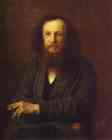
1878. Oil on canvas. Mendeleev Museum at St. Petersburg State University, St. Petersburg, Russia. Read Note.
- Christ In The Desert.
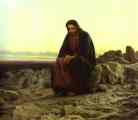
1872. Oil on canvas. The Tretyakov Gallery, Moscow, Russia. Read Note.

