Alexander Ivanov Biography
Alexander Andreevich Ivanov was born in 1806 in St. Petersburg. His father, Andrey Ivanov, was an artist, the professor of the Academy of Arts. It was his father who first taught Alexander art, and since 1817 till 1824 he studied in the Academy of Arts. One of his first notable works, made while in the Academy, was Priam Asking Achilles to Return Hector's Body (1824). For the picture Joseph Interprets the Butler's and the Baker's Dreams in a Prison (1827) he was awarded a Major Gold Medal by the Society for the Promotion of Artists and sent to Italy as a pensioner of that society.
He went to Italy in 1830 and after 1831, settled in Rome. He travelled all over Italy, studying the masterpieces of art. During his first years he painted Apollo, Hyacinth and Cypariss Singing and Playing Music (1831-1834) and The Appearance of Christ to Mary Magdalene (1834-1836) which were greatly appreciated by his contemporaries and approved of by his sponsors in St. Petersburg. At about 1833 Ivanov conceived a plan to paint a large picture The Appearance of Christ to the People (1837-1857). This picture truly became the work of his life, he worked on it for twenty years. Over 100 sketches, numerous detail drawings, and large-scale designs, most of them in oil, preceded the monumental composition. Its size is 540 x 750 cm (18' x 25'). In the foreground of the picture there is a number of male figures, some already undressed, awaiting to be baptized in the Jordan River by John the Baptist. While John the Baptist, in his garb of animal skin under a long mantle, a crosier in his left hand, turns and raises his arms dramatically towards the lone figure of Christ, who appears on a rocky rise in the middle ground, behind him a broad plain and distant mountains.
Ivanov also painted several genre pictures such as Ave Maria (1839), Bridegroom Buying a Ring for His Fiancee (1839) and very beautiful landscape studies: Olives Near Cemetery in Albano. New Moon (1842-1846), A Tree Branch (1840s-1850s), Via Appia (1845), Water and Stones Near Palacculo (1850s). In the 1850s, he conceived another grandiose plan to paint a series of large frescos illustrating the Bible, in a palace specially built for this purpose. In preparation to this project he painted dozens of sketches in watercolour with various scenes from the Bible. Ivanov died from cholera in St. Petersburg in 1858, several month after his return to Russia.
Bibliography
Russian Historical Painting. by M. Rakova. Moscow. Iskusstvo. 1979.
Alexander Ivanov. by M. Allenov. Moscow. 1980.
Paintings of the 18th-early 20th centuries from the Reserves of the Russian Museum. by K. Mikhailova and G. Smirnov. Leningrad. 1982.
The Art and Architecture of Russia (Pelican History Art) by George Heard Hamilton. Yale Univ Pr, 1992.
A Dictionary of Russian and Soviet Artists 1420-1970 by John Milner. Antique Collectors' Club, 1993.
- Priam Asking Achilles To Return Hector's Body.
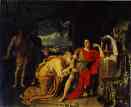
1824. Oil on canvas. The Tretyakov Gallery, Moscow, Russia. Read Note.
- Joseph Interprets The Butler's And The Baker's Dreams In A Prison.
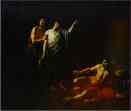
1827. Oil on canvas. The Russian Museum, St. Petersburg, Russia. Read Note.
- Apollo, Hyacinthus And Cyparissus Singing And Playing Music.
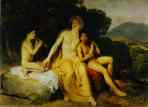
1831-1834. Oil on canvas. The Tretyakov Gallery, Moscow, Russia. Read Note.

