Theophanes the Greek Biography
Theophanus the Greek belongs to the greatest masters of the Medieval times. His works fulfilled in Byzantium have not survived. All his preserved and known works were made for Rus and mostly in Rus, where he spent more than 30 years. Being a highly educated and talented man, he brought to Rus the highest achievements of Byzantine culture and art.
In one of the letters of the period, a Russian monk wrote how he was impressed seeing Theophanus at work, who did not copy the model, like other icon painters, but thought and painted from his thoughts. The same monk wrote that everyone who talked to Theophanus was impressed with his ‘high mind’.
It's known that Theophanus decorated more than 40 Churches in Constantinople, Khalkidon, Galat, Kapha (Pheodosia) and Rus. In Novgorod the first mentioned work by Theophanus refers to 1378. This work, murals in the Church of Our Savior on Ilyin Street is the only work that has documentary confirmation, and it's the basis for art historians for identification of his other works. The frescos nowadays exist only in fragments.
“Theophanus’ painting is the philosophical conception in colors, and besides conception is stern enough, far from everyday optimism. The essence of the conception is the global sinfulness of a man, as a result of which he distanced himself from the Lord and now could only with fear and horror await the coming of his uncompromised and ruthless Judge… Theophanus the Greek creates a world full of drama and tenseness of spirit. His saints are stern, aloof, absorbed in contemplation and thoughts of the savior.”
Some Novgorod icon painters tried to follow Theophanus’ style, but on the whole the master's individuality is exceptional for Old Russian art, a country that was far from the spiritual and cultural experience of Byzantium, and was looking for its own way.
After 1378, Theophanus worked in Nizhny Novgorod, but the works of that period did not survive. Approximately from 1390 he worked in Moscow. The master fulfilled frescos in the Moscow Kremlin in the Church of the Virgin Nativity (1395), where he worked with Simeon Tcherny; in Archangels (1399) and Annunciation (1405) Cathedrals. Blagovezhensky (Annunciation) Cathedral he painted with Andrei Rublev and Prokhor from Gorodez. Theophanus’ style in murals differs greatly in his style in icons. Among the icons which are considered to belong to Theophanus are John the Baptist, Angel of Desert and Transfiguration, all in the Tretyakov Gallery.
Bibliography
Theophanus the Greek and his School. By V.N. Lazarev. Moscow. 1961.
Theophanus the Greek. By G.I. Vzdornov. Moscow. 1983.
- Fresco.
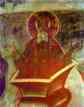
1378. The Church of Our Savior on Ilyin Street, Novgorod, Russia.
- The Trinity.

1378. Fresco. The Church of Our Savior on Ilyin Street, Novgorod, Russia. Read Note.

