Pieter de Hooch Biography
Pieter de Hooch (also Hoogh, Hooghe) was born into the family of a bricklayer in Rotterdam in 1629. He received his early training under Nicolaes Berchem in Haarlem and experienced the influence of the Haarlem genre painters of
Frans Hals’ circle. Around 1650 he worked for a cloth merchant and art collector, Justus de la Grange, in Rotterdam – both as painter and a servant. He had to accompany his master on his travel to Leiden, the Hague and Delft. De Hooch married in Delft in May 1654 and joined the painters’ St. Lukas Guild in September 1655. He remained in the town until 1661, when he moved to Amsterdam, where he remained to the end of his life. De Hooch’s most important creative period was his years at Delft. In his early years De Hooch had painted scenes of soldiers and guardrooms but after his move to Delft, under the influence of Vermeer and the Rembrandt's pupil Fabritius he turned to genre scenes showing the idyll of Dutch domestic life, in home interiors, courtyards and gardens. His main characters are women: busy housewives, loving mothers and careful and neat maids. Hooch is an outstanding master of interior. He depicts anfilades of rooms, intimate and poetic domestic world; gentle sun light penetrates through open doors and windows. Hooch’s colours are warmer and softer than Vermeer’s.
Hooch had moved from Delft to Amsterdam by 15 April 1661, when one of his daughters was baptized in the Westerkerk. In his Amsterdam years his domestic interiors became richer and his compositions more complex. His technique becomes progressively cruder and his late paintings often contain clumsy figure drawings and a coarse palette. His works of Amsterdam period of festive companies of ladies and gentlemen in luxurious interiors do not belong to his best works.
The painter died im Amsterdam after 1683.
Bibliography
Dutch Genre Painting. XVII century. by E. Fehner. Moscow. Izobrazitelnoe Iskusstvo. 1979.
Painting of Western Europe. XVII century. by E. Rotenberg. Moscow. Iskusstvo. 1989.
Painting of Europe. XIII-XX centuries. Encyclopedic Dictionary. Moscow. Iskusstvo. 1999.
- A Soldier And A Maid.
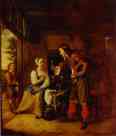
c.1653. Oil on wood, 71 x 59. The Hermitage, St. Petersburg, Russia.
- Morning Of A Young Man.
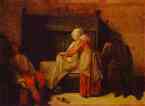
c.1650s. Oil on wood, 40 x 53 cm. The Pushkin Museum of Fine Art, Moscow, Russia.

