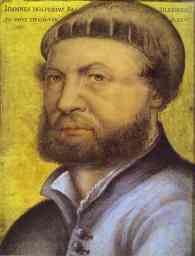
Hans Holbein at Artprice. To look at auction records, find Holbein's works in upcoming auctions, check price levels and indexes for his works, read his biography and view his signature, access the Artprice database.
Notes
Jacob Meyer, businessman and Burgomaster
of Basel, he was elected to the office on June 24, 1516. In 1521, he was
impeached for a larger bribe from the French than was permitted, imprisoned
when he protested at this treatment and barred from office thereafter.
He remained a Catholic after the city’s secession to the reformed religion
and led the Catholic party in the city. Dorothea Kannengiesser was
the second wife of Jacob Meyer, their double portrait, was probably commissioned
to celebrate Meyer’s election as Burgomaster.
See: Hans Holbein. Portrait of
Jakob Meyer. Portrait of Dorothea Kannengiesser.
also Hans Holbein. Meyer Madonna.,
on which all the family of Meyer is depicted.
The Meyer or Darmstadt Madonna is the
last, most famous and most effective of Holbein’s great religious works.
This is a Schulzmantelbild (a Virgin of Pity painting), in which the donor,
Jacob Meyer, appeals to divine protection for himself and his family. On
the right are his wives – enwrapped profile of his first, Magdalena Baer
(who died in 1511) and Dorothea Kannengiesser. Before them kneels Anna,
the only surviving child. A friend of Holbein’s, one Magdalena Offenburg,
posed for the Madonna. She also posed for the Lais. The commission for
the painting was the result of the death of Meyer’s two sons during
Holbein’s first English absence, and Meyer decided to include all members
of his family, living and dead.
See: Hans Holbein. Meyer Madonna.
Bonifacius Amerbach, son of
the Basle publisher Johanes Amerbach (1430-1513), he was a lawyer and Professor
of Law at the university of Basle. Bonifacius was a close friend of Erasmus
of Rotterdam, the later made him his only heir, leaving him books,
gold and several works by Hans Holbein the Yonger. The picture bears Amerbach’s
own words of praise for the artist’s truthfulness to nature.
See: Hans Holbein. Portrait of Bonifacius
Amerbach.
The Artist’s Family. Hans
married the widow of a soldier Elsbeth Bingenstok in 1519. They had 4 children.
On the picture Elsbeth is with Philip (born 1521) and Catarina (born in
1526 when her father left for England). Philip Holbein studied later in
Paris and became a gold- and silversmith in the Augsburg court of Emperor
Maximilian. Elsbeth, who was separated from her husband for years at a
time, brought up their children alone. She eventually had to sell the painting
to make ends meet.
See: Hans Holbein. The Artist's Family.
Lais Corinthiaca was said to have
been the mistress of the ancient Greek artist Apelles, her personage signifies
Mercenary Love. A friend of Holbein’s, one Magdalena Offenburg, a woman
of negotiable virtue, sat for the picture.
See: Hans Holbein. Portrait of Lais
Corinthiaca.
The Ambassadors. Jean de Dinteville,
on the left, was in England on a mission for Francis
I on the subject of Henry’s quarrel with the papacy over his marriage
to Anne Boleyn in 1533. De Selve (later Bishop of Lavaur) probably gave
his friend diplomatic and moral support.
See: Hans Holbein. The Ambassadors.
St. Sir Thomas More (1478-1535)
English humanist, statesman and scholar. He was educated at Oxford. During
the last years of Henry VII he became under-sheriff of London and a member
of Parliament. Under Henry VIII he took important
offices, the highest of which was Lord Chancellor, to which he was appointed
against his own wish. For all his saintly reputation More was ferocious
enough to condemn heretics to be burnt. In 1532, he resigned the chancelloship.
In 1534, after Henry VIII was declared Head of the English Church, More
refused to recognize any head of the church other than the pope and was
accused of high treason. He was imprisoned and then, in a year, beheaded.
He was canonized in 1935.
See: Hans Holbein. Portrait of Sir Thomas
More.
Sir Henry Guildford (1489-1532),
was a great favorite of Henry VIII, ending
his career at court as Comptroller of the Royal Household, whose baton
of office he holds. He also wears the Order of the Garter, awarded him
in 1526. He was a strong proponent of religious reform.
See: Hans Holbein. Portrait of Sir Henry
Guildford.
Charles de Solier, Sire de Morette
was a French diplomat, who replaced Jean de Dinteville as the envoy in
England. De Solier’s stay in England was brief; the break with the Church
of Rome was by this time an accomplished event.
See: Hans Holbein. Portrait of Charles
de Solier, Sire de Morette.
Robert Cheseman (1485-1547) was
an influential figure in Middlesex, where he was responsible for marshalling
levies.
See: Hans Holbein. Portrait of Robert
Cheseman.
Nicholas Kratzer (c. 1497-
c.1550) was a native of Munich, who came to England in 1516 and was employed
by both Thomas More and Cardinal Wolsey (whose downfall occurred a year
after the portrait was painted). Kratzer remained in England until his
death. He was a friend of Holbein.
See: Hans Holbein. Portrait of Nicholas
Kratzer.
Sir Richard Southwell (?
- c. 1564) was one of the most calculating and treacherous members of Henry
VIII's court. He became a creature of Thomas Cromwell and was instrumental
in aiding Richard Rich in his attempts to force the imprisoned Sir Thomas
More to incriminate himself in 1532. Southwell also made accusations against
a childhood friend, the Earl of Surrey, that led to the latter’s execution.
Cromwell employed him as a general factotum during the dissolution of the
monasteries between 1536 and 1539. He was knighted (after Cromwell’s downfall)
in 1542. Southwell later renounced Protestantism, and thus found favor
under Mary I (1553-8), but as a result he was shunned in Elizabeth’s reign.
See: Hans Holbein. Portrait of Sir Richard
Southwell. Portrait of Sir Richard
Southwell.
Sir Thomas Elyot was a member of Sir Thomas More’s circle and praised him in his great treatise on education the Governor, (1531). After More’s execution, however, he reneged, asking Cromwell to forget the erstwhile friendship. The Governor experienced influence up to and throughout Elisabeth’s I reign. The book is thought to have been instrumental in determining the reformers to set up a tier of academies – the King Edward VI grammar schools – in the early 1550s.
Henry VIII (1491-1547), second son of
Henry VII, King of England from 1509. Outstanding political and military
figure, he was also remembered in history for his multiple and unsuccessful
marriages. In 1509, he married his brother’s widow, Catherine of Aragon.
In 1533, Anne Boleyn became his second wife. In 1536, the Queen Catherine
died and Anne Boleyn was accused of infidelity and executed. The day after
her execution Henry married Jane Seymore.
Jane Seymore, the eldest daughter of Sir John Seymour, was lady-in-waiting,
first to Catherine of Aragon, then to Anne Boleyn. 20 May, 1536, only one
day after Anne’s execution, she became Henry’s 3rd wife. She died
after giving birth to her husband’s desperately hoped-for male heir, later
Edward
VI (ruled in 1547-53).
Anne of Cleves (1515-1557) German princess, daughter of John,
Duke of Cleves, a noted champion of Protestantism in Germany, was chosen
as his forth wife, first of all for political reasons. But there was also
one more reason and this is where Holbein lost the King’s favor. Holbein
was sent as a painter-ambassador to execute the portrait of Anne. It was
a difficult task, in fact, he found himself between a rock and a hard place.
Henry VIII liked the portrait, but when his bride arrived to the marriage
ceremony in 1540 he found her more like a ‘fat Flanders mare’. This cost
Holbein dearly in prestige. The marriage was annuled by parliament six
months later. Anne of Cleves obtained a handsome settlement from Henry
and lived in quiet comfort in England until 1555.
Henry’s two subsequent wives were English.
See: Hans Holbein. Portrait of Henry
VIII. Portrait of Jane Seymour.
Portrait of Anne of Cleves. Portrait
of Henry VIII.
Edward VI (1537-1553) king of England
and Ireland from 1547, son of Henry VIII and
his third wife, Jane Seymour. Since Edward was only ten years old
at the time of the coronation, the government was first entrusted to a
lord protector, the king's uncle, Edward Seymour, Duke of Somerset, who
was executed in 1552 and replaced by John Dudley, Earl of Warwick and Duke
of Northumberland. The king's health, never robust, deteriorated in 1553
and Northumberland made efforts to induce the dying boy to alter the succession
in favour of his own daughter-in-law, Lady Jane Grey.
See: Hans Holbein. Portrait of Edward,
Prince of Wales. Portrait of Edward,
Prince of Wales, with Monkey.
Design for a Pendant. It
is thought the design may have been commissioned as one of many pieces
Holbein provided for Anne Boleyn in peak of her success from 1533 to 1536.
See: Hans Holbein. Design for Pendant.
Simon George of Quocote was a minor
court figure at the court of Henry VIII.
See: Hans Holbein. Portrait of Simon
George of Quocote.
Christina (Kristina) of Denmark. After
Jane Seymore’s death Henry VIII was looking
for the next wife. Holbein was sent to Brussels to execute the portrait
of Christina, this work, which was accomplished within only three hours,
is the result. The portrait impressed officials and Henry VIII himself.
But Christina’s common sense sabotaged Henry’s hopes for marriage: ‘if
I had two heads, one would be at the service of the King of England.’ In
this way she expressed her disapproval of the beheading of his previous
wife, Anne Boleyn.
See: Hans Holbein. Portrait of Christina
of Denmark.
Henry and Charles Brandon, sons
of Charles Brandon (1484-1545), Duke of Suffolk, and Lady Mary, sister
of Henry VIII, were schoolfellows of Prince
Edward. The brothers died of the notorious ‘sweating sickness’ within an
hour of each other in 1551.
See: Hans Holbein. Portrait of Henry
Brandon. Portrait of Charles Brandon.
Sir Brian Tuke was Governor of the
King’s Post, secretary and treasurer of the royal household. Sir Brian
was 57 when this portrait was executed.
See: Hans Holbein. Portrait of Sir Brian
Tuke.
William Warham (c.1450- 1532) English
religious and political figure. He took orders, but practiced law and made
his career under Henry VII; master of Rolls (1494), Lord Chancellor (1501),
Bishop of London (1503) and Archbishop of Canterbury (1503) In 1515 he
had to resign the great seal to Wolsey.
See: Hans Holbein. Portrait of William
Warham.
Sir Thomas Godsalve, born
in Norwich, was a notary and judge, his son John later became a
secretary to the Chancellor, then was the head of the Royal Mint.
See: Hans Holbein. Double Portrat of
Sir Thomas Godsalve and his Son John.
John Chambers was a personal physician
to Henry VIII. In 1543 he was 88.
See: Hans Holbein. Portrait of John
Chambers.
Bibliography:
Painting of Europe. XIII-XX centuries. Encyclopedic Dictionary. Moscow.
Iskusstvo. 1999.
Holbein. by A. Nemilov. Moscow-Leningrad. 1962.
Holbein and Henry VIII. by R. Strong. London. 1967.
Holbein
and England by Susan Foister. Paul Mellon Center BA, 2005.
Five
Centuries of British Painting: From Holbein to Hodgkin by Andrew
Wilton. Thames & Hudson, 2002.
Hans
Holbein the Younger: Painter at the Court of Henry VIII by
Stephanie Buck, Jochen Sander. Thames & Hudson, 2004.
Hans
Holbein: Paintings, Prints, and Reception by Mark Roskill,
John Oliver Hand. NGW-Stud Hist Art, 2001.
Holbein`s
"Ambassadors" : Making and Meaning by Susan Foister, Ashok
Roy, Martin Wyld. National Gallery London, 1998.
Henry
VIII Revealed: Holbein's Portrait and Its Legacy by Xanthe
Brooke, David Crombie. Paul Holberton Publishing, 2003.