Hans Holbein the Elder Biography
Hans Holbein the Elder was born in Augsburg, the son of an artist, where he spent most of his life. From Augsburg he travelled to the other cities of Germany, such as Ulm, Munich, Frankfurt-am-Mein, etc. to fulfill commissions, mostly for churches and monasteries. He was an acknowledged master of altars in the Southern Germany. In Augsburg both his sons, Ambrosius and Hans, were born. They both received their professional training in the workshop of their father. In 1516 Hans Holbein the Elder left his native Augsburg and settled in Eisenheim, where he died eight years later.
In 1501, Hans Holbein the Elder created an altar for the Dominican church in Frankfurt-am-Mein. Part of the right wing of the altarpiece, called Death of the Virgin is in Basel now. The dying Virgin is surrounded by the twelve apostles; the skill with which Hans Holbein the Elder depicts the faces reveals him as an outstanding portraitist. And the Portrait of 34-year-old Woman, which the painter executed in Basel while visiting his sons there, is not only the masterpiece of the artist, but also a pearl of all German painting of early 16th century.
Bibliography
Hans Holbein der Ältere. by N. Lieb and A Strange. Berlin. 1960.
Painting of Europe. XIII-XX centuries. Encyclopedic Dictionary. Moscow. Iskusstvo. 1999.
- Death Of The Virgin.
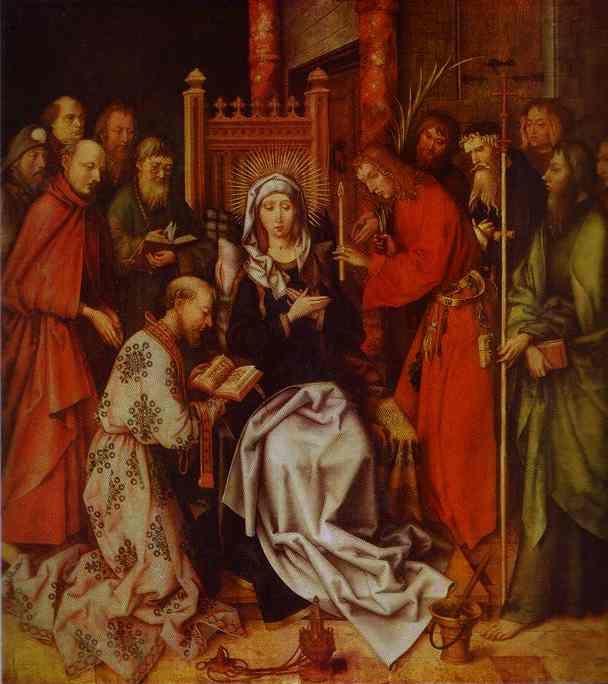
c.1501. Tempera on wood. Kunstmuseum Basel, Basel, Switzerland. Read Note.

