William Hogarth Biography
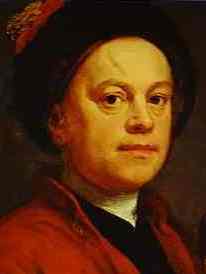
William Hogarth is unquestionably one of the most influential English artists of his time and a man of remarkable character and thought. He is one of the great innovators in English art, both as a critic and as an artist. As an artist, he was the first to bring themes from "popular culture" into fine art, borrowing themes and subjects from Shakespeare, Milton and the theater, and was the founder of a wholly original genre of "moral histories", which continued to be described for centuries (and to this day!) as Hogarthian. As a critic, he investigated the aesthetic principles of art, which resulted in his seminal book The Analysis of Beauty (1753).
William Hogarth was born on 10 November, 1697. He was the 5th child of Richard Hogarth, a schoolmaster and classical scholar from the north of England who had come to London in the mid-1680s. His father's premature death in 1718 was a major event in Hogarth's early life, as it placed the financial burden of supporting his mother and siblings on the young artist.
In February of either 1713 or 1714, Hogarth began his apprenticeship to a plate engraver, Ellis Gamble, who was a distant relation. By April 1720, he had set up an independent business as an engraver. His first works included a number of commissions for small etched cards and bookplates, and in 1721 he produced two inventive engraved allegories, The South Sea Scheme and The Lottery. These thematic prints attracted considerable attention, and were the beginning of the black-and-white satires which made Hogarth so widely known in Britain and abroad. As a painter, his first successes were with "conversational pieces", which feature informal groups of family and friends surrounded by customary things from their everyday life. He was not the inventor of the genre, and had many contemporary rivals, but his pictures bear Hogarth's humorous, almost irreverent, hallmark that set them apart from others: The Fishing Party (c.1730), The Wedding of Stephen Bechingham and Mary Cox (c.1730).
In 1729, he married a daughter of his painting instructor, Sir James Thornhill.
Around 1730, he created his painting The Beggar's Opera, which brought him great success. He was commissioned to paint several versions and as a result, had the idea to bring something of the theater into his work by putting together "pictorial dramas". Engraving, which he was a master of, would make these dramas more accessible to the wider public than they could be as paintings. His first successful series was The Harlot's Progress. Unfortunately, only the engravings have survived to this day; the original paintings were lost in a fire in 1755. It was immediately followed by the groundbreaking Rake's Progress and, a few years later, by the masterpiece of the "pictorial drama" genre The Marriage a la Mode. Besides being technically excellent paintings, Hogarth's works were serious moral and social satires, executed with just enough of a humorous touch to give them popular appeal.
In 1735, the painter was successful enough to open his own academy in St. Martyn's Lane.
In portraiture, Hogarth displays great variety and originality: George Arnold (c.1740), Mary Edwards (1742), Bishop Benjamin Hoadly (1743). The charm of childhood, the ability to compose a vivid group, a delightful delicacy of color appear in The Graham Children (1742). The portraits of his servants are penetrating studies of character: Hogarth's Servants. (c.1750). The painting of Captain Thomas Coram (1740), the philanthropic sea captain who took a leading part in the foundation of the Foundling Hospital, adapts the trappings of the ceremonial portrait and brings them down to earth. The painter's character is reflected faithfully in his forthright Self-Portrait with Pug-Dog (1745). The quality of Hogarth as an artist is seen to advantage in his sketches and one sketch in particular, the famous The Shrimp Girl (c.1740-1743), which was quickly executed with a limited range of color. Critics regard it widely as one of the great fine art masterpieces. Hogarth died in 1764 in London and is buried in Chiswick cemetery.
Bibliography
Hogarth W. The Analysis of Beauty. Leningrad. 1987.
Painting of Europe. XIII-XX centuries. Encyclopedic Dictionary. Moscow. Iskusstvo. 1999.
Engravings by Hogarth by William Hogarth. Dover Pubns, 1975.
Hogarth: Art and Politics 1750-1764 by Ronald Paulson. Rutgers University Press, 1993.
Hogarth (World of Art) by David Bindman. Thames & Hudson, 1985.
William Hogarth by Matthew Craske, William Hogarth. Princeton Univ Pr, 2000.
- South Sea Scheme.
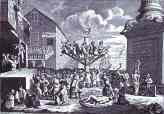
1721. Engraving. The British Museum, London, UK.
- The Fishing Party.
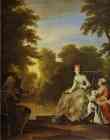
c.1730. Oil on canvas. Dulwich College Picture Gallery, London, UK.
- The Wedding Of Stephen Bechingham And Mary Cox.
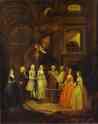
c.1730. Oil on canvas. Metropolitan Museum of Art, New York, USA.
- Surrounded By Artists And Professors. (A Rake's Progress).
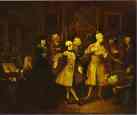
1732-1734. Oil on canvas. Sir John Soane's Museum, London, UK.
- George Arnold.
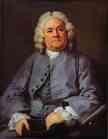
c.1740. Oil on canvas. Fitzwilliam Museum, Cambridge, UK.

