Jan Gossaert, called Mabuse Biography
Red Jan Gossaert was born c. 1478/88 in Maubeuge (Hennengau). It is not known where he was trained, and the stylistic assessment has not yet offered many clues about this. From 1503 to 1507 he lived and worked in Antwerp. A visit to Rome in 1508/09 was decisive in his development; the artist traveled in the retinue of his patron, Philip of Burgundy, for whom he had to draw ancient architecture and sculpture. On his return Gossaert nevertheless adhered at first to the traditions of the Netherlandish masters, copying the works of
Jan van Eyck, for example. However, after 1515 his Italian experience gradually took effect as can be seen particularly in his depiction of architecture as well as his interest in three-dimensional figure painting, and interest to mythological subjects, e.g. Neptune and Amphitrite, Danae.
In 1515, Philip of Burgundy invited Gossaert to decorate the Soubourg palace near Middelburg; Gossaert carried out court commissions without being bound by Guild regulations. He concentrated on mythological scenes and portraiture, favoring large-scale, “statuary” figures, which, although modeled on the ideal body of Italian antiquity, nevertheless bear traces of ordinary characters of the day.
Gossaert played an important role in enriching a Northern Renaissance style with Italian features and is considered one of the first important Netherlandish “Romanists”. (Netherlandish “Romanist” is a term used to denote a large group of leading Flemish artists of the first half of the 16th century, who integrated the classical imagery in their work. From this time on, painting mythological scenes and nudes as the main subject also became popular in the Netherlands.)
The artist died c. 1533/36, probably in Breda.
Bibliography
Painting of Europe. XIII-XX centuries. Encyclopedic Dictionary. Moscow. Iskusstvo. 1999.
- Neptune And Amphitrite.
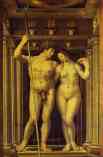
1516. Oil on panel. Gemäldegalerie, Berlin, Germany. Read Note.
- Danae.
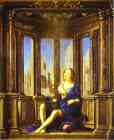
1527. Oil on panel. Alte Pinakothek, Munich, Germany. Read Note.

