-
-
- Tweet
-

-

Domenico Ghirlandaio - Paintings Gallery
(1449-1494)
Domenico di Tommaso Bigordi called Domenico Ghirlandaio (1449 Florence – 1494 Florence) was one of the most popular Florentine artists of his time. His father, Tommaso di Curradi Bigordi, had a business with jewellery, and Domenico started as a goldsmith. His nickname of Ghirlandaio, i. e. the "Garland-maker", came from his speciality, namely, the manufacture of silver or gold crowns or diadems, popular with young women of Florence.
Read Domenico Ghirlandaio's Full Biography- 1-26
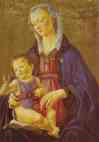
|
Madonna and Child. c.1470. Tempera on wood. The National Gallery of Art, Washington, DC, USA. |
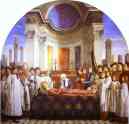
|
The Funeral of St. Fina. 1475. Fresco. Collegiata, San Gimignano, Italy. Read Note. |
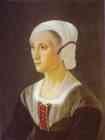
|
Portrait of Lucrezia Tornabuoni. 1475. Tempera on wood. The National Gallery of Art, Washington, DC, USA. |
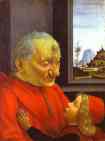
|
Old Man with a Young Boy. c.1480. Tempera on wood. Louvre, Paris, France. |
|
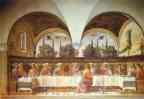
Last Supper. 1480. Fresco. Convent of San Marco, Refectory, Florence, Italy. Read Note. |
|
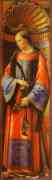
St. Stephen. c.1480. Tempera on wood. Louvre, Paris, France. Read Note. |
|
St. Jerome. 1480. Fresco. Ognissanti, Florence, Italy. Read Note. |
|
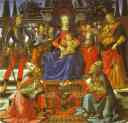
Madonna and Child Enthroned with Four Angels, the Archangels Michael and Raphael, and St. Gusto and St. Zenobius. 1480-1485. Oil and tempera on panel. Galleria degli Uffizi, Florence, Italy. Read Note. |
|
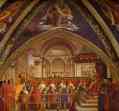
The Confirmation of the Rule of the Order of St. Francis by Pope Honorius III. c.1480-1485. Fresco. Santa Trinita, Sassetti Chapel, Florence, Italy. Read Note. |
|
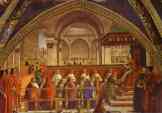
The Confirmation of the Rule of the Order of St. Francis by Pope Honorius III. Detail. c.1480-1485. Fresco. Santa Trinita, Sassetti Chapel, Florence, Italy. |
|
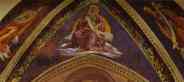
The Confirmation of the Rule of the Order of St. Francis by Pope Honorius III. Detail. c.1480-1485. Fresco. Santa Trinita, Sassetti Chapel, Florence, Italy. |
|
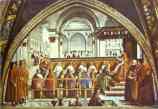
The Confirmation of the Rule of the Order of St. Francis by Pope Honorius III. Detail. c.1480-1485. Fresco. Santa Trinita, Sassetti Chapel, Florence, Italy. |
|
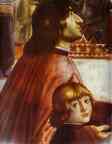
The Confirmation of the Rule of the Order of St. Francis by Pope Honorius III . Detail. c.1480-1485. Fresco. Santa Trinita, Sassetti Chapel, Florence, Italy. |
|
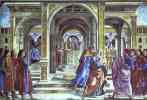
Expulsion of Joachim from the Temple. c.1480-1485. Fresco. Santa Trinita, Sassetti Chapel, Florence, Italy. Read Note. |
|
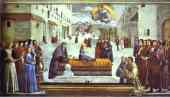
The Miracle of a Child. 1482-1486. Fresco. Santa Trinita, Sassetti Chapel, Florence, Italy. |
|
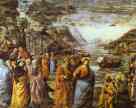
The Calling of St. Peter. 1482. Fresco. Sistine Chapel, Vatican. Read Note. |
|
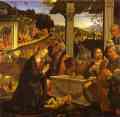
Adoration of the Shepherds. 1485. Tempera on wood. Santa Trinita, Sassetti Chapel, Florence, Italy. Read Note. |
|
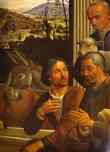
Adoration of the Shepherds. Detail. 1485. Tempera on wood. Santa Trinita, Sassetti Chapel, Florence, Italy. |
|
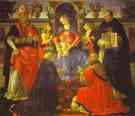
Madonna and Child Enthroned with Two Angels, St. Dionysius the Aereopagite and St. Dominic, Pope Clement and St. Thomas Aquinas. c.1485. Oil and tempera on panel. Galleria degli Uffizi, Florence, Italy. Read Note. |
|
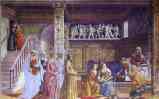
The Birth of Mary. c.1485-1490. Fresco. Santa Maria Novella, main choir, Florence, Italy. Read Note. |

|
Zachariah in the Temple: Marsilio Ficino, Cristoforo Landino, Angelo Poliziano and Demetrios Chalkondyles. Detail. 1486-1490. Fresco. Santa Maria Novella, Tornabuoni Cappella, Florence, Italy. Read Note. |
|
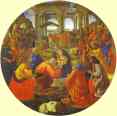
The Adoration of the Magi. 1487. Oil on panel. Galleria degli Uffizi, Florence, Italy. Read Note. |
|
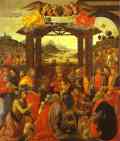
Adoration of the Magi. 1488. Tempera on wood. Galleria dell'Ospedale degli Innocenti, Florence, Italy. Read Note. |
|
|
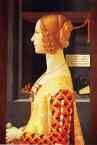
Portrait of Giovanna Tornabuoni. 1488. Tempera on wood. Thyssen-Bornemisza Collection, Lugano-Castagnola, Switzerland. This image was provided by Mr. Solomon Fagan, Vancouver, Canada. |
|
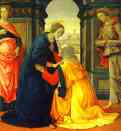
The Visitation. . Tempera on wood. Louvre, Paris, France. Read Note. |
|
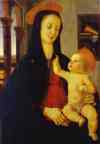
The Virgin and Child. . Tempera on wood. Louvre, Paris, France. |

