Paul Gauguin Biography
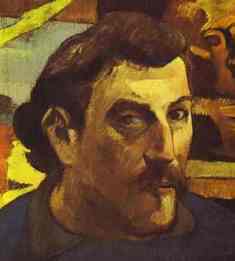
Eugène Henri Paul Gauguin was born in Paris on 7 June, 1848, the son of Clovis Gauguin, a Republican editor, and his wife Aline Marie Chazal. In 1849, after Louis Napoléon came to power, the family emigrated to Peru. Clovis Gauguin died on the way. His widow and 2 children (Paul and his elder sister Mari) stayed in Lima with their rich relatives and did not return to France until 1855. On coming back they settled with the uncle Isidore Gauguin in Orléans. In 1865, Paul became a sailor and spent the next three years voyaging between France and South America, and made a voyage around the world. In 1868, Paul joined the navy, which he left after the Franco-Prussian War. Instead, he started to work as a broker’s agent in Paris. The first known drawings by Gauguin dated 1871, when he was in his late twenties. In the broker’s agency Gauguin met and befriended Claude-Emile Schuffenecker (1851-1934), a shy clerk, who shared Gauguin’s interest in painting, they both started to study painting at the Colarossi Academy, worked together en plein-air and in the Louvre and met Parisian artists.
In 1873, Gauguin married a Dane, Mette Sophie Gad (1850-1920), who gave birth to his 5 children: Emile (1874 -), Aline (1877-1897), Clovis (1879-1900), Jean René (1881-1961) and Pola (1883-1961).
In 1874, Gauguin met Pissaro and other Impressionists. He traded at the stock exchange, which provided a comfortable income and he bought many of the Impressionists' paintings and had a handsome collection. His début in the Salon took place in 1876. He also exhibited paintings and sculptures with Impressionists and the Indépendents in 1879, 1880 and 1882. The works of the period are close to Impressionism; he was greatly influenced by Pissaro, who gave his advice generously, and later by Cezanne. But gradually Gauguin broke away from Impressionism and adopted a bolder style - radical simplifications of drawing, brilliant, pure, bright colors, an ornamental character of composition, and deliberate flatness of planes, the style, which he called ‘synthetic symbolism’.
In 1883, Gauguin quit the stock exchange; financial troubles weren't long in waiting. In 1885, he left his family in Copenhagen with his parents-in-law, and returned to Paris. In 1886 and 1888, he worked in Brittany, beside Emile Bernard, Laval and Meyer de Haan, he executed some of his most expressive works, such as Breton Girls Dancing, Pont-Aven. (1888), The Yellow Christ. (1889) and Vision after the Sermon; Jacob Wrestling with the Angel. (1888).
In October-December 1888, following the persistent suggestions of his art-dealer, Theo van Gogh, Gauguin visited the man's brother, Vincent, in Arles. His stay with the sick artist, whom he disliked and even despised as a painter, and never bothered to conceal this, finished after a Van Gogh cut off his own ear.
In 1891, he managed to organize a trip to Tahiti at the expense of the French government; there he started his autobiographical Noa Noa (published in 1897). He fell seriously ill, but despite this much and sent pictures to Paris, where he did not return until 1893. In 1894 he took a farewell visit to Copenhagen and in 1895 left for Tahiti a second time.
Plagued by illness (his health was ruined by alcohol and syphilis), depression and financial worries, in 1898 he even attempted suicide, Gauguin still painted numerous masterpieces D'où venons nous? Que sommes-nous? Où allons-nous? (Where Do We come from? What Are We? Where Are We Going?) (1897), And the Gold of Their Bodies (Et l'or de leurs corps). (1901).
In 1900, after a contract with Vollard, a Parisian dealer, his financial position improved, but his health was irreparably ruined. In 1901 he moved from Tahiti to Atuana on the Island of Dominique in the Marquesas, where his colors grew even more abundant and lush, and where he executed such pink and mauve paintings as Horsemen on the Beach. (1902) and The Call. (1902).
In 1903, Gauguin was sentences to three-months in prison and fined 1,000 francs because of problems with the church and the colonial administration. Before he could begin his sentence he died, on the 8th of May at his home in Atuana.
Besides legitimate children Gauguin had several illegitimate ones. A daughter Germaine Chardon (born 13 August, 1891 - ?), herself an artist, from Juliette Huais, who was Gauguin’s model and lover in 1890, he painted her in several pictures: The Loss of Virginity. Son Emile (born 1899 - ?) from Tahitian Pau’ura. And another daughter, born 14 September 1902, by Tahitian Mari-Rose Vaa’oho.
Bibliography
Henri Perruchot. La vie de Gauguin. Hachette. Paris. 1961.
Paul Gauguin. His Life and Art. by A. Kantor-Gukovskaya. Moscow-Leningrad. 1965.
French Paintings from the Hermitage, Leningrad. Aurora. Leningrad. 1975.
Gauguin as viewed from Russia. Moscow. 1990.
Painting of Europe. XIII-XX centuries. Encyclopedic Dictionary. Moscow. Iskusstvo. 1999.
Noa Noa: The Tahitian Journal by Paul Gauguin. Dover Pubns, 1985.
Paul Gauguin: An Erotic Life by Nancy Mowll Mathews. Yale Univ Pr, 2001.
Van Gogh and Gauguin: The Studio of the South by Douglas Druick, Peter Kort Zegers. Thames & Hudson, 2001.
The Way to Paradise by Mario Vargas Llosa, Natasha Wimmer. Farrar Straus Giroux, 2003.
Gauguin's Intimate Journals by Paul Gauguin, Van Wyck Brooks, Emil Gauguin. Dover Publications, 1997.
Van Gogh and Gauguin: The Search for Sacred Art by Deborah Silverman. Farrar Straus Giroux, 2000.
- Breton Girls Dancing, Pont-Aven.
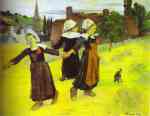
1888. Oil on canvas. The National Gallery of Art, Washington, DC, USA.
- The Yellow Christ.
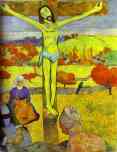
1889. Oil on canvas. Albright-Knox Art Gallery, Buffalo, NY, USA.
- Vision After The Sermon; Jacob Wrestling With The Angel.
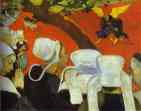
1888. Oil on canvas. National Gallery of Scotland, Edinburgh, UK.
- D'Où Venonsnous? Que Sommes-Nous? Où Allons-Nous? (Where Do We Come...
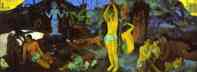
1897. Oil on canvas. The Museum of Fine Arts, Boston, MA, USA.
- And The Gold Of Their Bodies (Et L'Or De Leurs Corps).
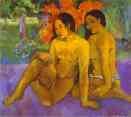
1901. Oil on canvas. Musée d'Orsay, Paris, France.

