Pavel Fedotov Biography
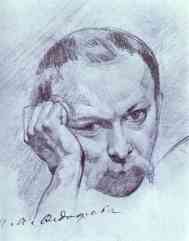
Pavel Andreevich Fedotov was born in Moscow, in 1815, the son of a retired officer. Graduating from the Moscow Cadet School, he served for ten years in the Finland Regiment of the Imperial Guards in St. Petersburg. When still in the Army, Fedotov, like many of his fellow-officers, was concerned in art and occupied his leisure with playing the flute, taking part in amateur performances, and doing a lot of drawing and painting. Amateurism, thriving in the first half of the 19th century, largely determined the tastes of the Russian educated milieu and became a reserve for professional art. At one time, Fedotov attended the evening classes at the Academy of Fine Arts. As a student he was not particularly outstanding, yet, in the Army, he gained a reputation as a regiment painter by his portraits of officers and regiment scenes. Fedotov had already mastered the technique of the then popular watercolor portrait. He began to turn to caricature, but satirical subjects, like that of the Police Commissary’s Reception Room the Night before a Holiday (1837), were rare. At that early period Fedotov preferred to depict what he had seen at firsthand enjoying every manifestation of life’s beauty. He had not yet started painting in oils, limiting himself entirely to graphic techniques (pencil and watercolor).
The career of a regiment painter, however attractive, did not appeal to Fedotov, who understood that a true creative artist should devote himself to art completely. In 1844, he retired to give himself entirely to painting. It wasn’t an easy decision – his officer’s salary was his only income, from which he also had to support his kin in Moscow. Fedotov concentrated his effort on portraiture, he painted small portraits, mostly of his friends or their relations. Thus he produced a series of portraits showings the members of the family of Zhdanovich, Fedotov’s friend in the regiment. The portraits, in no way ceremonial, are simple and unsophisticated; they all have an air of the genre and are characterized by a deep insight into the model. The Portrait of Natalia Zhdanovich at the Harpsichord (c. 1850) is especially striking by its serenity and perfect spiritual harmony, and revels the painter’s concern with the inner life of a human being.
Fedotov began to paint in oils in 1846, his first attempt at the new technique and also his first genre composition, the Newly Decorated, Difficult Bride, Untimely Guest, are full of satire and criticism. The supreme achievement of this period of the artist’s maturity is the Major’s Marriage Proposal (1851). Fedotov’s works were recognized as a new word in art at the exhibitions of 1849 and 1850 in St. Petersburg and Moscow and brought the painter success that promised his prosperity and, hence, the possibility to continue his work.
However, after the trial of the Petrashevsky social-democratic group, with which he was closely associated, Fedotov found himself in isolation. Fedotov wrote in one of his letters, “The furor my works created… appears to have been a gnat’s buzz rather than a thunder, since at the time, a real thunder was heard from the West when thrones were shaking in Europe.” To the revolutionary events of 1848 and 1949 in Europe the Tsarist government responded by persecutions against freedom of thought in Russia. Sharing the fate of the many democratic-minded intelligensia, Fedotov was crushed by the reactionary tide. But before he perished, Fedotov had produced his, probably, best works imbued with a feeling of desperate sorrow gradually growing until it reached its climax in the Encore, Encore!, Gamblers, and Young Widow.
In 1852, after a period of suffering, he died in a mental clinic.
Bibliography
Fedotov. by L. Sarabyanov. Russian Painters of the XIX century. Moscow. 1985.
Pavel Fedotov. by E. Kuznetsov. Leningrad. 1990.
- Police Commissary's Reception Room The Night Before A Holiday.
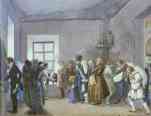
1837. Watercolor, pen and Indian ink on paper mounted on paper, 18.4 x 23.5 cm. The Tretyakov Gallery, Moscow, Russia.
- Portrait Of N. P. Zhdanovich At The Harpsichord.
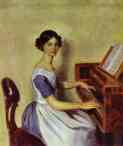
c.1849-50. Oil on canvas. The Russian Museum, St. Petersburg, Russia.
- Newly Decorated (The Morning After The Official Has Received His First...
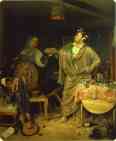
1846. Oil on canvas, 48.2 x 42.5 cm. The Tretyakov Gallery, Moscow, Russia.
- Difficult Bride.
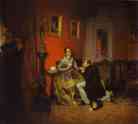
1847. Oil on canvas, 37 x 45 cm. The Tretyakov Gallery, Moscow, Russia.

