Gentile da Fabriano Biography
Gentile di Niccolò di Giovanni Massi, born in Fabriano in the Italian Marches, was the son of a cloth merchant. He became a major Italian figure in the International Gothic style. No doubt he must have encountered Sienese art at an early age, but all evidence suggests that he was trained in the great cultural centers of Milan and Verona.
Gentile was, in fact, the most sought-after and famous artist in Italy during the first quarter of the 15th century. This can be seen from his travels to great cities, such as Venice, Florence, and Rome. It can also be deducted from the large number of pupils he attracted, including Pisanello, Jacopo Bellini, and Fra Angelico, his greatest heir. A typical example of Gentile’s early work is the Polyptych of the Coronation of the Virgin. This was painted for a convent at Val Romita, near Fabriano. It is now in the Brera Gallery in Milan. Virgin and Child with St. Nicholas and St. Catherine is another important example of Gentile’s early work. In particular it reveals the Sienese and Lombard elements in his training. The painting has all the beautiful characteristics of late International Gothic Art.
In 1408, Gentile was called to Venice to paint some frescoes (unfortunately destroyed) in the Doge’s Palace. His arrival in Venice is the first officially recorded date we have concerning Gentile. He remained there until at least 1414. There he earned great fame. One of his Venetian pupils was Jacopo Bellini, who became a famous painter in his own right – although later overshadowed by his sons Giovanni and Gentile. Nothing of Gentile da Fabriano’s Venetian work survives, nor of the commissions he carried out for the Malatesta in Brescia, for the Pope in the Lateran Basilica in Rome and for clients in Siena.
After Brescia, in 1419 the painter settled in Florence where the generation of Donatello, Ghilberti, and Brunelleschi was working. Gentile da Fabriano’s work is stylish and elegant, making much use of gold backgrounds and countless precious details. His great technical skill hints at a new interest in classical sculpture.
In 1423, he produced his best-known work, the monumental Adoration of the Magi for the Strozzi Chapel in Santa Trinita and now in the Uffizi. In 1425, Adoration of the Magi was followed by the Quaratesi triptych (now in separate pieces and kept in various museums). See: A Miracle of St. Nicholas and St. Nicholas and the Three Gold Balls, both are the panels from the predella of the Quaratesi triptych.
After his stay in Siena and Orvieto (where he painted the fresco of the Virgin and Child in the cathedral) in January 1427 he moved to Rome. There he started the ambitious fresco decoration of the central nave of the Basilica of St. John Lateran, which remained unfinished when he died in August that year. His assistant and pupil Pisanello took charge of the project and his workshop, assimilating the artistic legacy of Gentile.
Bibliography
Painting of the Gothic Era by Robert Suckate and Matthias Weniger. 1999 Benedikt Taschen Verlag GmbHThe Art of the Italian Renaissance. Architecture. Sculpture. Painting. Drawing. Könemann. 1995.
Painting of Europe. XIII-XX centuries. Encyclopedic Dictionary. Moscow. Iskusstvo. 1999.
- Virgin And Child With St. Nicholas And St. Catherine.
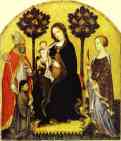
c.1405. Tempera on wood. Gemäldegalerie, Berlin, Germany. Read Note.
- Adoration Of The Magi. From The Strozzi Chapel In Santa Trinita, Florence.
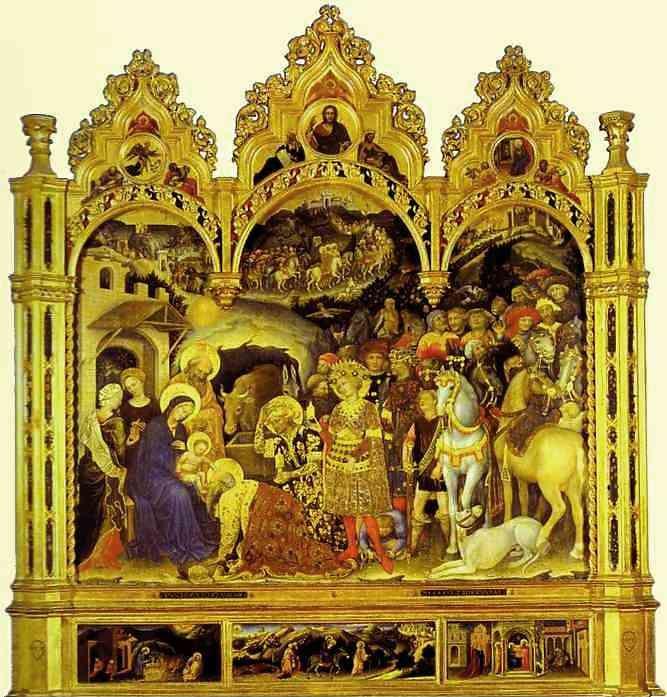
1423. Tempera on wood. Galleria degli Uffizi, Florence, Italy. Read Note.
- A Miracle Of St. Nicholas. From The Predella Of The Quaratesi Triptych...
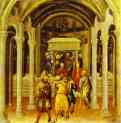
1425. Tempera on wood. The National Gallery of Art, Washington, DC, USA. Read Note.

