Jan van Eyck Biography
Jan van Eyck is considered to be a founder of the Early Renaissance style in the Northern Renaissance. We do not know the exact date and place of his birth, it is believed that he was born in early 1390s in the eastern province of the Netherlands Limburg. He probably was taught the art by his brother Hubert van Eyck, with whom he created the masterpiece The Ghent Altarpiece(1425-1432), which they started in 1425, but after the death of Hubert, his younger brother finished it alone.
Until 1425 Jan van Eyck served at the court of Duke Johann of Bavaria in Hague, painting and restoring pictures. Since 1425 he served at the court of Philip the Good of Burgundy, where he was greatly valued not only as an artist, but he also was entrusted by Duke with various diplomatic missions. Since 1430 van Eyck lived and worked in Bruges as painter to the court and city. It was believed, that Jan van Eyck invented painting with oils, maybe it is not true, but his technique in painting with oils is exceptional. His paint is so transparent that his works have a unique, almost luminous sheen. In The Virgin of the Chancellor Rolin (1434-1436) Van Eyck revealed himself as a master in representation of space. Van Eyck was one of the first great masters of portrait painting in Europe. His best portraits are Portrait of Cardinal Nicola Albergati (c.1432), Portrait of a Young Man (1432), Man in a Red Turban (1433), which is probably a self-portrait, Portrait of Margaret van Eyck, Artist's Wife(?) (1439) and also one of the masterpieces of the Western world Giovanni Arnolfini and His Wife Giovanna Cenami (The Arnolfini Marriage) (1434). Among his other best works are Madonna from the Inn's Hall (1433), The Lucca Madonna (1436), The Madonna of Canon van der Paele (1436), The Virgin and Child in a Church (central section of a portable altar) (1437), The Virgin and Child with Saints and Donor (1441). Jan van Eyck died in 1441 in Bruges.
Bibliography
Jan van Eyck. by A. Sarabyanov. Moscow. 1990.
Painting of Europe. XIII-XX centuries. Encyclopedic Dictionary. Moscow. Iskusstvo. 1999.
The Arnolfini Betrothal: Medieval Marriage and the Enigma of Van Eyck's Double Portrait (Discovery Series, 3)
by Edwin Hall. University of California Press, 1997.
Jan Van Eyck: The Play of Realism by Craig Harbison. Reaktion Books, 1997.
Jan Van Eyck: Two Paintings of Saint Francis Receiving the Stigmata by J. R. J. Van Asperen De Boer, Kenneth Be, Marigene H. Butler, Peter Klein, Katherine Crawford Luber, Joseph J. Rishel, Maurits Smeyers, James Snyder, Carlenrica Spantigati. Philadelphia Museum of Art, 1997.
Van Eyck: the Ghent altarpiece (Art in context) by Elisabeth Dhanens. Viking Press, 1973.
- The Ghent Altarpiece With Altar Wings Closed.
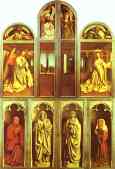
1432. Oil on wood. St. Bavon, Ghent, Belgium.
- The Virgin Of The Chancellor Rolin.
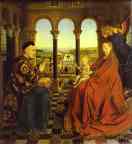
1434-1436. Oil on wood. The Louvre, Paris, France. Read Note.

