Eugène Delacroix Biography
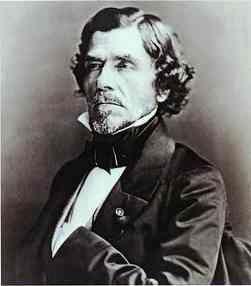
Ferdinand Victor Eugène Delacroix, the most vivid representative of French Romanticism, was born on 26 April 1798, the forth child of Charles Delacroix, Foreign Minister under the Directory and Prefecture of Marseilles. There is some reason to believe that his real father was Talleyrand (1754-1838), the famous diplomat, whom Eugene Delacroix resembled in character and appearance.
Charles Delacroix died in 1805; in 1814 Eugene’s mother followed, leaving him an orphan at the age of 16. In 1816 he entered l'Ecole des Beaux-Art, where he befriended Bonington and Pierret.
In 1822 his The Barque of Dante was accepted for the Paris Salon, and subsequently acquired by the state. At the 1824 Salon Delacroix presented The Massacre of Chios, a personal reaction to the genocide practiced by Sublime Porte against the Greeks. This work placed Delacroix firmly among the Romantic painters. Summer of 1825 he spent with Bonington in England, acquainting himself with English literature; made lithograph illustrations for Macbeth and Hamlet and heroes of Sir Walter Scott and Byron.
In 1828 a series of 17 lithographs illustrating Goethe’s Faust was published. At the 1828 Salon Delacroix exhibited The Death of Sardanapalus and The Execution of Marino Faliero. In his Liberty Leading the People (28 July 1830) Delacroix expressed his emotions and understanding of the July Revolution of 1830.
In 1832, Delacroix spent 6 months in North Africa, in the retinue of the Count Charles de Mornay, Ambassador to the Sultan of Morocco, abd er-Rugman. The life and customs of the Arabs fascinated him and were to inspire many paintings: The Fanatics of Tangier (1837-1838), The Sultan of Morocco and His Entourage (1845), The Lion Hunt in Morocco (1854), Arab Saddling His Horse (1855). In 1833-1837 Delacroix received many commissions for portraits, decorated the King's Chamber in the Palais Bourbon: Frescoes on the west wall (1833-1837). His Women of Algiers in Their Apartment (1834) was a great success at the 1834 Salon.
In 1838-1844 he decorated the library of the Chambre des Deputes and the Chambre des Pairs in the Palais du Luxembourg, as well as the Chapel of the Holy Sacrament at Saint-Denis; he continued to exhibit at the Salon; The Shipwreck of Don Juan (1840), Medea about to Kill Her Children (1838), The Entry of the Crusaders into Constantinople (1840). In 1850-51 he decorated the ceiling of the Apollo Gallery in the Louvre: Apollo Slays Python (1850-1851). In 1855 he exhibited 48 paintings at the Universal Exposition in Paris. On his eighth attempt he was made a member of the Academy. His health worsened, he could no longer work and spent much time in the country. On 13 August 1863 he died.
Bibliography
Eugène Delacroix. by Ye.Kozhina. Moscow. 1961. (in Russian)
Delacroix. by A.Gastev. Moscow. 1966. (in Russian)
Delacroix. by Barthélémy Jobert. Editions Gallimard, 1997.
Delacroix les dernières années. Réunion des Musées Nationaux. Paris. 1998.
Painting of Europe. XIII-XX centuries. Encyclopedic Dictionary. Moscow. Iskusstvo. 1999.
The Journal of Eugene Delacroix: A Selection (Arts & Letters) by Eugene Delacroix, Hubert Wellington (Editor), Lucy Norton (Translator). Phaidon Press Inc., 1995.
Delacroix by Barthelmy Jobert, Eugene Delacroix, Terry Grabar (Translator). Princeton Univ Pr, 1998.
The Cambridge Companion to Delacroix (Cambridge Companion to the History of Art) by Beth Segal Wright (Editor). Cambridge Univ Pr, 2001.
Delacroix: The Late Work by Eugene Delacroix, Vincent Pomarde, Arlette Serullaz, Joseph J. Rishel, Louis-Antoine Prat, David Loit. Thames & Hudson, 1998.
Delacroix Pastels by Lee Johnson. George Braziller, 1995.
A Century of Artists' Letters: Notes to Family, Friends, & Dealers, 1855-1968: Delacroix to Leger by Jacqueline Albert Simon, Lucy D. Rosenfeld. Schiffer Publishing, 2004.
Eugene Delacroix: The Graphic Work a Catalogue Raisonne by Loys Delteil, Susan Strauber. Alan Wofsy Fine Arts, 1996.
The Paintings of Eugene Delacroix: A Critical Catalogue, 1832-1863 (Movable Pictures and Private Decorations, Volumes III and IV) by Lee Johnson. Oxford University Press, 1987.
- The Barque Of Dante.
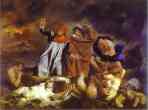
1822. Oil on canvas. Louvre, Paris, France. Read Note.
- The Massacre Of Chios.
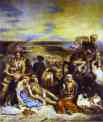
1824. Oil on canvas. Louvre, Paris, France. Read Note.
- The Death Of Sardanapalus.
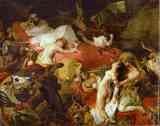
1827-1828. Oil on canvas. Louvre, Paris, France. Read Note.

