Olga's Gallery


Jacques-Louis David

(1748-1825)

Jacques-Louis David at Artprice. To look at auction records, find Jacques-Louis David's works in upcoming auctions, check price levels and indexes for his works, read his biography and view his signature, access the Artprice database.

David was born into the family of a wealthy Parisian merchant on August 30, 1748. When the boy was about 10 years old his father, Louis-Maurice, died after a pistol duel. David's two uncles, François Buron (1731-1818) and Jacques- François Desmaisons (c.1720-89) who were both architects and building contractors, took care of the boy's upbringing. First he was educated at a boarding school and the Collège des Quatre Nations in Paris. When he decided on the career of an artist his uncles helped him to become a student of Joseph-Marie Vien (1716-1809), a professor at the Academy who had a reputation as a good teacher. As many young painters, David used his close relatives as his models, thus he painted both his uncles, his aunt Marie-Josephe, and his cousin Marie-Françoise, who had supported his wish to become a painter.

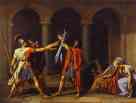
In 1766-1774 David studied at the Royal Academy of Painting and Sculpture, in Vein's class. The goal of practically every Academy student was to win the premier student prize: the Grand Prix, or Prix de Rome. David took part in the competition every year starting from 1770, until at last in 1774 he finally won it with Antiochus and Stratonice. After that he spent 5 years in Italy (1775-1780), where drew from antique models. On his return to Paris in 1780, Ancient history and mythology became his favorite subject. In 1781 David was made an Associate member of the Academy for his work Belisarius, which was much admired, and two years later, in 1783, he became a full Academician for Andromache Mourning Hector. In 1784, he fulfilled Louis XVI’s commission - The Oath of the Horatii.

David enthusiastically greeted the French Revolution and from 1789 he actively participated in political life. In 1791 he was elected a deputy of the Convention from Paris. He voted for the death of Louis XVI in 1793 and supported Robespierre’s and the left radicals’ regime; David was a member of the Committee of Public Safety and artistic director of the great national fêtes founded on classical customs. After the 9 Termidor (27 July) 1794 coup, when Robespierre and his closest supporters were overthrown and hurriedly executed by the temporary coalition of both left- and right-wing moderates in the Convention, David was arrested twice and narrowly escaped with his life. His political career ended, but his artistic career revived. The most prominent work of the second half of the 1790s was The Intervention of the Sabine Women.

In 1797 he met Napoleon and was granted a single portrait sitting, during which David did not manage to paint much, but was absolutely captivated by Napoleon's personality.  Later on David created many paintings devoted to his new hero and his relatives: Bonaparte Crossing the St. Bernard Pass (1800), Napoleon in His Study (1812), the grandiose canvases Consecration of the Emperor Napoleon I and Coronation of the Empress Josephine (1808), The Distribution of the Eagle Standards, etc.

In 1802 Napoleon founded the Legion of Honor, and David was made a Knight (or Chevalier) of the Legion (the first of the five ranks of the order) in December 1803. During the following years he would reach the third rank of the order, a Commander (or Commandant) of the Legion of Honor (1815).

After the fall of Napoleon and the Bourbon restoration David was banished in 1816 as a regicide, and fled to Brussels, where he spent his last 10 years. During this period he returned to mythological subjects and intimate portraiture. David died on 29 December 1825 and was buried at the Saint-Josse-ten-Noode cemetery, Brussels.

The influence of David was very high. He was an outstanding teacher; from his studio came Gros, Gérard, Ingres, and many others. The art of their teacher and their own influenced the European art until Impressionism.

Bibliography:
Jacques-Louis David. by  I. Kuznetsova. Moscow. 1965.
David. by Simon Lee. Phaidon. 1999.
Painting of Europe. XIII-XX centuries. Encyclopedic Dictionary. Moscow. Iskusstvo. 1999.
Neoclassicism (Art & Ideas) by David G. Irwin. Phaidon Press Inc., 1997.
Jacques-Louis David, Revolutionary Artist : Art, Politics, and the French Revolution by Warren Roberts. Univ of North Carolina Pr, 1992.
Jacques-Louis David by Dorothy Johnson. Princeton Univ Pr, 1993.
Jacques-Louis David: Empire to Exile by Philippe Bordes. Clark Art Institute, 2005.
Jacques-Louis David's 'Marat' by Will Vaughn, Helen Weston. Cambridge University Press, 1999.
Portraiture in Paris Around 1800: Cooper Penrose by Jacques-Louis David by Philippe Bordes. Timken Museum of Art, 2004.


Notes


Leonidas at Thermopylae. Leonidas, Sparta’s King in 480-488 B.C., was the leader of the allied Greek troops in the Battle at Thermopylae against the Persians. After the positions of the Greeks were turned, Leonidas ordered his troops to withdraw, while he himself with 300 Spartans stayed to defend the narrow Thermopylae Pass to give the Greeks time. The heroic death of the Spartan detachment was glorified in poetry and art.
See: Jacques-Louis David. Leonidas at Thermopylae.
Bibliography:
Lexikon der Antike. VEB Bibliographisches Institut Leipzig. 1987.

Jacobus Blauw (1756-1829) and Gaspar Mayer were representatives of the new revolutionary government of the Dutch Republic, called the Batavian Republic. They were to negotiate peace after the French invasion of the Netherlands.
Blauw highly appreciated his portrait by David, he wrote, “My wishes are at last satisfied, my dear David. You have brought me to life again on the canvas; you have, in a way, immortalized me with your sublime brush”. It was also a political act, by commissioning a portrait from the disgraced artist Blauw evidently wanted to show his support to the more radical revolutionary politics associated with David.
“Mayer, on the other hand, probably doubted the political wisdom of having his portrait painted by David and found the whole episode highly embarrassing, and never bothered to collect it from David's studio, where it remained until the artist's death.”
See: Jacques-Louis David. Portrait of Jacobus Blauw. Portrait of Gaspar Mayer.
Bibliography:
David. by Simon Lee. Phaidon. 1999.

Comtesse Vilain XIIII (1780-1853), wife of Philippe Vilain XIIII, who was ennobled by Napoleon in 1811. She was lady-in-waiting to the Empress Marie-Louise. After the fall of Napoleon she had to escape to Brussels, where David, also in exile, fulfilled the portrait. In the portrait the Comtesse is with her five-year-old daughter, Louise.
See: Jacques-Louis David. Portrait of the Countess Vilain XIIII and Her Daughter.
Bibliography:
David. by Simon Lee. Phaidon. 1999.

Count Stanislas Potocki (1755-1821) Polish nobleman, collector and connoisseur. He met David in Rome during his Grand Tour in 1779-80 and commissioned there his equestrian portrait, which was finished a little later in Paris. Back in Poland, Stanislas Potocki pursued a political career and held a number of offices; as minister of education he helped to found the Warsaw University. His sons were in Russian service and are remembered in Russian history.
See: Jacques-Louis David. Portrait of Count Stanislas Potocki.
Bibliography:
Famous Russians in the 18th and 19th centuries. St. Petersburg. 1996.
David. by Simon Lee. Phaidon. 1999.

Jean-Paul Marat (1743-93) French revolutionary, radical politician, physician, physicist and journalist. He studied medicine at Bordeaux, Paris, Holland and London; then practiced medicine in England in the 1770s and in Paris from 1777. Simultaneously he went into scientific research in optics and electricity and wrote several scientific works. He was also interested in political issues; he joined the Cordelier Club. In September 1789 he started publishing his radical paper L’ami du peuple (The Friend of the People), which provoked and justified revolutionary violence. In 1792 he was elected a deputy to the Convention. With Robespierre and Danton he overthrew Girondins and helped to instigate the Reign of Terror. He was already very ill and could work only sitting in his bath, when on July 13, 1793 he was assassinated in his bath by Charlotte Corday, who was later executed. See allso Sometimes Strange Relations Happen…
See: Jacques-Louis David. Death of Marat.
Bibliography:
History of the French Revolution. by Thomas Carlyle. Harper & Brothers, NY
Chambers Biographical Dictionary. Chambers. 1996.

Antoine-Laurent Lavoisier (1743-94) French chemist, born in Paris, known as the founder of modern chemistry. To finance his investigations, he accepted in 1768 the office of farmer-general of taxes. He built a large laboratory in which he discovered the composition of air, oxygen, its importance in respiration, combustion and as a compound with metals. A political liberal, he saw the great necessity for reform in France but was against revolutionary methods. He frequented the circle of the Trudaine brothers, where he met David. As a tax farmer and Commissioner for Gunpowder, Lavoisier came under suspicion during the Revolution and was executed during the Reign of Terror.
Marie-Anne Lavoisier, wife of Antoine-Laurent Lavoisier.
See: Jacques-Louis David. Portrait of Antoine-Laurent and Marie-Anne Lavoisier.
Bibliography:
Chambers Biographical Dictionary. Chambers. 1996.

Emilie Sériziat, née Pécoul, married to a lawyer Pierre Sériziat, was sister of David's wife, Marguerite-Charlotte David, née Pécoul. David stayed in their country house after he was released from the Luxembourg prison at the end of December 1794. The visit was stopped by the new arrest in May 1795. The portraits of Emilie and Pierre is a demonstration of gratitude and friendship. David showed the portraits at the 1795 Salon. He wrote: ‘Here is fodder for my enemies. I believe they will be forced to admit that at least I have not yet lost my talent.’
See: Jacques-Louis David. Portrait of Emilie Sériziat and Her Son. Portrait of Pierre Sériziat.
Bibliography:
David. by Simon Lee. Phaidon. 1999.

Mme Charles-Louis Trudaine, wife of Charles-Louis Trudaine de Montigny (1765-94). Charles-Louis and his brother, Charles-Michel Trudaine de la Sablière (1766-94), sons of a wealthy financier, held important gatherings of the liberal and intellectual elite at their grand town house in the Place Royale, Paris. David was a constant visitor of the meetings and the ‘Trudaine Society’ helped to shape his opinions. Though no great royalists, the both brothers were executed during the Reign of Terror.
See: Jacques-Louis David. Portrait of Madame Charles-Louis Trudaine.
Bibliography:
David. by Simon Lee. Phaidon. 1999.

Marguerite-Charlotte David (1765- ), née Pécoul, daughter of a building contractor Charles-Pierre Pécoul;  David and Margueerite-Charlotte were married on 16 May 1782 in the church of St. Germain-l’Auxerrois, close to Louvre. They had 4 children: son Charles-Louis-Jules, born on 15 February 1783, son Eugène, born on 27 April, 1784 and twin daughters, Emilie and Pauline, born on 26 October 1786. After David voted for the death of Louis XVI in 1793, Mme David was so disgusted that she divorced him. The couple re-married in 1796.
“In Napoleonic Paris David and his wife were hardly a splendid or striking couple. The English novelist Fanny Burney called Madame David ‘a woman of no sort of elegance… and if she ever possessed any beauty, it had deserted her at an early period’, but in compensation she was clever, shrewd and penetrating, yet prone to sarcasm.”
See: Jacques-Louis David. Portrait of Marguerite-Charlotte David.
Bibliography:
David. by Simon Lee. Phaidon. 1999.

View of the Garden of the Luxembourg Palace. It is known that while in prison August - October 1794, David worked much. Among other works he produced his one and only landscape a View of the Garden of the Luxembourg Palace, painted from his prison window. The picture in Louvre maybe that landscape, though many scholars doubt the authorship of it.
See: Jacques-Louis David. View of the Garden of the Luxembourg Palace.

Suzanne Le Pelletier de Saint-Fargeau, daughter of Louis Michel Le Pelletier de Saint-Fargeau (1760-94), an aristocrat, who turned revolutionary and member of the Convention. He voted for the death of the king, and was assassinated on the eve of the king's execution. Given a splendid state funeral, Le Pelletier was celebrated as a republican martyr and commemorated in a painting by David. This work has not survived as Le Pelletier’s daughter grew up to be an ardent royalist, she bought the picture and had it burnt.
See: Jacques-Louis David. Portrait of Suzanne Le Pelletier de Saint-Fargeau.
Bibliography:
David. by Simon Lee. Phaidon. 1999.

Brutus, Lucius Junius, nephew of the last Roman King Tarquinius the Proud, participated in revolt against his tyranny (see the related topic The Rape of Lucretia) and after establishing of the republic was one of the first two Roman consuls.
Brutus’ two sons started a conspiracy to restore the monarchy. The plot was foiled and they were convicted and sentenced to death by their father.
See: Jacques-Louis David. The Lictors Returning to Brutus the Bodies of His Sons.
Bibliography:
Titus Livy. The History of Early Rome. The Easton Press. 1978.
Plutarch. Biographies of Outstanding Greeks and Romans. Minsk. 1995.

Back to Jacques-Louis David's Page

Home      Artist Index     Country Index