Correggio Biography
Correggio is the pseudonym of Italian painter Antonio Allegri, who was born around 1489/93 into the family of provincial artists in the town of Correggio. As a painter he worked in Parma, where he came in contact and experienced a wide range of influences of different Italian art schools of the High Renaissance – first
Leonardo de Vinci and the Venetians, then Michelangelo and Raphael. He managed to make his own way in Italian art. He surpassed the traditions of the High Renaissance; at the same time he has practically no links with Mannerism, which began to form in the 1520s-1530s. Exceptionally gifted, with a powerful talent, thirst for novelty, rich fantasy and refined taste Correggio enriched Italian painting with many discoveries, which anticipated the Italian Baroque of the 17th century.
During his 20-year-long career Correggio created many big altar paintings, such as Judith (1512-1514), Madonna and Child with St. George (1520s-1530s). Having started with traditional for Italian painting of the 16th century, solemn altar with Madonna on a throne and Saints surrounding her pedestal, Correggio then introduced new topics for altar paintings: Adoration of the Shepherds(The Holy Night) (1522), Madonna del Latte (c.1523). He introduced some theatrical effects into religious painting, combining grandeur with tenderness and sentiment, even sensuality. There was little difference between physical and spiritual ecstasy for Correggio, who thereby established an important precedent for Baroque artists. Especially sensual are his mythological canvases: The Abduction of Ganymede (c.1531-1532), Zeus and Io (c.1531-1532), Leda and Swan (c.1531-1532), Danae (c.1531) and others.
The reformatory character of his talent expressed itself especially brightly in his monumental works. The first of them is Camera of Abyss in the convent of San Paolo, Parma, 1519: General View of the Abbess' Room (c.1519), Diana (c.1519). In frescos of the Church of San Giovanni Evangelist (1520-21, Parma), Correggio was the first to “tear” the ceiling, depicting open skies with Christ: Vision of St. John the Evangelist(1520-1524).
In the frescoes of the Parma Cathedral (1524-30) the composition is more sophisticated. “His largest work, the fresco of The Assumption of the Virgin in the dome of Parma Cathedral, is a masterpiece of illusionistic perspective, a vast, luminous space filled with soaring figures. Although they move with such exhilarating ease that the force of gravity seems not to exist for them, these are healthy, energetic beings of flesh and blood, not disembodied spirits, and they frankly delight in their weightless condition.” Frescoes of Parma Cathedral became an example for later dome frescoes of Mannerists and Baroque artists.
Correggio had no immediate successors, nor did he have any lasting influence on the art of his century, but toward 1600 his work began to be widely appreciated as the equal of Raphael and Michelangelo, while the Mannerists, so important before, were largely forgotten.
Bibliography
Painting of Europe. XIII-XX centuries. Encyclopedic Dictionary. Moscow. Iskusstvo. 1999.
Correggio by David Ekserdjian, Correggio. Yale Univ Pr, 1998.
Correggio by Lucia Fornari Schianchi, Edoardo Villata. 5 Continents, 2006.
Correggio's Frescoes in Parma Cathedral by Carolyn Smyth. Princeton University Press, 1997.
Correggio by Elbert Hubbard. Kessinger Publishing, 2005.
- Judith.
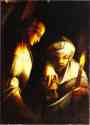
1512-1514. Oil on wood. Musee des Beaux-Arts, Strasbourg, France. Read Note.
- Madonna And Child With St. George.
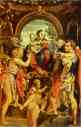
1520s-1530s. Oil on canvas. Alte Meister Gallerie, Dresden, Germany. Read Note.
- Adoration Of The Shepherds (The Holy Night).
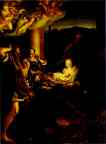
1522. 1522. Oil on wood. Alte Meister Gallerie, Dresden, Germany. Read Note.
- Madonna Del Latte.
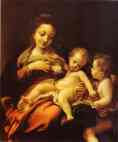
c.1523. Oil on canvas. Szepmuveseti Muzeum, Budapest, Hungary.

